


Japanese lawmakers have been refraining from visiting China for fear of being arrested and not being able to return, while Taiwan is a popular destination, Japan’s Sankei Shimbun reported.
As 120 Japanese Diet members visited Taiwan last year and fewer than 10 went to China, Beijing hopes that they could visit China more often, Japanese Ambassador to China Kenji Kanasugi was cited as saying during a meeting of Japan’s Liberal Democratic Party on Thursday last week.
Kanasugi was in Japan to attend the Conference of the Ambassadors to Asian and Oceanian Countries and International Organizations, which was held on Thursday and Friday last week.
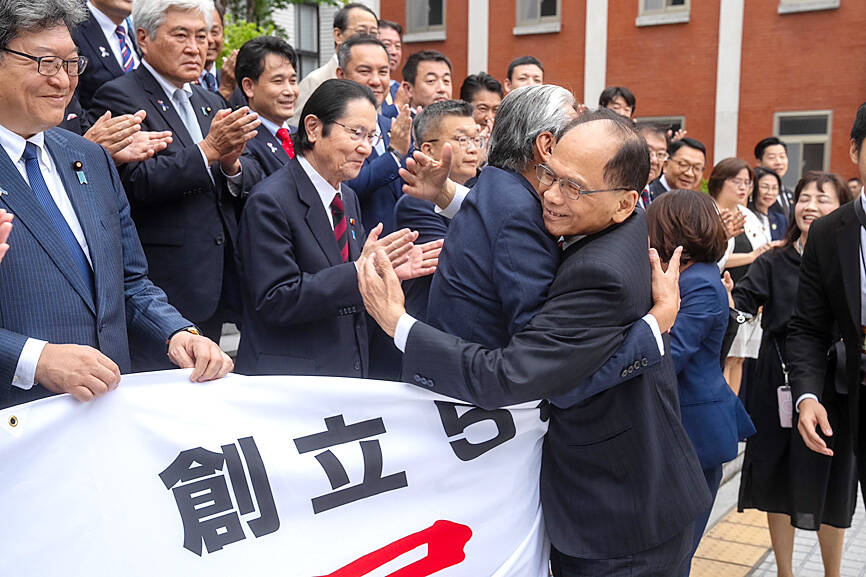
Photo courtesy of the Legislative Yuan
“Even if asked to pay a visit, I might be arrested and not be able to go home,” one of the legislators attending the meeting said.
Chinese authorities in March last year detained an employee of Japanese drugmaker Astellas Pharma Inc on a charge of contravening China’s anti-espionage law.
Japan’s efforts through official channels to have the man released have been in vain.
Former Japanese Diet member Shiori Kanno, who has long been concerned about human rights violations in Xinjiang and Hong Kong, was accused by the Hong Kong Department of Justice of being a “conspirator” with pro-democracy media tycoon Jimmy Lai (黎智英) for establishing the Japan Parliamentary Alliance on China.
The two did not know each other and had no interactions.
Japanese Diet member Arfiya Eri, who is of Uighur descent, on Tuesday last week said that Kanno could risk her safety if she went to China, or a country with which Beijing has an extradition treaty.
A survey conducted by Japan’s Nikkei newspaper last year showed that 74 percent of Japanese said they “dislike” China, a sentiment expressed by more than 70 percent of Japanese for six consecutive years, the paper reported last month.
On the other hand, 76.6 percent of Japanese said they felt “close” or “somewhat close” to Taiwan, a survey conducted last year by Tokyo-based Central Research Services showed.
Of the respondents, 65 percent said that Taiwan is “very trustworthy” or “trustworthy,” citing the two sides’ shared values.
Additional reporting by Liu Tzu-hsuan

NATIONAL SECURITY: Authorities are working to confirm the identities of the military personnel involved and investigating possible illegal conduct and regulatory violations Authorities are probing possible national security implications after Kinmen police and immigration officers on Sunday found a Chinese woman allegedly posing as a tourist while engaging in prostitution involving more than 10 military personnel. The woman, surnamed Chen (陳), has since been deported, authorities said, adding that investigators are still working to confirm the identities of those implicated, as the records only listed code names and aliases. The case stemmed from a report received by the Kinmen District Prosecutors’ Office on Friday last week from the Jinhu Precinct of the Kinmen County Police Bureau. On Sunday, police, along with the National Immigration

GLOBALGIVING: ‘ Caving to external pressure is not acceptable for an organization that has cultivated justice reform and human rights for 30 years,’ one NGO said A slew of non-government organizations (NGOs) have withdrawn from the GlobalGiving fundraising platform after it announced it would use “Chinese Taipei” instead of “Taiwan” from next month. The Taiwan Good Rice Association wrote on Facebook on Friday that it was informed on April 28 via a teleconference call of the change, which was made because the platform wanted to operate in China. Taiwan Good Rice is to terminate all cooperative relationships with GlobalGiving in response to the platform’s “unilateral and non-negotiable” decision to remove references to Taiwan, the NGO said. “Taiwan is in the official name of Taiwan Good Rice Association and the
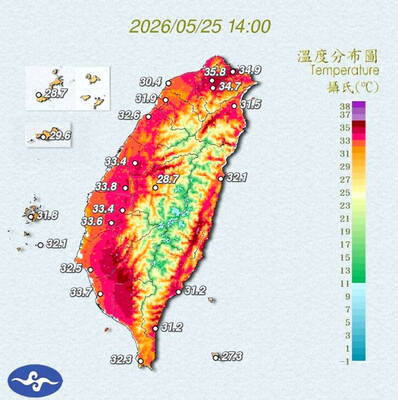
STAY COOL: The HPA recommended that people stay hydrated, use air-conditioning or fans while indoors, wear loose-fitting clothes and walk in the shade while outdoors Employers must implement measures such as installing cooling equipment, and providing drinking water and rest breaks for outdoor workers starting from Monday next week, the Taipei Department of Labor said on Sunday. Employers who fail to comply could face fines of NT$30,000 to NT$300,000 under the Occupational Safety and Health Act (職業安全衛生法), the department said. Businesses in Taipei employing fewer than 100 workers, as well as registered self-employed workers with labor insurance coverage, could receive on-site assessments and guidance from occupational safety consultants to help them apply for central government subsidies to implement or improve heat-protection measures, it said. Under the Ministry of

Chinese Nationalist Party (KMT) Chairwoman Cheng Li-wun (鄭麗文) yesterday briefed her party’s Central Standing Committee regarding her scheduled visit to the US between Monday next week and June 16, saying that her purpose would be to persuade the US that the Republic of China (ROC) Constitution was a “one China” constitution that would foster stable and peaceful cross-strait relations. The ROC Constitution is the most important defense for all Taiwanese citizens, as it upholds our democracy and has contributed to our robust economy, which aligns with international and US interests, she said. “We would not be troublemakers and drag the US under,”


 RSS
RSS