


Efforts to achieve transitional justice by the Democratic Progressive Party (DPP) government have not gone far enough, said Peter Pan (潘信行), whose father was executed by the then-Chinese Nationalist Party (KMT) government during the 228 Incident.
The 228 Incident refers to a crackdown launched by the then-KMT regime against civilian demonstrations following an incident in Taipei on Feb. 27, 1947.
The event marked the beginning of what is known as the 228 Massacre and led to the White Terror era, which saw thousands of Taiwanese arrested, imprisoned and executed.
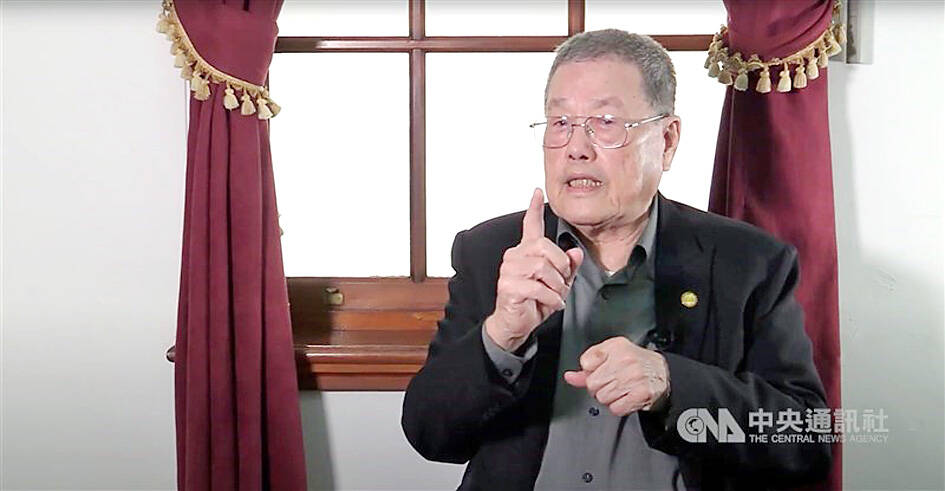
Photo: CNA
Pan’s father, then-city councilor Pan Mu-chih (潘木枝), negotiated with KMT troops on behalf of Chiayi’s 228 Settlement Committee, but was detained during the talks and executed in front of Chiayi Railway Station on March 25, 1947.
“All evidence indicates that Chiang Kai-shek (蔣介石) was responsible for 228, but his giant statue is still housed in a memorial hall” in Taipei, Peter Pan said in an interview on Monday. “That is just rubbing it in for the family.”
Allowing the statue and Chiang Kai-shek Memorial Hall to remain as it is means that the DPP has “only done half a good deed,” he added.
Taiwan should approach the matter of Chiang’s statue through legislation, he said, adding that the memorial hall should be renamed and given back to the people, who funded its construction with their taxes.
Lin Li-tsai (林黎彩), whose father, Lin Chieh (林界), was also executed during the 228 Incident, said that as long as Chiang’s statue remains in the hall, “there will never be transitional justice.”
Removing the statue would be the “most meaningful thing” the government could do for the families of 228 victims, Lin Li-tsai said.
Tseng Chien-chun (曾建鈞), an official at the Cabinet’s Department of Human Rights and Transitional Justice Office, said that the Ministry of Culture, tasked with the transformation of the hall, could adopt “interim measures” in the absence of a legislative amendment.
The measures could include canceling the nine daily “changing of the guard” ceremonies inside the building and ridding the site of symbols idolizing Chiang so that it could be redesigned to include concepts of transitional justice, Tseng said.
Wu Rwei-ren (吳叡人), an associate research fellow at Academia Sinica, said that transitional justice is a delicate matter that must be handled carefully.
People are divided over Chiang’s legacy, and those who have favorable opinions about it should also be respected, Wu said.
As with many historical figures, Chiang had his faults, but also contributed to society, he said.
“Did Chiang send in the troops, impose martial law and implement a reign of terror?” he asked. “Of course — these are generally accepted facts, but at the same time, some credit him with safeguarding Taiwan during the Cold War and, with the help of the US, keeping the Chinese Communist Party forces at bay.”
More work should be done to expose perpetrators, Wu said, adding that this is the “weakest link” since Taiwan began its quest for transitional justice in the 1990s.
Ordinarily, work to pursue transitional justice is initiated by presidents of pro-democracy camps, as was the case in South Africa, Germany and Latin America, he said.
However, in Taiwan, when former president Lee Teng-hui (李登輝), a member of the “old forces,” began taking steps toward transitional justice, he was leading an administration riddled with perpetrators, Wu said.
“Obviously, [Lee] could not purge his own troops and special agents, so he implemented compromise measures, including by identifying victims,” Wu said.
Since then, many of the perpetrators of violence during the 228 Incident and the White Terror era have died, so they cannot be held responsible for their actions, which is why the administration of President Tsai Ing-wen (蔡英文) has not named more perpetrators or removed the Chiang statue, despite being in office for eight years, he added.
Even so, the government should disclose the names of perpetrators and their wrongdoings, so at the very least there would be “historical justice,” Wu said.


UPGRADE: The Kang Ding-class frigate is replacing its Chaparall missiles with Tien Chien II and Hua Yang VLS, which would provide it with long-range, 360° air defense Taiwan plans to produce 1,200 to 1,376 Hai Chien II missiles (海劍二, Sea Sword II) — also known as TC-2N — to serve as the standard air defense system of the navy’s surface combatant fleet, a source said yesterday. Last week, the Hai Chien II, the naval version of the Tien Kung II missile (天劍二, Sky Sword II), completed a live-fire test in waters off the National Chungshan Institute of Science and Technology’s Jiupeng facility (九鵬) in Pingtung County’s Manjhou Township (滿州). The MIM72 Chaparral and other dated air defense missiles that currently arm Taiwanese ships have inadequate range to combat Chinese

REASONS FOR TRAVEL: An assistant professor said that proposed amendments to penalize drivers if they used drugs overseas would not deter people from traveling People who operate a motor vehicle under the influence of marijuana would have their driver’s license revoked, even if they used the substance while overseas, the Ministry of Transportation and Communications said yesterday, citing proposed amendments to the Road Traffic Management and Penalty Act (道路交通管理處罰條例). The amendments would also authorize the government to revoke the licenses of people determined to have used Category 1 or Category 2 narcotics, even if they were not operating a vehicle while under the influence of drugs, as well as ban them from taking the license test for three years, the ministry said. People aged 18 or
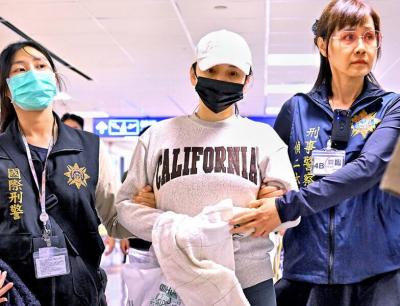
Johanne Liou (劉喬安), a Taiwanese woman who shot to unwanted fame during the Sunflower movement protests in 2014, returned to Taiwan last night after being deported from the US. She is to stand trial in Taiwan for charges involving embezzlement, fraud and drug crimes. The Criminal Investigation Bureau (CIB) said it took her into custody at Taiwan Taoyuan International Airport and would first question her before transferring her to the New Taipei District Prosecutors’ Office. She was arrested upon disembarking a flight from San Francisco that landed shortly before 7pm. Liou absconded to the US in 2019 after jumping bail
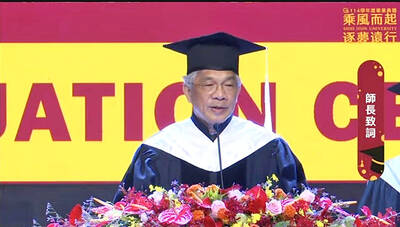
Shih Hsin University President Chen Ching-he (陳清河) yesterday issued a public apology for comments made in his commencement speech last week, stating that he has asked the school to suspend his duties and halt his wages for two months as a show of contrition. At the commencement ceremony on May 30, Chen said, “If you don’t manage your time well, or your own emotions, or your health, then I am telling every one of you — put a quick end to ‘you,’ because the world has no need for ‘you.’” The comments have sparked significant controversy online, and Chen through an open


 RSS
RSS