


The Fisheries Research Institute has developed artificial reproduction techniques for blackthroat sea perch, making Taiwan the second country in the world, after Japan, to breed the highly sought-after fish, the institute said on Monday.
Popular among Taiwanese for its taste and attractive color, blackthroat sea perch (Doederleinia berycoides) fetches NT$1,400 to NT$2,000 per kilogram for a large catch due to its short supply.
Blackthroat sea perch is a deep-sea fish typically found at depths of 400m below the sea’s surface, which poses challenges for artificial breeding, due to the distinct atmospheric pressure conditions between deep-sea and aquaculture environments, Fisheries Research Institute Director-General Chang Chin-i (張錦宜) said.
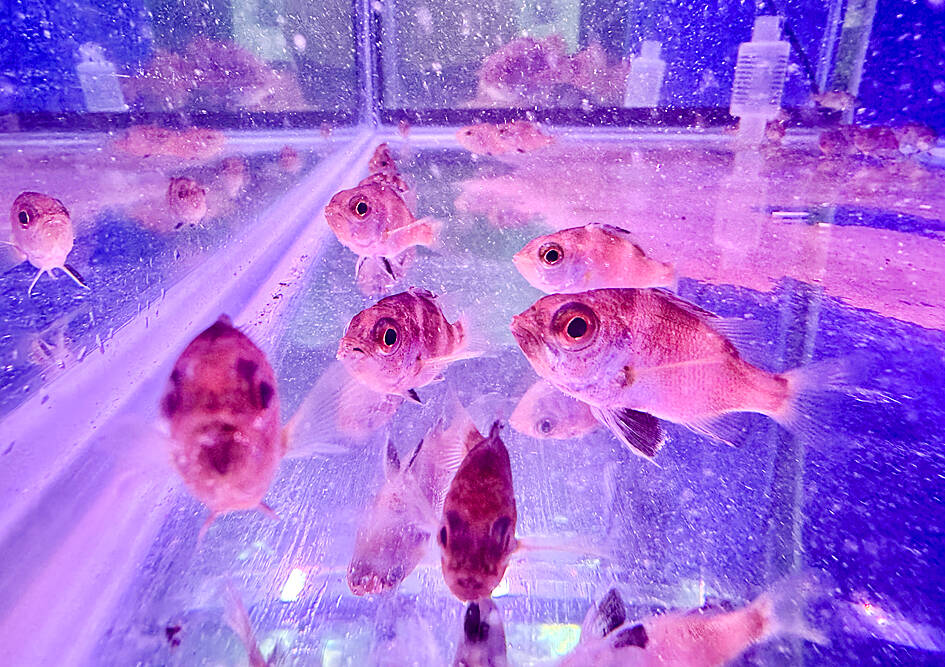
Photo: CNA
With the help of local fishers in September and October last year, institute researchers caught blackthroat sea perch that had ascended to depths of 200m below sea level for breeding, Chang said.
The researchers conducted artificial insemination using sperm and eggs from sexually mature male and female fish captured in the wild, and the artificially fertilized eggs were sent to the institute’s Tungkang Aquaculture Research Center for further cultivation, he said.
Fisheries Research Institute assistant researcher Lee Yen-Hung (李彥宏), who has been involved in the development of artificial reproduction techniques for the fish since 2007, said that of 50,000 artificially fertilized eggs, only 500 juvenile fish, or fries, averaging 3cm in length had been bred.
Japan has released fries into Toyama Bay since 2016, Lee said, adding that he hoped that in three years, when the initial batch of artificially bred blackthroat sea perch become sexually mature, the researchers would be able to breed a second batch from the first.
That would establish a “full-life cycle aquaculture” for blackthroat sea perch, he said.
“We have just successfully artificially bred it, following the progress of Japan. If everything goes as planned, we might be the first in the world to achieve full-life cycle aquaculture three years later,” Lee said.
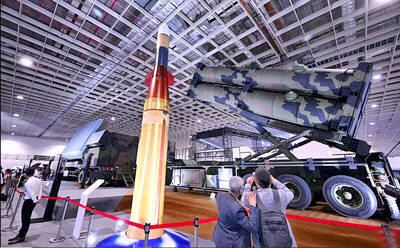
Taiwan is to commence mass production of the Tien Kung (天弓, “Sky Bow”) III, IV and V missiles by the second quarter of this year if the legislature approves the government’s NT$1.25 trillion (US$39.78 billion) special defense budget, an official said yesterday. Commenting on condition of anonymity, a defense official with knowledge of the matter said that the advanced systems are expected to provide crucial capabilities against ballistic and cruise missiles for the proposed “T-Dome,” an advanced, multi-layered air defense network. The Tien Kung III is an air defense missile with a maximum interception altitude of 35km. The Tien Kung IV and V
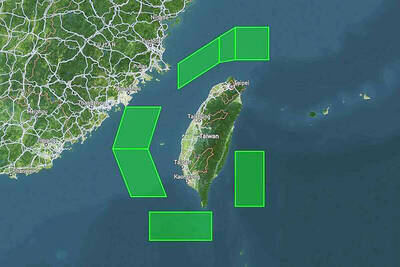
The disruption of 941 flights in and out of Taiwan due to China’s large-scale military exercises was no accident, but rather the result of a “quasi-blockade” used to simulate creating the air and sea routes needed for an amphibious landing, a military expert said. The disruptions occurred on Tuesday and lasted about 10 hours as China conducted live-fire drills in the Taiwan Strait. The Civil Aviation Administration (CAA) said the exercises affected 857 international flights and 84 domestic flights, affecting more than 100,000 travelers. Su Tzu-yun (蘇紫雲), a research fellow at the government-sponsored Institute for National Defense and Security Research, said the air
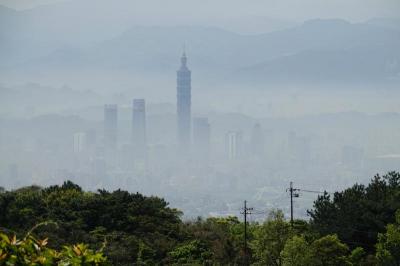
A strong continental cold air mass is to bring pollutants to Taiwan from tomorrow, the Ministry of Environment said today, as it issued an “orange” air quality alert for most of the country. All of Taiwan except for Hualien and Taitung counties is to be under an “orange” air quality alert tomorrow, indicating air quality that is unhealthy for sensitive groups. In China, areas from Shandong to Shanghai have been enveloped in haze since Saturday, the ministry said in a news release. Yesterday, hourly concentrations of PM2.5 in these areas ranged from 65 to 160 micrograms per cubic meter (mg/m³), and pollutants were
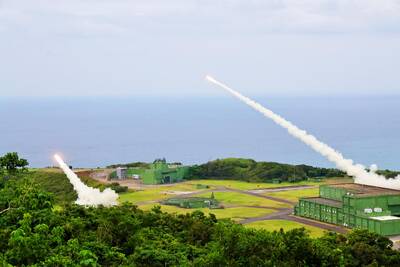
Taiwan lacks effective and cost-efficient armaments to intercept rockets, making the planned “T-Dome” interception system necessary, two experts said on Tuesday. The concerns were raised after China’s military fired two waves of rockets during live-fire drills around Taiwan on Tuesday, part of two-day exercises code-named “Justice Mission 2025.” The first wave involved 17 rockets launched at 9am from Pingtan in China’s Fujian Province, according to Lieutenant General Hsieh Jih-sheng (謝日升) of the Office of the Deputy Chief of the General Staff for Intelligence at the Ministry of National Defense. Those rockets landed 70 nautical miles (129.6km) northeast of Keelung without flying over Taiwan,


 RSS
RSS