


The arms race across the Taiwan Strait and Chinese military pressure is unlikely to end no matter who wins Taiwan’s closely watched elections.
China has cast Taiwan’s presidential and legislative elections on Saturday as a choice between war and peace, warning that an attempt by Taiwan to push for formal independence means conflict.
The Democratic Progressive Party (DPP) and Taiwan’s largest opposition party, the Chinese Nationalist Party (KMT), say only they can preserve peace. Both parties have also committed to bolstering Taiwan’s defenses and say only Taiwanese can decide their future.
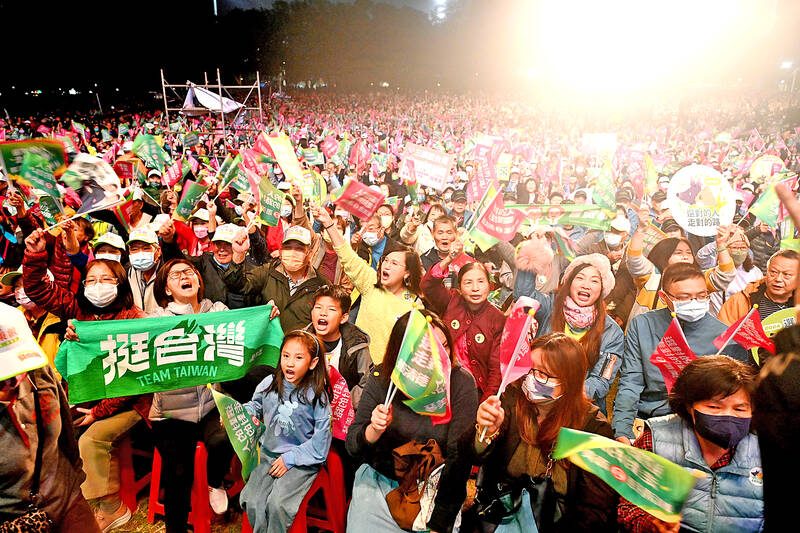
Photo: Wang Yi-sung, Taipei Times
Wang Zaixi (王在希), a deputy head of China’s Taiwan Affairs Office between 2000 and 2006 and a retired major general in China’s People’s Liberation Army (PLA), was quoted last month in China’s Global Times’ newspaper as saying that the DPP’s presidential candidate, Vice President William Lai (賴清德), was an “extremist” independence supporter.
“If he is elected, you cannot rule out the possibility of a military clash across the Taiwan Strait,” Wang said.
Such an outcome could have grave geopolitical and economic outcomes, pitting China against the US while blocking key shipping lanes and disrupting semiconductor and commodity supply chains.

Photo: CNA
“I believe they [Beijing] will take more hawkish actions to try to warn the new president over his future policies toward China,” said retired admiral Lee Hsi-ming (李喜明), Taiwan’s former chief of general staff.
Western security officials are trying to gauge how serious China could be about a military response to the election outcome.
Beijing might wait and see, with any strong reaction coming after May 20 when Taiwan’s next president takes office and gives an inaugural speech, an official said, speaking on condition of anonymity as they were not authorized to speak to the media.
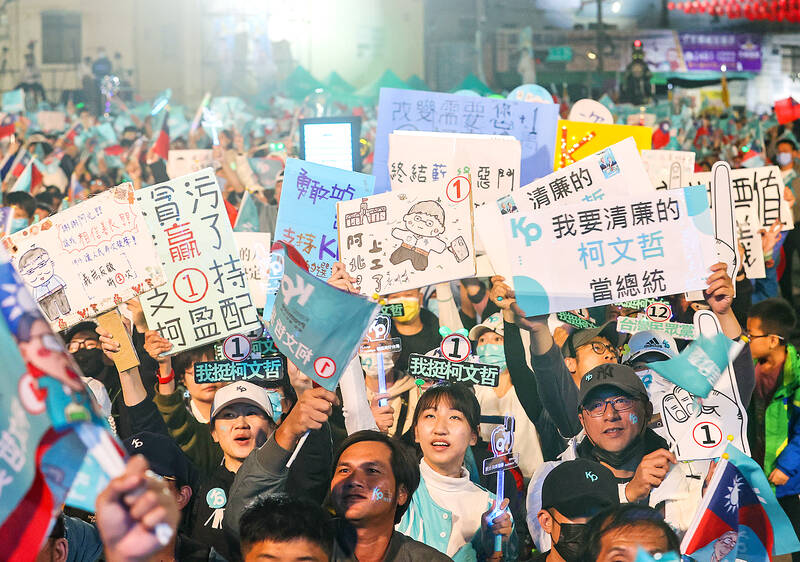
Photo: CNA
If the DPP wins the presidency, but loses its majority in the legislature, that could also temper China’s response, given it would weaken the DPP’s ability to pass legislation, the Western official added.
China’s defense ministry, which has accused Taiwan’s government of “hyping up” a military threat from China for electoral gain, did not respond to a request for comment.
In Taipei. Ministry of National Defense spokesperson Sun Li-fang (孫立方) told reporters that the ministry’s assessment of China’s moves would not be based on whether it is election season.
“We’ll look at the signs and what the enemy is up to as a basis for our judgement,” Sun said.
After Chinese and US leaders met in San Francisco in November last year, Chinese President Xi Jinping (習近平) reportedly told US President Joe Biden that while Taiwan is the most “dangerous” bilateral issue, he indicated that China is not preparing for an invasion of Taiwan.
However, since Taiwan’s last presidential election in 2020, China has engaged in an unprecedented level of increased military activity in the Taiwan Strait, including holding two rounds of major war games near the country in the past year-and-a-half.
Chinese jets now regularly cross an unofficial median line in the strait, seeking to wear down Taiwan’s far smaller air force by making it repeatedly scramble fighter jets.
Some analysts predict Taiwan’s contiguous zone — 24 nautical miles (44.45km) off its coast — being increasingly challenged by the PLA in the coming years.
Taiwan is strengthening its armor. China was well aware that every year they wait to “resolve the Taiwan problem,” it gives Taipei a further opportunity to beef up its defenses, a second Western security official said.
“That is not good for the PLA,” the official said.
Defense has featured prominently on the campaign trail.
The DPP has repeatedly brought up Taiwan’s indigenous submarine program, while other arms programs, including drones, are being developed.
The KMT champions the “Three Ds” of deterrence, dialogue and de-escalation.
The KMT’s vice presidential candidate and Broadcast Corp of China chairman, Jaw Shaw-kong (趙少康), said last month that Taiwan should ramp up its missile production to show it could strike into China in the event of a war, although he also said China should allow in Taiwanese military observers as a sign of goodwill and to relax tensions.
Whoever wins the presidency, Taiwan has a big weapons order backlog from the US.
In the next few years, Taiwan is due to receive advanced US weapons, including F-16V jets, M-1A tanks, Harpoon anti-ship missiles, and the High Mobility Artillery Rocket System, or HIMARS.
While clearly a superior military power, recent purges in the PLA that have felled generals in China’s navy, rocket force and air force, as well as a former defense minister, could lower the risk of conflict.
“The more problems they have, the more corruption they have, the better it is for us,” former Taiwan military chief of the general staff Lee said. “I don’t think there will be a full-scale invasion in the next few years because they have their own difficulties.”
Over the past week, Xi has given two speeches where he reiterated the need for “reunification” with Taiwan. He made no mention of using force in either occasion, although Beijing has never renounced that possibility.
China could also wield economic pressure post-election, targeting a trade deal signed in 2010 that Beijing says Taipei has breached with unfair trade barriers. Beijing could also ramp up operations to influence people in Taiwan through its “united front” department.
“China needs to be able to lead and control the situation in Taiwan, and we do that via a variety of means, not just by one means,” said Wu Xinbo (吳心伯), a professor at Shanghai’s Fudan University.

The military has spotted two Chinese warships operating in waters near Penghu County in the Taiwan Strait and sent its own naval and air forces to monitor the vessels, the Ministry of National Defense (MND) said. Beijing sends warships and warplanes into the waters and skies around Taiwan on an almost daily basis, drawing condemnation from Taipei. While the ministry offers daily updates on the locations of Chinese military aircraft, it only rarely gives details of where Chinese warships are operating, generally only when it detects aircraft carriers, as happened last week. A Chinese destroyer and a frigate entered waters to the southwest

A magnitude 6.1 earthquake struck off the coast of Yilan County at 8:39pm tonight, the Central Weather Administration (CWA) said, with no immediate reports of damage or injuries. The epicenter was 38.7km east-northeast of Yilan County Hall at a focal depth of 98.3km, the CWA’s Seismological Center said. The quake’s maximum intensity, which gauges the actual physical effect of a seismic event, was a level 4 on Taiwan’s 7-tier intensity scale, the center said. That intensity level was recorded in Yilan County’s Nanao Township (南澳), Hsinchu County’s Guansi Township (關西), Nantou County’s Hehuanshan (合歡山) and Hualien County’s Yanliao (鹽寮). An intensity of 3 was

Japanese Prime Minister Sanae Takaichi’s comment last year on Tokyo’s potential reaction to a Taiwan-China conflict has forced Beijing to rewrite its invasion plans, a retired Japanese general said. Takaichi told the Diet on Nov. 7 last year that a Chinese naval blockade or military attack on Taiwan could constitute a “survival-threatening situation” for Japan, potentially allowing Tokyo to exercise its right to collective self-defense. Former Japan Ground Self-Defense Force general Kiyofumi Ogawa said in a recent speech that the remark has been interpreted as meaning Japan could intervene in the early stages of a Taiwan Strait conflict, undermining China’s previous assumptions
Taiwan Railways Corp (TRC) today announced that Shin Kong Mitsukoshi has been selected as the preferred bidder to operate the Taipei Railway Station shopping mall, replacing the current operator, Breeze Development Co Ltd. Among eight qualified firms that delivered presentations and were evaluated by a review committee, Shin Kong Mitsukoshi was ranked first, while Breeze was named the runner-up, the rail company said in a statement. Contract negotiations are to proceed in accordance with regulations, it said, adding that if negotiations with the top bidder fail, it could invite the second-ranked applicant to enter talks. Breeze in a statement today expressed doubts over


 RSS
RSS