


Professional go player Hsu Hao-hung yesterday received the Special Award at this year’s Sports Elite Awards ceremony in Taipei for winning an Asian Games title in Hangzhou, China to complete a remarkable year for the 22-year-old.
Hsu, who was ranked 35th in the world heading into the Asian Games, secured the title in late September by upsetting the three highest-ranked go players in the world from China and South Korea in the quarter-finals, semi-finals and final.
Premier Chen Chien-jen (陳建仁), who awarded the trophy to Hsu, said he set a good example for the public and showed that everyone can rise to the top if they specialize in a particular field.
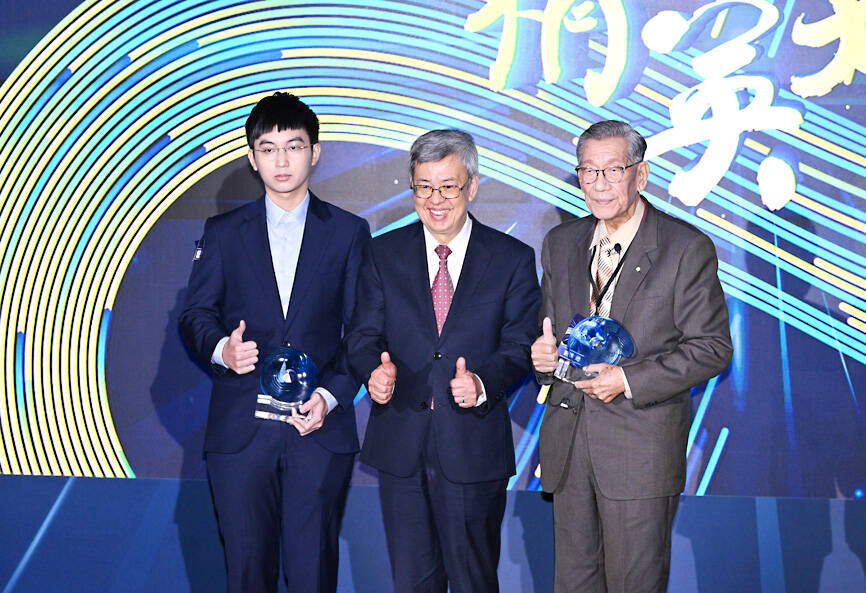
Photo: Tien Yu-hua, Taipei Times
Hsu thanked his family and friends for their support, and his team for helping him before the Asian Games.
Go is a very interesting activity suitable for people of all ages, and he hoped more people would pay attention to the game, Hsu said.
The Special Award was introduced in 2011 mainly to honor professional athletes who have performed well overseas. Golfer Yani Tseng (曾雅妮) and baseball pitcher Chen Wei-yin (陳偉殷) have won the award in the past.
The award is not given every year, as was the case in 2013 and 2014.
Meanwhile, basketball coach Liu Jin-chi (劉錦池) received the Lifetime Achievement Award for his contributions to the development of student basketball, mainly in Kaohsiung.
His efforts have earned him the nickname “promoter of basketball in southern Taiwan,” said the Sports Administration, the organizer of the awards ceremony.
Liu, who recently turned 80, said he asked players to study hard and be good people in addition to playing good basketball, to enable students to cultivate good careers after graduating.
The Sports Elite Awards were established by the government to recognize athletes and teams based on their performance and contributions in Taiwan and overseas over the past year, the Sports Administration said.
Eighty-five recommendations were submitted for the Sports Elite Awards this year, Sports Administration Deputy Director-General Hung Chih-chang (洪志昌) said.
Except for the Lifetime Achievement Award, the awards were decided based on performances between Oct. 1 last year and Oct. 16, the administration said.
The Best Male Athlete Award was awarded to judoka Yang Yung-wei (楊勇緯), while judoka Lien Chen-ling (連珍羚) was handed the Best Female Athlete award.
The Best Coach Award went to boxer Tseng Tzu-chiang (曾自強), while the Best Sports Team Award went to the Asian Games men’s 3x3 basketball squad — Lin Sin-kuan (林信寬), Chiang Chun (江均), Yu Xiang-ping (余祥平) and Wang Jhe-yu (汪哲宇).
The Best Newcomer Award went to 110m hurdles athlete Hsieh Yuan-kai (謝元愷) and the Sportspersonship Award went to karate-ka Gu Shiau-shuang (谷筱霜).

Considering that most countries issue more than five denominations of banknotes, the central bank has decided to redesign all five denominations, the bank said as it prepares for the first major overhaul of the banknotes in more than 24 years. Central bank Governor Yang Chin-lung (楊金龍) is expected to report to the Legislative Yuan today on the bank’s operations and the redesign’s progress. The bank in a report sent to the legislature ahead of today’s meeting said it had commissioned a survey on the public’s preferences. Survey results showed that NT$100 and NT$1,000 banknotes are the most commonly used, while NT$200 and NT$2,000

The Centers for Disease Control (CDC) yesterday reported the first case of a new COVID-19 subvariant — BA.3.2 — in a 10-year-old Singaporean girl who had a fever upon arrival in Taiwan and tested positive for the disease. The girl left Taiwan on March 20 and the case did not have a direct impact on the local community, it said. The WHO added the BA.3.2 strain to its list of Variants Under Monitoring in December last year, but this was the first imported case of the COVID-19 variant in Taiwan, CDC Deputy Director-General Lin Ming-cheng (林明誠) said. The girl arrived in Taiwan on

South Korea is planning to revise its controversial electronic arrival card, a step Taiwanese officials said prompted them to hold off on planned retaliatory measures, a South Korean media report said yesterday. A Yonhap News Agency report said that the South Korean Ministry of Foreign Affairs is planning to remove the “previous departure place” and “next destination” fields from its e-arrival card system. The plan, reached after interagency consultations, is under review and aims to simplify entry procedures and align the electronic form with the paper version, a South Korean ministry official said. The fields — which appeared only on the electronic form

The Ministry of Foreign Affairs (MOFA) is suspending retaliation measures against South Korea that were set to take effect tomorrow, after Seoul said it is updating its e-arrival system, MOFA said today. The measures were to be a new round of retaliation after Taiwan on March 1 changed South Korea's designation on government-issued alien resident certificates held by South Korean nationals to "South Korea” from the "Republic of Korea," the country’s official name. The move came after months of protests to Seoul over its listing of Taiwan as "China (Taiwan)" in dropdown menus on its new online immigration entry system. MOFA last week


 RSS
RSS