


More than a quarter of domestic university students showed moderate to severe depressive tendencies this year, according to a survey released by the Taiwan Counseling Psychologist Union on Monday.
Chen Po-lin (陳柏霖), an academic in National Taipei University of Education’s Department of Psychology and Counseling, told a news conference that 25.5 percent of students surveyed showed moderate to serious depressive tendencies — almost 10 points higher than pre-COVID-19 levels.
Chen said that in the final survey before the onset of the pandemic in early 2020, 16.3 percent of respondents showed depressive tendencies.
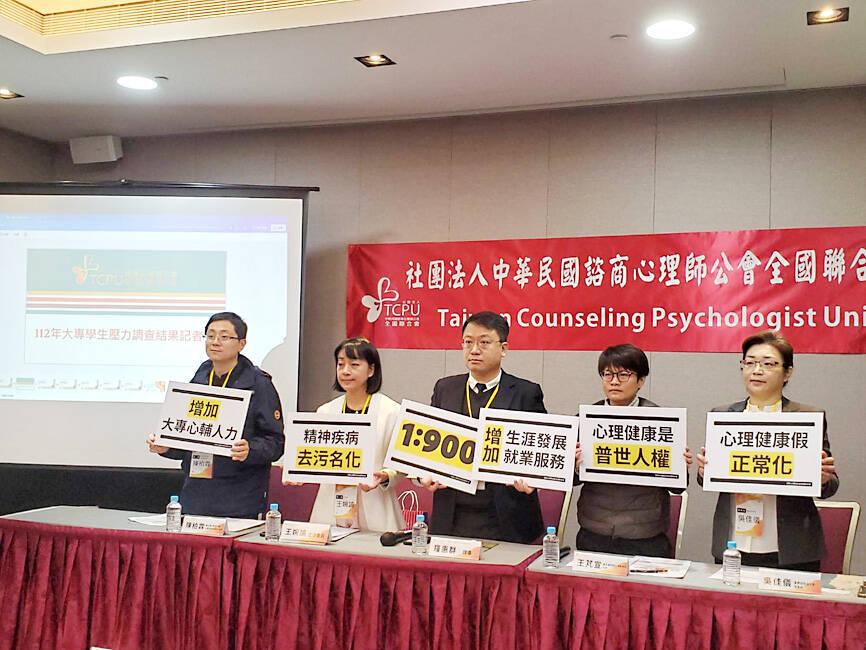
Photo: Lin Hui-chin, Taipei Times
Union member Hu Yen-wei (胡延薇) said that the impact of the pandemic on Taiwanese university students has been far greater than they first thought, with those in their junior year being most profoundly affected in terms of studies, relationships and hopes for the future.
Chen said that before the COVID-19 pandemic, the majority of domestic university students felt a moderate level of happiness and depression, followed by those who sensed a high level of happiness with low depression and those who had a moderate sense of happiness with low depression.
However, the first group remained the majority among university students this year, followed by increasing numbers of students who have a low sense of happiness with high depression and a low sense of happiness with a moderate level of depression in second and third respectively, Chen added.
Chen called for greater attention to university students’ mental health, including providing more access to counseling as well as regular monitoring and evaluation of individuals.
Many seemingly well-adjusted third-year university students are highly concerned about an array of challenges, including juggling coursework and relationships, as well as anxiety regarding time management and career development, Hu said.
Echoing Chen, Taiwan Association Against Depression chairperson Wu Chia-yi (吳佳儀) called for mental health resources to be better funded on university campuses, expressing hope that the average counselor-to-student caseload ratio could be lowered to one to 900 from one to 1,200.
Ministry of Health and Welfare official Wang Peng-hsuan (王芃宣) said those aged 15 to 30 were entitled to three free counseling sessions as part of a service launched on Aug. 1.
As of the end of last month, more than 14,000 people had sought such mental health counseling, with 30 percent of them in the high-risk group who need adequate medical assistance, Wang said.
The Taiwan Counseling Psychologist Union survey was conducted from Nov. 4 to Dec. 1 and collected 1,635 valid samples.
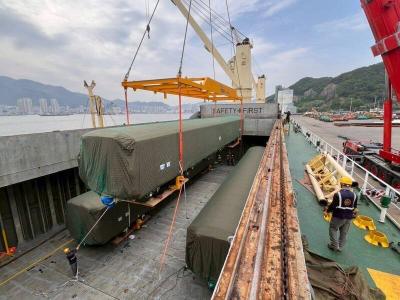
The first of 10 new high-capacity trains purchased from South Korea’s Hyundai Rotem arrived at the Port of Taipei yesterday to meet the demands of an expanding metro network, Taipei Rapid Transit Corp (TRTC) said yesterday. The train completed a three-day, 1,200km voyage from the Port of Masan in South Korea, the company said. Costing NT$590 million (US$18.79 million) each, the new six-carriage trains feature a redesigned interior based on "human-centric" transportation concepts, TRTC said. The design utilizes continuous longitudinal seating to widen the aisles and optimize passenger flow, while also upgrading passenger information displays and driving control systems for a more comfortable
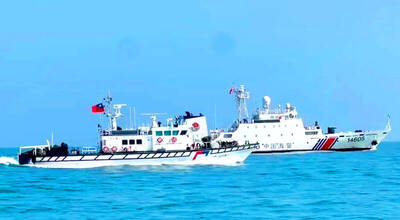
Instead of focusing solely on the threat of a full-scale military invasion, the US and its allies must prepare for a potential Chinese “quarantine” of Taiwan enforced through customs inspections, Stanford University Hoover fellow Eyck Freymann said in a Foreign Affairs article published on Wednesday. China could use various “gray zone” tactics in “reconfiguring the regional and ultimately the global economic order without a war,” said Freymann, who is also a nonresident research fellow at the US Naval War College. China might seize control of Taiwan’s links to the outside world by requiring all flights and ships entering or leaving Taiwan
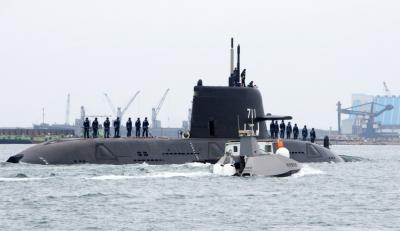
Taiwan's first indigenous defense submarine, the SS-711 Hai Kun (海鯤, or Narwhal), departed for its 13th sea trial at 7am today, marking its seventh submerged test, with delivery to the navy scheduled for July. The outing also marked its first sea deployment since President William Lai (賴清德) boarded the submarine for an inspection on March 19, drawing a crowd of military enthusiasts who gathered to show support. The submarine this morning departed port accompanied by CSBC Corp’s Endeavor Manta (奮進魔鬼魚號) uncrewed surface vessel and a navy M109 assault boat. Amid public interest in key milestones such as torpedo-launching operations and overnight submerged trials,
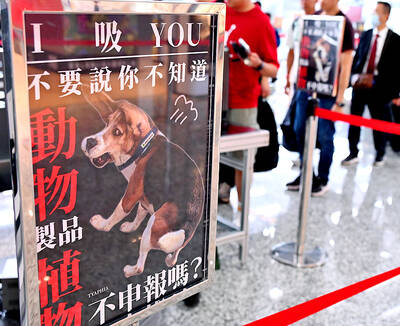
Quarantine awareness posters at Taiwan Taoyuan International Airport have gone viral for their use of wordplay. Issued by the airport branch of the Animal and Plant Health Inspection Agency, the posters feature sniffer dogs making a range of facial expressions, paired with advisory messages built around homophones. “We update the messages for holidays and campaign needs, periodically refreshing materials to attract people’s attention,” quarantine officials said. “The aim is to use the dogs’ appeal to draw focus to quarantine regulations.” A Japanese traveler visiting Taiwan has posted a photo on X of a poster showing a quarantine dog with a


 RSS
RSS