


The Ministry of Education should review its 2020 project to renovate dormitories or subsidize rental units for disadvantaged students, and conduct a review of its policy of making student dorms a self-liquidating investment, the Control Yuan said in a report yesterday.
Citing the National Audit Office’s 2022 central government budget audit report, the Control Yuan said that 64 universities in the 2021 academic year did not have sufficient space to accommodate students and were 31,078 beds short.
Taipei had the most severe deficiency at 9,455 beds, followed by Taichung at 6,947 beds, the Control Yuan said.
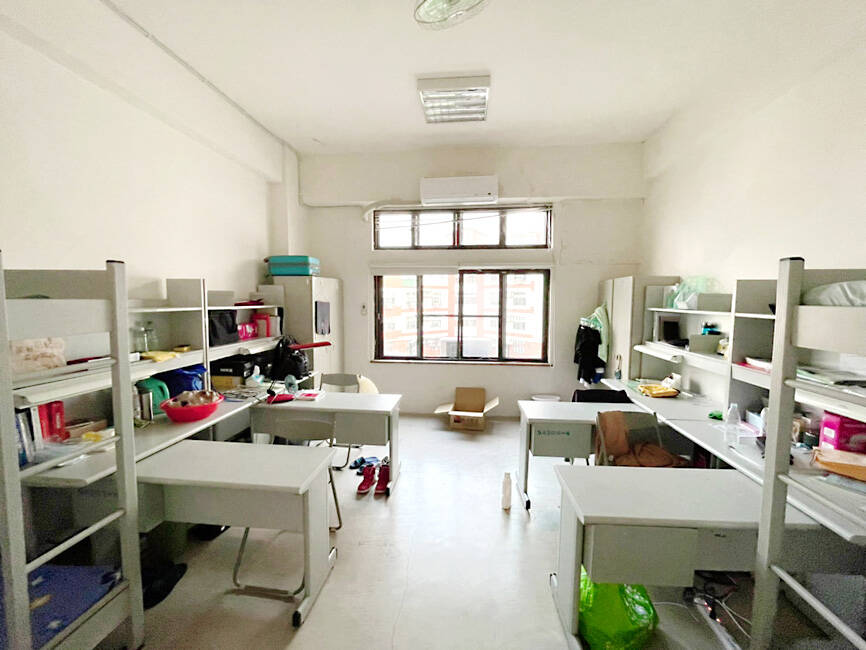
Photo courtesy of National Chi Nan University
The ministry’s 2020 project was launched to address the shortage, and as of September this year, it had helped universities build or repurpose buildings to provide 42,401 beds, only achieving 64.2 percent of its intended goal, the Control Yuan report said.
Seven universities were 500 beds short, had no plans to participate in the project and were not given consultations, leading to some universities having new dorms and others having older buildings, the report said.
The ministry’s project failed to consider the availability of bed space, the equality of dorm rooms and the order of application — factors that affect students’ willingness to apply for school dorms, the Control Yuan said.
Furthermore, universities failed to consider the number of students living off-campus, leading them to underestimate the total number of students wishing to stay in dorms, it said.
The ministry failed to work with universities to inventory the total number of dorms and gauge student needs before prioritizing “ameliorative efforts” to provide more dormitories, it said.
The universities also failed to establish a standard for living space, resulting in spacious communal areas, but small bedrooms in new dorms, the report said.
The report added that universities could consider social housing projects as alternate dormitory spaces, as 62 of the 91 social housing projects seeking construction bids are near universities.
However, the Ministry of Education has yet to consider working with the Ministry of the Interior on this issue, and it should make efforts to rectify this oversight, it said.
Rectifications of the aforementioned oversights should serve as a reference when the education ministry extends the project for another five years, it said.

Considering that most countries issue more than five denominations of banknotes, the central bank has decided to redesign all five denominations, the bank said as it prepares for the first major overhaul of the banknotes in more than 24 years. Central bank Governor Yang Chin-lung (楊金龍) is expected to report to the Legislative Yuan today on the bank’s operations and the redesign’s progress. The bank in a report sent to the legislature ahead of today’s meeting said it had commissioned a survey on the public’s preferences. Survey results showed that NT$100 and NT$1,000 banknotes are the most commonly used, while NT$200 and NT$2,000

The Centers for Disease Control (CDC) yesterday reported the first case of a new COVID-19 subvariant — BA.3.2 — in a 10-year-old Singaporean girl who had a fever upon arrival in Taiwan and tested positive for the disease. The girl left Taiwan on March 20 and the case did not have a direct impact on the local community, it said. The WHO added the BA.3.2 strain to its list of Variants Under Monitoring in December last year, but this was the first imported case of the COVID-19 variant in Taiwan, CDC Deputy Director-General Lin Ming-cheng (林明誠) said. The girl arrived in Taiwan on

South Korea is planning to revise its controversial electronic arrival card, a step Taiwanese officials said prompted them to hold off on planned retaliatory measures, a South Korean media report said yesterday. A Yonhap News Agency report said that the South Korean Ministry of Foreign Affairs is planning to remove the “previous departure place” and “next destination” fields from its e-arrival card system. The plan, reached after interagency consultations, is under review and aims to simplify entry procedures and align the electronic form with the paper version, a South Korean ministry official said. The fields — which appeared only on the electronic form

The Ministry of Foreign Affairs (MOFA) is suspending retaliation measures against South Korea that were set to take effect tomorrow, after Seoul said it is updating its e-arrival system, MOFA said today. The measures were to be a new round of retaliation after Taiwan on March 1 changed South Korea's designation on government-issued alien resident certificates held by South Korean nationals to "South Korea” from the "Republic of Korea," the country’s official name. The move came after months of protests to Seoul over its listing of Taiwan as "China (Taiwan)" in dropdown menus on its new online immigration entry system. MOFA last week


 RSS
RSS