


More than 2,000 political documents that were once permanently classified are expected to be made public after the legislature yesterday passed amendments to the National Secrets Acts (國家機密保護法).
About half of the 4,500 documents are to be unsealed next year after wording was changed in Article 12 of the act to declassify them after a 30-year limit on secrecy.
However, authorities can ask the agency that issued the classification rating or a higher-ranking agency to ask for an extension of the secrecy of files.
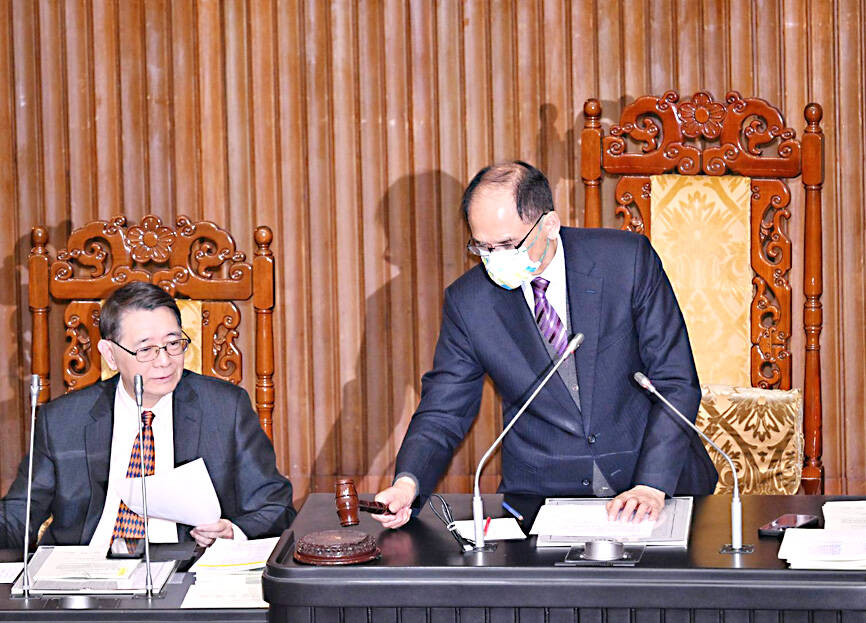
Photo: Fang Pin-chao, Taipei Times
Each extension may be at most 10 years and files that have remained sealed for 60 years should be reviewed by high-ranking agencies to determine whether they must remain out of public view, the amendments say.
The agency in charge must say within two months whether an extension has been approved and if it does not, the request to extend the classification status would be automatically revoked, the amendments say.
Separate amendments to the Political Archives Act (政治檔案條例) were also passed yesterday.
The changes to the Political Archives Act state that until declassified, original classified documents that fall under Article 12 of the National Secrets Act should not be moved.
Classified files that fall under Article 12 should be unsealed by the 40th year after they have been classified.
When extensions of classification of documents is required because they bear the names of intelligence personnel that if released would compromise their safety, the National Security Bureau (NSB) must be informed, which would relay the extension request to the National Security Council (NSC) to decide whether the request would be approved.
Extensions granted in such cases may be at most three years per request, and the NSB should reassess the files within six months after the amendments take effect, the amendments say.
Failure to complete the assessment within the given time will be considered agreement that the document be unsealed, the changes to the Political Archives Act say.
The National Archives Administration said that while the amended Political Archives Act is to take effect on Feb. 28, declassifying an estimated 2,250 political files, the number that are unsealed would depend on reviews conducted by the NSB and the NSC.
The 40-year declassification rule was to expedite a motion to make the documents available to the public, the archives agency said.
Unless there was need, such as protecting the identity of agents, such information should not be classified, it said.
The Political Archives Act amendments were written with the privacy of people who have been arrested or detained in mind, it said, adding that unless they or their families give their consent, information on their family, sex and other matters would be redacted.
Additional reporting by CNA

SECURITY: Starlink owner Elon Musk has taken pro-Beijing positions, and allowing pro-China companies to control Taiwan’s critical infrastructure is risky, a legislator said Starlink was reluctant to offer services in Taiwan because of the nation’s extremely high penetration rates in 4G and 5G services, the Ministry of Digital Affairs said yesterday. The ministry made the comments at a meeting of the legislature’s Transportation Committee, which reviewed amendments to Article 36 of the Telecommunications Management Act (電信管理法). Article 36 bans foreigners from holding more than 49 percent of shares in public telecommunications networks, while shares foreigners directly and indirectly hold are also capped at 60 percent of the total, unless specified otherwise by law. The amendments, sponsored by Chinese Nationalist Party (KMT) Legislator Ko

The military has spotted two Chinese warships operating in waters near Penghu County in the Taiwan Strait and sent its own naval and air forces to monitor the vessels, the Ministry of National Defense (MND) said. Beijing sends warships and warplanes into the waters and skies around Taiwan on an almost daily basis, drawing condemnation from Taipei. While the ministry offers daily updates on the locations of Chinese military aircraft, it only rarely gives details of where Chinese warships are operating, generally only when it detects aircraft carriers, as happened last week. A Chinese destroyer and a frigate entered waters to the southwest
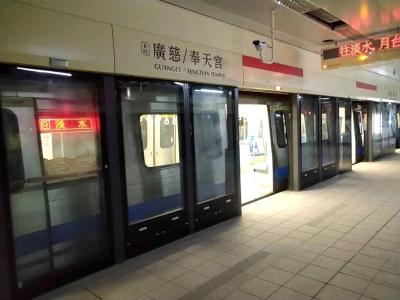
The eastern extension of the Taipei MRT Red Line could begin operations as early as late June, the Taipei Department of Rapid Transit Systems said yesterday. Taipei Rapid Transit Corp said it is considering offering one month of free rides on the new section to mark its opening. Construction progress on the 1.4km extension, which is to run from the current terminal Xiangshan Station to a new eastern terminal, Guangci/Fengtian Temple Station, was 90.6 percent complete by the end of last month, the department said in a report to the Taipei City Council's Transportation Committee. While construction began in October 2016 with an
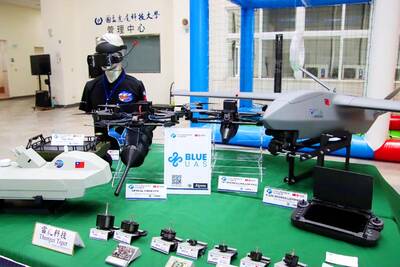
NON-RED SUPPLY: Boosting the nation’s drone industry is becoming increasingly urgent as China’s UAV dominance could become an issue in a crisis, an analyst said Taiwan’s drone exports to Europe grew 41.7-fold from 2024 to last year, with demand from Ukraine’s fight against Russian aggression the most likely driver of growth, a study showed. The Institute for Democracy, Society and Emerging Technology (DSET) in a statement on Wednesday said it found that many of Taiwan’s uncrewed aerial vehicle (UAV) sales were from Poland and the Czech Republic. These countries likely transferred the drones to Ukraine to aid it in its fight against the Russian invasion that started in 2022, it said. Despite the gains, Taiwan is not the dominant drone exporter to these markets, ranking second and fourth


 RSS
RSS