


The Ministry of National Defense urged the public to back the military’s plan to deploy mobile Harpoon missile platforms in central and southern Taiwan to deter a military invasion of Taiwan by the Chinese Communist Party (CCP).
Local residents last week expressed concern over the plans.
A person in the know said the new deployment would be carried out on mobile platforms that would be moved to tactical positions, instead of being at a fixed base, adding, however, that there would be some form of fixed structures that would serve as a command center as well as a logistics and administrative base.
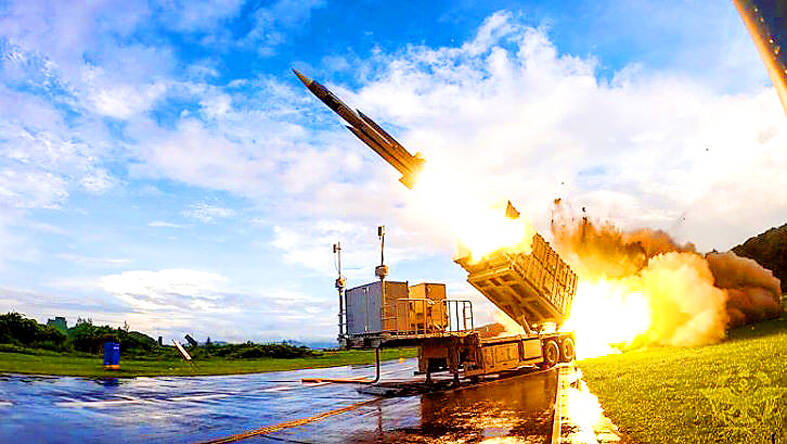
Photo: Ministry of Defense handout via EPA-EFE
The source, citing ministry statistics, said the military is expected to launch 52 construction projects across the nation for the deployment of the majority of its surface-to-air missiles, while planning to upgrade the launch systems for six fixed bases.
The Legislative Yuan has approved the funding for these projects, they added.
According to the Sea-Air Combat Power Improvement Plan Purchase Special Regulation (海空戰力提升計畫採購特別條例), deployment of the Hsiung Feng anti-surface missiles is divided into two stages, with the first stage, from 2017 to 2026, focusing on expanding missile production capability — particularly for Hsiung Feng II (Brave Wind II, 雄風) and Hsiung Feng III missiles — and establishing seven facilities.
The source said the first stage also included plans to upgrade the launch systems at the six fixed-location bases.
The second stage would focus on broadening the nation’s capabilities to produce HF-2, HF-3 and the HF-3 extended-range variant, as well as the construction of 12 other facilities, including garages, driver training grounds, component warehouses, maintenance centers and combat readiness control centers, the source said.
The military said it would construct three facilities, including vehicle garages, munitions depots and land-based anti-air capabilities, mainly comprised of land-based variants of the Sky Sword II (天劍).
The military is also constructing an additional 17 facilities — including manufacturing plants — to support land-based surface-to-air sites featuring the land-based variant of the upgraded Ting Kung II (Sky Bow, 天弓) and the Tien Kung III missiles.
The military also plans to build a hangar shed, warehouse and maintenance centers for the Chien Hsiang uncrewed aerial vehicles, the source said, adding that additional facilities are to be built to house the munitions for the Wan Chien (Thousand Swords, 萬劍) cluster munitions missile.

NATIONAL SECURITY: Authorities are working to confirm the identities of the military personnel involved and investigating possible illegal conduct and regulatory violations Authorities are probing possible national security implications after Kinmen police and immigration officers on Sunday found a Chinese woman allegedly posing as a tourist while engaging in prostitution involving more than 10 military personnel. The woman, surnamed Chen (陳), has since been deported, authorities said, adding that investigators are still working to confirm the identities of those implicated, as the records only listed code names and aliases. The case stemmed from a report received by the Kinmen District Prosecutors’ Office on Friday last week from the Jinhu Precinct of the Kinmen County Police Bureau. On Sunday, police, along with the National Immigration

GLOBALGIVING: ‘ Caving to external pressure is not acceptable for an organization that has cultivated justice reform and human rights for 30 years,’ one NGO said A slew of non-government organizations (NGOs) have withdrawn from the GlobalGiving fundraising platform after it announced it would use “Chinese Taipei” instead of “Taiwan” from next month. The Taiwan Good Rice Association wrote on Facebook on Friday that it was informed on April 28 via a teleconference call of the change, which was made because the platform wanted to operate in China. Taiwan Good Rice is to terminate all cooperative relationships with GlobalGiving in response to the platform’s “unilateral and non-negotiable” decision to remove references to Taiwan, the NGO said. “Taiwan is in the official name of Taiwan Good Rice Association and the

HEAVY WEATHER: Typhoon Jangmi is due to crash straight into the Ryukyus as airlines look to shift flights to larger aircraft or cancel flights to Okinawa entirely Taiwan’s international air carriers announced flight adjustments over the weekend as Typhoon Jangmi is forecast to hit the Ryukyu Islands today and tomorrow. The Central Weather Administration (CWA) upgraded Jangmi from a tropical storm to a typhoon at 8am yesterday, with the eye located 580km south of Naha city. It was moving north at 19kph. Today, China Airlines’ CI-120, CI-121, CI-122 and CI-123 flights between Taoyuan and Naha, Okinawa, have been canceled as well as CI-132 and CI-133 between Kaohsiung and Naha. EVA Air’s BR-112, BR-113, BR-186 and BR-185 flights between Taoyuan and Naha are also canceled. Low-cost carrier Tigerair Taiwan canceled IT-230,

Chinese Nationalist Party (KMT) Chairwoman Cheng Li-wun (鄭麗文) yesterday briefed her party’s Central Standing Committee regarding her scheduled visit to the US between Monday next week and June 16, saying that her purpose would be to persuade the US that the Republic of China (ROC) Constitution was a “one China” constitution that would foster stable and peaceful cross-strait relations. The ROC Constitution is the most important defense for all Taiwanese citizens, as it upholds our democracy and has contributed to our robust economy, which aligns with international and US interests, she said. “We would not be troublemakers and drag the US under,”


 RSS
RSS