


The Democratic Progressive Party’s (DPP) legislator-at-large candidates yesterday registered their candidacy for January’s elections at the Central Election Commission (CEC) in Taipei, saying that they would push for digital reforms that would safeguard Taiwan’s democratic liberties.
The DPP has nominated 16 men and 18 women for legislator-at-large seats, said DPP Secretary-General Hsu Li-ming (許立明), who accompanied the candidates to the commission.
The candidates, who wore matching vests, come from all walks of life and “represent the opinions of all kinds of groups in society,” Hsu said.
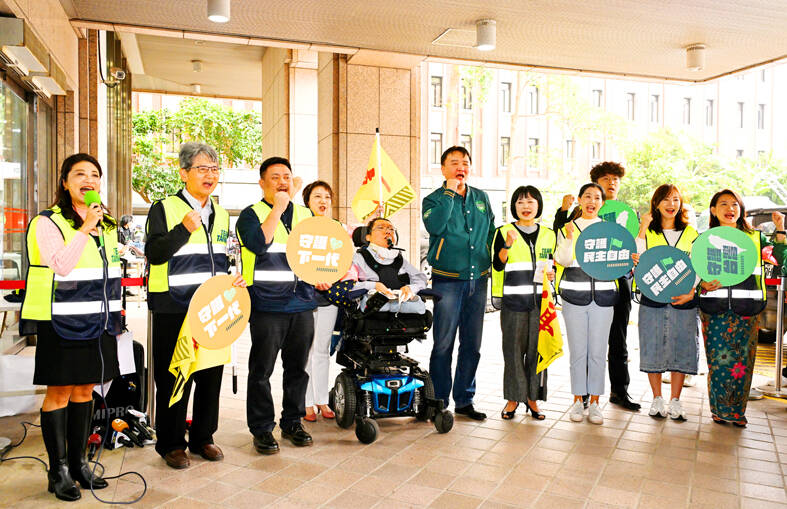
Photo: Tien Yu-hua, Taipei Times
The party had asked them to run, as their voices would contribute to efforts to safeguard the next generation, he said.
Jing Chuan Child Safety Foundation chief executive officer Lin Yue-chin (林月琴), one of the candidates, said she has long fought to safeguard the rights of children and adolescents, adding that she would continue to do so in the Legislative Yuan if elected.
Lin pledged to fight for more social welfare funding and listen to the suggestions of civic groups.
Taiwan Parks and Playgrounds for Children by Children president Ariel Chang (張雅琳) said she became a candidate because she hoped the government would begin to consider policies to address the needs of children.
National Taipei University Graduate School of Criminology director Puma Shen (沈伯洋) said that this was the moment for him to “change roles” and “become part of the system,” so he could contribute to efforts that would identify and control false information.
Beijing is trying to influence Taiwanese through cognitive warfare and spread the idea that Taiwan is alone and democracy is useless, Shen said.
“This is what is threatening our democratic freedom,” he said.
Entertainer and TV host Jean Kuo (郭昱晴) said that the stronger Taiwan becomes, the more people are aware of external and internal forces that seek to suppress the nation’s development.
Without the strength to defy such forces, talented Taiwanese performers and creators would be forced to conform to stereotypes, and act out soulless characters and scripts, Kuo said.
At a separate event, reporters asked Hsu about the failed alliance that the Chinese Nationalist Party (KMT) and the Taiwan People’s Party (TPP) had been working on to combine their presidential candidates into a single ticket.
Most Taiwanese must be worried about whether they could entrust the nation’s future to such parties, Hsu said.
The DPP has solid policy platforms and faith in the democratic system, he said.
People would form their own opinions on whether the vice presidential candidates of the KMT, Broadcasting Corp of China chairman Jaw Shaw-kong (趙少康), and the TPP, Legislator and business executive Cynthia Wu (吳欣盈), were better choices than the DPP’s vice presidential candidate, former representative to the US Hsiao Bi-khim (蕭美琴).
Additional reporting by CNA
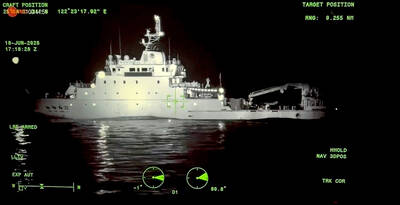
EXCUSES: Beijing is using government and research vessels as a pretext to harass the nation and enter its EEZ, and engage in ‘hegemonic expansion,’ the coast guard said The Coast Guard Administration yesterday said it drove away Chinese oceanographic research vessel Xiang Yang Hong 22 (向陽紅33) from restricted waters after warning it that it was in Taiwan’s exclusive economic zone (EEZ). The Chinese vessel entered restricted waters off the coast of Yilan County’s Suao (蘇澳) at 11:35pm on Thursday, the coast guard said, adding that it dispatched the Lanyu patrol vessel and the boat PP-10077 to shadow the Chinese ship and issue radio warnings ordering it to leave. China has no sovereignty over waters off Taiwan’s east coast, Lanyu’s crew told Xiang Yang Hong 22 over the radio, and demanded

BAIT AND SWITCH: Allowing KMT-run counties to sell to China while the threat of abrupt cancelations hangs overhead is another form of coercion, officials said Beijing is using agricultural purchase offers announced during the Straits Forum to deepen Taiwan’s dependence on the Chinese market, a Taiwanese official said yesterday as they criticized the Taitung County commissioner’s participation in the initiative. During the Straits Forum held in Xiamen on Saturday, Chinese officials announced a sales and purchase agreement for agricultural products from some counties led by the Chinese Nationalist Party (KMT). Taitung County Commissioner Yao Ching-ling (饒慶鈴), who was barred from attending the event in person by the Mainland Affairs Council, participated via video. Under the agreement, China would purchase atemoyas, pomeloes, tea and grouper harvested in Taitung,

SHIFTING FIRE: While the tempo of purely military exercises around Taiwan has gone down somewhat, Beijing is working to isolate Lai diplomatically from support abroad Chinese President Xi Jinping (習近平) is shifting tactics in his campaign to pressure Taiwan, ramping up diplomatic isolation of the nation while dialing down provocative displays of military aggression. Taiwan recorded a daily average of five Chinese military aircraft crossing the Taiwan Strait’s buffer line with China through May this year — half the number logged in the same period last year. In March, Beijing did not send a single fighter jet near Taiwan for seven days, the longest absence on record outside of typhoon season. In comparison, China sent 153 planes near Taiwan during one day at its peak in
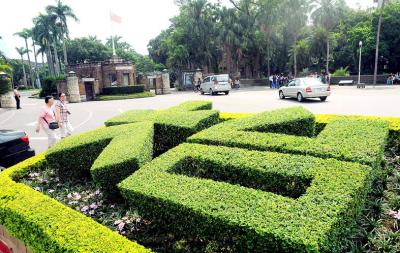
Four Taiwanese universities have been ranked among the world's top 200 institutions in the Quacquarelli Symonds (QS) World University Rankings for next year, the highest Taiwan has ever placed in the category, with National Taiwan University (NTU) achieving its best performance at 54th globally and 17th in Asia. The four Taiwanese institutions in the global top 200 are NTU (54th), National Tsing Hua University (142nd), National Yang Ming Chiao Tung University (177th) and National Cheng Kung University (191st), the rankings showed. All four universities achieved their highest-ever global rankings this year, QS data showed. National Cheng Kung University entered the top 200 for


 RSS
RSS