


Collection fees are to be subsidized for plastics that conform to environmental standards, as well as those made from at least 25 percent recycled materials, to encourage the use of environmentally friendly packaging, the Ministry of Environment said on Thursday.
The Resource Circulation Administration said in a news release that the new policy would benefit about 15,000 companies.
The policy would promote the use of plastic containers that conform to its Green Design standards, which are that the container is made from a single material, has no added coloring and has limited labeling, Resource Circulation Administration Director-General Lai Ying-ying (賴瑩瑩) said.
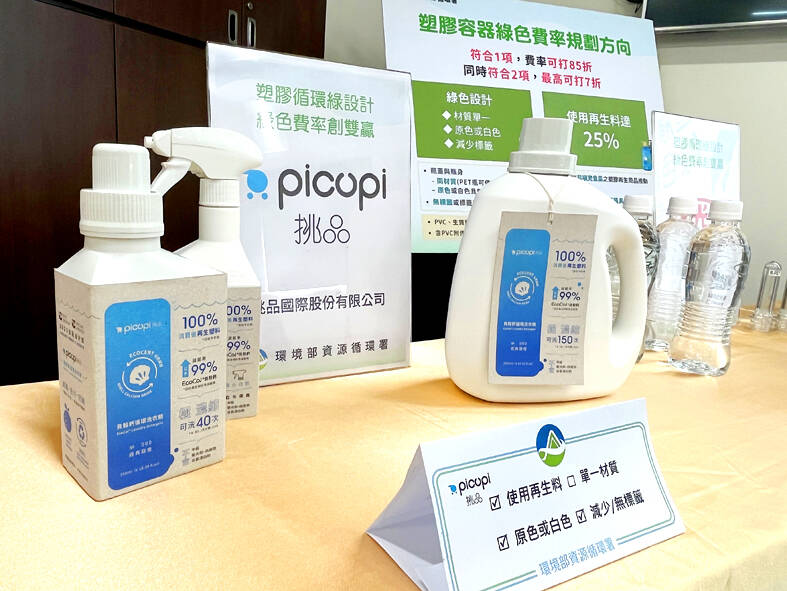
Photo: Chen Chia-yi, Taipei Times
In addition, products are eligible for a “green differential fee rate” if they are made of at least 25 percent recycled materials, Lai added.
“Taiwan’s waste recycling sector is built upon the concept of extended producer responsibility,” Lai said. “The ministry’s agencies collect recycling and clean-up treatment fees at the source, whether that be a manufacturer or an importer.”
“The fees — which vary depending on the materials in a product — go into a fund to manage the circulation and recycling of resources, with a portion subsidizing the wages of trash collectors, and enterprises that process or recycle waste,” she said.
Lai said that in November last year, her agency released the Operation Guidelines for Promoting Recycled Plastic Products for Non-Food Packaging, which encourages industries to use more recycled materials.
Thursday’s announcement was to outline the financial incentives of recycling plastic containers, she added.
The policy encourages producers by offering a 15 percent discount on the fees — which are partly based on how much of a category of waste is collected — if their products meet the Green Design criteria, she said.
They are also eligible for the 15 percent subsidy if at least 25 percent of the product is made from recycled materials, she said, adding that if the product meets both criteria, the discount would be 30 percent.
Fees are NT$7 to NT$10 per kilogram of product category that a firm makes or imports, Resource Circulation Administration deputy head Wang Yueh-bin (王嶽斌) said.
A product that is eligible for the 30 percent subsidy would save a company NT$2,000 for every tonne that is collected, Wang said.
About 15,000 firms would benefit from the new policy, he said.
“Agency data indicate that the policy would boost the use of recycled materials by 240,000 tonnes by 2025, which would reduce carbon emissions by 480,000 tonnes per year,” he said.
Hsinchu County-based Kao (Taiwan) Co, a supplier of cleaning products, said that its plastic containers are 30 to 100 percent recycled materials.
However, its environmental efforts have increased production costs by 20 to 30 percent, said Wu Meng-chuan (吳孟娟), who heads the company’s purchasing department.
“The new Ministry of Environment policy on use of recycled materials is a financial incentive for producers and would attract more companies to join the effort,” Wu said.
This would expand the market for recycled materials in Taiwan,” Wu said.
Most containers are made from thermosetting polymers, said Hsu Juei-hsiang (許祥瑞), a section manager at the Taichung-based Plastics Industry Development Center.
Thermosets are made by irreversibly hardening a prepolymer.
“Thermoset products are recyclable, but when they are printed on or use multiple materials, the recycling costs are higher,” Hsu said.
“Producers must consider how containers they design would be recycled,” he said. “That is necessary to maintain a circular economy.”
The Ministry of Health and Welfare has set standards for recycled materials in plastic food containers, as the next policy phase is to encourage people to be more accepting of containers and other products with high recycled material content, he added.

FUKUOKA SITUATION: Japanese media reported that the pathogen is expected to be identified by the summer, while the CDC downplayed the idea that it was hMPV A “mysterious cold-like illness” reported in Japan’s Fukuoka Prefecture does not seem to be a new disease, but Japanese authorities have been asked about the situation, the Centers for Disease Control (CDC) said yesterday. The Fukuoka Prefectural Medical Association on Wednesday told a news conference that a “mystery cold” that has become a hot topic on social media is “highly likely to be caused by some kind of viral infection,” Japan’s KBC News reported. “Many people are experiencing symptoms starting with a sore throat, followed by a runny nose, phlegm and a severe cough,” KBC News reported, citing association officials. Health authorities are

Nvidia Corp CEO Jensen Huang (黃仁勳) arrived in Taiwan yesterday ahead of upcoming AI and technology events, saying he plans to meet with clients and Taiwan Semiconductor Manufacturing Co Chairman C.C. Wei (魏哲家) during his visit. After landing at Taipei Songshan Airport, Huang posed for photos with fans and handed out Yakult drinks to reporters and supporters waiting at the scene, saying he has “a lot to do” during the trip. Asked about reports that Nvidia’s planned headquarters site in Taipei’s Beitou Shilin Technology Park could break ground on May 27, Huang said that if the company holds an event, he would

The Ministry of Finance this afternoon announced the winning numbers for the March-April uniform invoice lottery. The winning number for the NT$10 million (US$318,060) special prize is 19531471, and the winning number for the NT$2 million grand prize is 85941329. Three numbers were drawn for the NT$200,000 first prize: 07225810, 20231230 and 83518781. Those with receipts matching the last seven digits of any of the first-prize numbers will win the NT$40,000 second prize, while those matching the last six digits will win the NT$10,000 third prize. Those whose receipts match the last five digits of the first-prize numbers can claim the NT$4,000 fourth prize,
SIX SUBSIDIES: The monthly allowance for older farmers is to increase to NT$10,000, and NT$5,000 is to be given to homemakers under the national pension system, Lai said The government is to implement major welfare policies for disadvantaged groups, including raising the monthly allowance for older farmers to NT$10,000 and providing homemakers with NT$5,000 per month, President William Lai (賴清德) said yesterday. Lai made the remarks during a visit to Wangling Temple in Chiayi County, saying that the planned increases were being introduced amid economic growth and an increase in tax revenue. Touting a policy, in which the government plans to provide a monthly allowance of NT$5,000 for every child under the age of 18 in a bid to address Taiwan’s low birthrate, Lai said that if received for the


 RSS
RSS