


More than 100 taxis, tour buses and trucks are to surround the Ministry of Transportation and Communications tomorrow to protest tougher penalties for automobile drivers.
The penalties, which took effect in June, were designed to penalize drivers who disregard the right of way for pedestrians, including a two-month driver’s license suspension if a driver accumulates 12 penalty points in one year.
A driver’s license would be revoked if the license is suspended twice in two years and if the driver accumulates additional points. Since the new penalties took effect in June, taxi drivers are often handed a NT$600 fine and one point for illegal parking, National Drivers’ Alliance Chairman Liu Hung-chang (劉鴻樟) said.
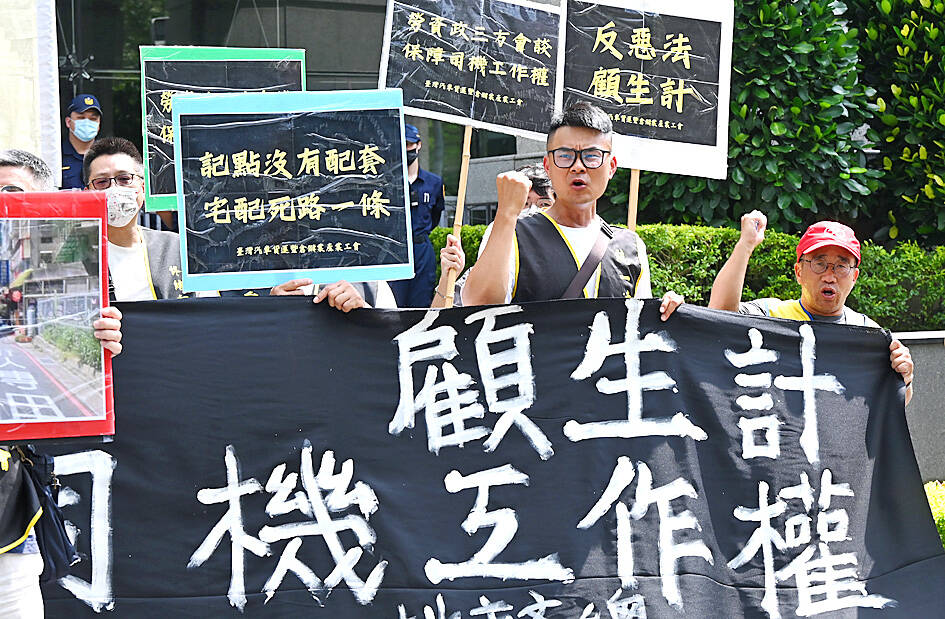
Photo: Liu Hsin-de, Taipei Times
“If a taxi driver’s license was suspended for two months after having accumulated 12 penalty points, it means they cannot work for two months, and they might not have other means to support themselves,” Liu said.
“Taxi drivers do not deliberately contravene traffic laws. Breaches of traffic regulations happen frequently because roads are ill-designed, having too many parking spaces for scooters and cars on the roadside,” he added.
There is also a lack of temporary parking zones in road sections where roadside parking is not available, Liu said, adding that taxi drivers are forced to break rules whenever a passenger hails a cab. Taxi drivers are frequently caught contravening traffic laws because some people make a living by using dashboard cameras to record contraventions and submit the evidence to collect cash prizes, he said.
“If a taxi driver can earn NT$3,000 per day, they would not have much left over if they were given two tickets that day for illegal parking,” he said, adding that the same problem has occurred with truck drivers as well. The ministry was passing the buck to local governments when the alliance told the ministry about the problem, Liu said.
“When we expressed our grievances to local government officials and hoped that they would reconfigure where red lines and yellow lines are drawn, we were vaguely told that yellow lines would be drawn as much as possible,” Liu said.
In Taiwan, parking or waiting is not allowed along red curbside lines, while five-minute waiting is allowed next to yellow curbs. The alliance specifically demanded that 10m to 12m-long yellow lines be drawn for every 150m of red lines, so motor vehicles could safely load and unload passengers and goods, Liu said.
Yellow lines should be drawn every 10m to 20m at every intersection, he said.
The ministry said it is working with local governments to create 456 temporary parking zones for car drivers.

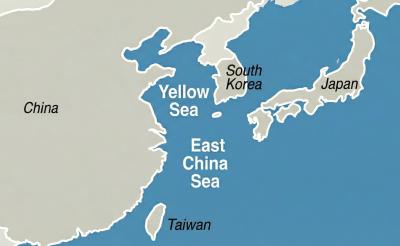
China has reserved offshore airspace in the Yellow Sea and East China Sea from March 27 to May 6, issuing alerts usually used to warn of military exercises, although no such exercises have been announced, the Wall Street Journal (WSJ) reported yesterday. Reserving such a large area for 40 days without explanation is an “unusual step,” as military exercises normally only last a few days, the paper said. These alerts, known as Notice to Air Missions (Notams), “are intended to inform pilots and aviation authorities of temporary airspace hazards or restrictions,” the article said. The airspace reserved in the alert is

NAMING SPAT: The foreign ministry called on Denmark to propose an acceptable solution to the erroneous nationality used for Taiwanese on residence permits Taiwan has revoked some privileges for Danish diplomatic staff over a Danish permit that lists “Taiwan” as “China,” Eric Huang (黃鈞耀), head of the Ministry of Foreign Affairs’ Department of European Affairs, told a news conference in Taipei yesterday. Reporters asked Huang whether the Danish government had responded to the ministry’s request that it correct the nationality on Danish residence permits of Taiwanese, which has been listed as “China” since 2024. Taiwan’s representative office in Denmark continues to communicate with the Danish government, and the ministry has revoked some privileges previously granted to Danish representatives in Taiwan and would continue to review
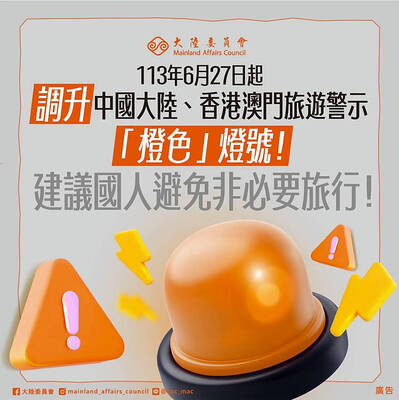
More than 6,000 Taiwanese students have participated in exchange programs in China over the past two years, despite the Mainland Affairs Council’s (MAC) “orange light” travel advisory, government records showed. The MAC’s publicly available registry showed that Taiwanese college and university students who went on exchange programs across the Strait numbered 3,592 and 2,966 people respectively. The National Immigration Agency data revealed that 2,296 and 2,551 Chinese students visited Taiwan for study in the same two years. A review of the Web sites of publicly-run universities and colleges showed that Taiwanese higher education institutions continued to recruit students for Chinese educational programs without

A bipartisan group of US senators has introduced a bill to enhance cooperation with Taiwan on drone development and to reduce reliance on supply chains linked to China. The proposed Blue Skies for Taiwan Act of 2026 was introduced by Republican US senators Ted Cruz and John Curtis, and Democratic US senators Jeff Merkley and Andy Kim. The legislation seeks to ease constraints on Taiwan-US cooperation in uncrewed aerial systems (UAS), including dependence on China-sourced components, limited access to capital and regulatory barriers under US export controls, a news release issued by Cruz on Wednesday said. The bill would establish a "Blue UAS


 RSS
RSS