


A Chinese BZK-005 reconnaissance drone circled Taiwan in a clockwise direction on Thursday as a Chinese aircraft carrier Shandong was sailing through waters south of Taiwan and into the Western Pacific the same day, the Ministry of National Defense said yesterday.
According to flight path information released by the ministry, the BZK-005 reconnaissance drone flew in a northeasterly direction north of Taiwan, then followed the perimeter of Taiwan’s air defense identification zone (ADIZ) southwards and then southeast.
Once it reached the airspace directly south of Taiwan, it changed course to head back toward China in a northwesterly direction.
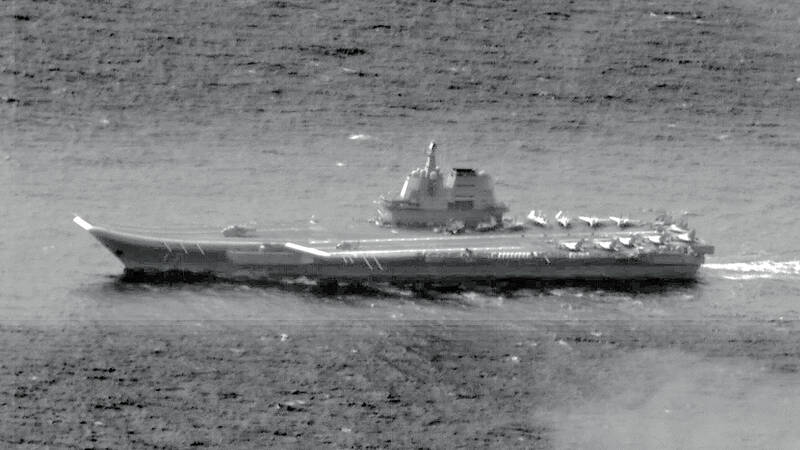
Photo courtesy of the Ministry of National Defence
The drone’s flight path was part of the daily surveillance data of People’s Liberation Army (PLA) activities in waters and airspace in Taiwan’s general vicinity released yesterday, covering the 24-hour period from 6am on Thursday to 6am yesterday.
Before the tracking data came out, the ministry reported on Thursday night on the navigation of one of China’s aircraft carriers, the Shandong, through the Bashi Channel and into the Western Pacific.
The Shandong also participated in Chinese military drills around Taiwan in April, sailed through the Taiwan Strait in June, and carried out drills in the Western Pacific last month.
The ministry did not comment on the purpose of the Shandong’s most recent movements.
It was unclear whether the mission was related to the joint drills, dubbed “Resolute Dragon,” that are being conducted on Kyushu, Okinawa and Hokkaido from Oct. 14 to Tuesday next week by the Japan Ground Self-Defense Force and the US military, as reported by Japanese broadcaster NHK.
In addition to the BZK-005 reconnaissance drone, a Z-9 anti-submarine warfare helicopter was spotted over waters east of Taiwan. The ministry believed the helicopter took off from the Shandong and was on an anti-submarine warfare training mission.
A total of 35 PLA aircraft and 15 vessels were detected around Taiwan during the 24-hour period, with 23 of the detected aircraft crossing the median line of the Taiwan Strait or entering its ADIZ, the ministry said.
An ADIZ is airspace declared by a country, enabling it to identify, locate and control approaching foreign aircraft, but it is not part of a country’s territorial airspace as defined by international law.
In response to media queries for comment regarding the Chinese warships, Premier Chen Chien-jen (陳建仁) yesterday said that both sides across the Taiwan Strait should agree to maintain freedom of navigation as a common goal.
“Beijing’s actions are unacceptable to the international community and China is urged to put a stop to this behavior,” he said.
The Taiwanese political mainstream firmly supports the government’s efforts toward safeguarding stability and facilitating peaceful interactions across the strait, which Beijing should acknowledge and respect, Chen said, citing Mainland Affairs Council polls.
It is the government’s hope that Taiwan and China could coexist in peace and prosperity, he added.

Kenting National Park service technician Yang Jien-fon (楊政峰) won a silver award in World Grand Prix Photography Awards Spring Season for his photograph of two male rat snakes intertwined in combat. Yang’s colleagues at Kenting National Park said he is a master of nature photography who has been held back by his job in civil service. The awards accept entries in all four seasons across six categories: architectural and urban photography, black-and-white and fine art photography, commercial and fashion photography, documentary and people photography, nature and experimental photography, and mobile photography. Awards are ranked according to scores and divided into platinum, gold and

SPACE VETERAN: Kjell N. Lindgren, who helps lead NASA’s human spaceflight missions, has been on two expeditions on the ISS and has spent 311 days in space Taiwan-born US astronaut Kjell N. Lindgren is to visit Taiwan to promote technological partnerships through one of the programs organized by the US for its 250th national anniversary. Lindgren would be in Taiwan from Tuesday to Saturday next week as part of the US Bureau of Educational and Cultural Affairs’ US Speaker Program, organized to celebrate the 250th anniversary of the signing of the Declaration of Independence, the American Institute in Taiwan (AIT) said in a statement yesterday. Lindgren plans to engage with key leaders across the nation “to advance cutting-edge technological partnerships and inspire the next generation of scientists and engineers,”

The Chinese Nationalist Party (KMT) caucus yesterday said it opposes the introduction of migrant workers from India until a mechanism is in place to prevent workers from absconding. Minister of Labor Hung Sun-han (洪申翰) on Thursday told the Legislative Yuan that the first group of migrant workers from India could be introduced as early as this year, as part of a government program. The caucus’ opposition to the policy is based on the assessment that “the risk is too high,” KMT caucus secretary-general Lin Pei-hsiang (林沛祥) said. Taiwan has a serious and long-standing problem of migrant workers absconding from their contracts, indicating that

TRADE-OFF: Beijing seeks to trade a bowl of tempura for a Chinese delicacy, an official said, while another said its promises were attempts to interfere in the polls The government must carefully consider the national security implications of building a bridge connecting Kinmen County and Xiamen, China, the Public Construction Commission (PCC) said yesterday. PCC Commissioner Derek Chen (陳金德), who is also a minister without portfolio, made the remarks in a meeting of the legislature’s Transportation Committee, after Democratic Progressive Party Legislator Hsu Fu-kuei (徐富癸) asked about China’s proposal of new infrastructure projects to further connect Kinmen and Lienchiang (Matsu) counties with Xiamen. China unveiled the bridge plan, along with nine other policies for Taiwan, on Sunday, the last day of Chinese Nationalist Party (KMT) Chairwoman Cheng Li-wun’s (鄭麗文) visit


 RSS
RSS