


Despite the considerable distance between Lithuania and Taiwan, both are “practically neighbors” given their shared democratic values, visiting Lithuanian Parliament Speaker Viktorija Cmilyte-Nielsen said in an interview with the Central News Agency yesterday.
Lithuanians are becoming more familiar with Taiwan amid warming bilateral relations, Cmilyte-Nielsen said.
One example is a newly opened “Taiwanese corner” at the National Library of Lithuania in Vilnius, she said.
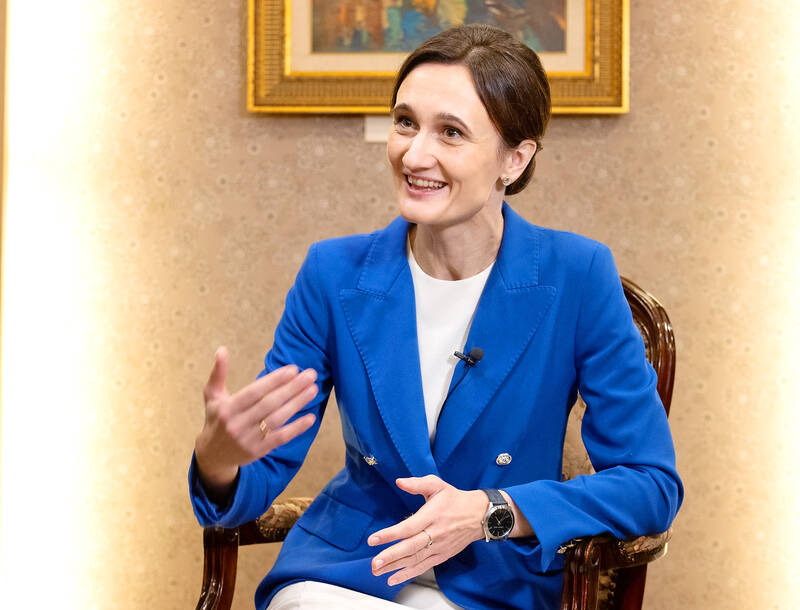
Photo: CNA
“I think such small details that bring people together, that present us to each other, are very important. And there is definitely, we are in the process of learning more and more,” she said.
The Lithuanian politician said her country sees Taiwan “as a friendly democracy.”
“In Lithuania, we feel very strongly that geographical distances matter much less than the way you think about things, the value you base your society on, what you believe is right, your respect for democracy, for freedom, for human rights, for the rule of law,” she said.
“So, these things make us practically neighbors ... [as] geographical distances matter so much less than your attitude to things,” she added.
Cmilyte-Nielsen said she believed these shared values provide a good foundation for collaboration, which is why she is making stops in Taiwan and Japan during her ongoing trip to the Indo-Pacific region.
“This region is very important for us in terms of diversifying, of generally promoting the international rules-based order that we see this region so important in, and democracies in this region,” she said.
Cmilyte-Nielsen arrived in Taiwan on Sunday night for a four-day visit, leading a delegation that includes business representatives. Her visit to Taiwan is the first by a speaker of the Seimas, Lithuania’s parliament.
She is scheduled to address the Legislative Yuan, which is to confer an honorary medal on her, the Ministry of Foreign Affairs said.
The Lithuanian dignitaries attended a banquet hosted by President Tsai Ing-wen (蔡英文) yesterday. They also met with Vice President William Lai (賴清德) and Premier Chen Chien-jen (陳建仁) later yesterday.
The delegation is also to participate in a financial technology forum and visit the Ultrafast Laser Technology Research and Innovation Center in Tainan, which was established jointly last month by Taiwan and Lithuania, a global leader in that type of technology, it said.
Asked about specific areas for future cooperation, the speaker said that other than the main focus on fintech, both sides also aim to cooperate on lasers and semiconductors.
“So, if there is something that I regret, it is that Taiwan and Lithuania have started to develop their relations a bit later than with many other European countries. But right now, I believe that we have the potential to become a success story for also that other countries would follow in Europe,” she said.
Relations between Taiwan and Lithuania have warmed over the past two years, with both sides signing an agreement in July 2021 to open reciprocal representative offices.
Taiwan opened its office in Vilnius on Nov. 18, 2021.
However, the Baltic state has come under heavy political and economic pressure from Beijing following a decision to let Taiwan’s office in Vilnius include the word “Taiwanese” in its name.
In the aftermath of the move, China recalled its ambassador to Lithuania and expelled Vilnius’ envoy in Beijing, while also suspending direct freight rail services and certain Lithuanian imports.
Asked if she has faced any pressure from Beijing over her visit to Taipei, Cmilyte-Nielsen said: “This trip is not directed against any country.”
“It is part of our clear strategy to develop cooperation with democracies and also to focus on the Indo-Pacific region, and I am not especially expecting any pressure or sort of problems with that,” she said.
With the opening of reciprocal offices in Lithuania and Taiwan, the speaker said she knows that many European countries “are a bit hesitant, and they are looking at our example in order to make their own decisions” about cooperating with Taiwan.
“So that is important for both sides to register concrete achievements that we can show to our people, and that, of course, is important in democracies where electoral cycles change,” she added.
“I think the good example and a success story of Lithuanian and Taiwanese cooperation could be a good reason for more European colleagues to hopefully follow in this path,” she said.

The Centers for Disease Control (CDC) yesterday reported the first case of a new COVID-19 subvariant — BA.3.2 — in a 10-year-old Singaporean girl who had a fever upon arrival in Taiwan and tested positive for the disease. The girl left Taiwan on March 20 and the case did not have a direct impact on the local community, it said. The WHO added the BA.3.2 strain to its list of Variants Under Monitoring in December last year, but this was the first imported case of the COVID-19 variant in Taiwan, CDC Deputy Director-General Lin Ming-cheng (林明誠) said. The girl arrived in Taiwan on

South Korea is planning to revise its controversial electronic arrival card, a step Taiwanese officials said prompted them to hold off on planned retaliatory measures, a South Korean media report said yesterday. A Yonhap News Agency report said that the South Korean Ministry of Foreign Affairs is planning to remove the “previous departure place” and “next destination” fields from its e-arrival card system. The plan, reached after interagency consultations, is under review and aims to simplify entry procedures and align the electronic form with the paper version, a South Korean ministry official said. The fields — which appeared only on the electronic form

The Ministry of Foreign Affairs (MOFA) is suspending retaliation measures against South Korea that were set to take effect tomorrow, after Seoul said it is updating its e-arrival system, MOFA said today. The measures were to be a new round of retaliation after Taiwan on March 1 changed South Korea's designation on government-issued alien resident certificates held by South Korean nationals to "South Korea” from the "Republic of Korea," the country’s official name. The move came after months of protests to Seoul over its listing of Taiwan as "China (Taiwan)" in dropdown menus on its new online immigration entry system. MOFA last week

A bipartisan group of US senators has introduced a bill to enhance cooperation with Taiwan on drone development and to reduce reliance on supply chains linked to China. The proposed Blue Skies for Taiwan Act of 2026 was introduced by Republican US senators Ted Cruz and John Curtis, and Democratic US senators Jeff Merkley and Andy Kim. The legislation seeks to ease constraints on Taiwan-US cooperation in uncrewed aerial systems (UAS), including dependence on China-sourced components, limited access to capital and regulatory barriers under US export controls, a news release issued by Cruz on Wednesday said. The bill would establish a "Blue UAS


 RSS
RSS