


A Taiwanese press cartoonist, who specializes in political satire, is making waves in France through her art and sense of humor, with her most recent publication gaining widespread acclaim.
Stellina Chen (陳筱涵), now in her 30s, is a graduate of National Chengchi University’s Department of Diplomacy and continued her studies in France.
She is a member of Paris-based international artist network Cartooning for Peace, an organization whose self-proclaimed description identifies it as a collective “who use humor to fight for respect for cultures and freedoms.”
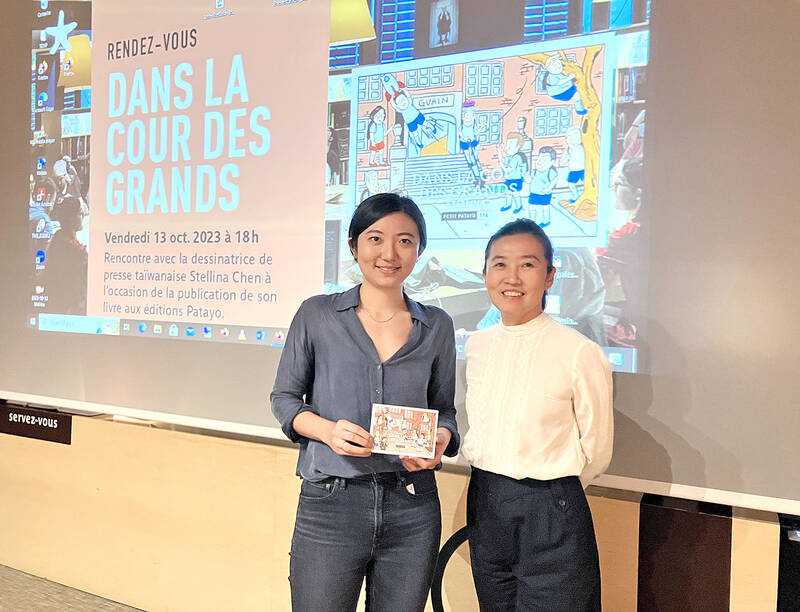
Photo: CNA
Her cartoons have been printed in French news publications such as Le Monde.
Focused primarily on the relationship between Taiwan, China and the US, Chen’s witty comedic chops even garnered her the rare opportunity of having her political satire featured in a social science textbook in France’s secondary-school curriculum.
French publisher Patayo commissioned her to create an entirely original book.
As French readers have a long-standing love of political satire and a deep understanding of international news, Chen’s book, which does not specifically target any nation or individual, received widespread acclaim upon its publication.
To celebrate the Oct. 6 release of the book, titled Dans la Cour des Grands (“In the Big Leagues”), an event was held at the Musee du quai Branly-Jacques Chirac in Paris on Friday last week.
It was attended by Philippe Barbat, former director of the French National Institute of Cultural Heritage.
Barbat — who is head of the Maison du Dessin de Presse (the House of Press Cartoons), an appointment by French President Emmanuel Macron — was impressed by Chen’s art and asked her to consider archiving her work at the institute, which is to begin operations in Paris by 2025.
Chen in a recent media interview spoke about In the Big Leagues and how the 92-page undertaking came to be.
Patayo invited her to pen a creation on the theme “first day back to school,” Chen said.
“When I picked up my pen, I realized then that I had artist’s block,” Chen said, adding that the political satire was limited to one scene per page without either layout or dialogue bubbles, which forced her pictures to speak louder than words, or the lack of them.
“And I also needed to showcase the current political climate of the world only through interactions between my characters,” she added. “It was not an easy task.”
Chen turned influential world figures such as the heads of the G20 and social media tycoons into the main school-going characters in the book.
She captured the physical traits of the famous figures to create the caricatures, pairing them with puns on their names, eg, French macarons as Macron, and Canadian national dish poutine as Russian President Vladimir Putin.
Chen used the stories and personality of her characters to reflect global politics, such as having character “X-man” in the likeness of Chinese President Xi Jinping (習近平) fighting to be class president for life, poking fun at his prolonged presidency.
She also has “Macaron” aiming to extend the end of the school day from 6:20pm to 6:40pm, a jab at the French president’s extension of the retirement age from 62 to 64.
“Even if someone doesn’t understand French or geopolitics, he or she can interpret the plot in a different way and just enjoy the story,” she said.
Through her membership with Cartooning for Peace, Chen has also spent years trying to educate people in France, Germany and the Netherlands about Taiwan, and its political position and leanings, by publishing her cartoons in mainstream media of those nations.
After giving a voice to Taiwan through humor on the international stage, Chen said she hopes to start political satire publications in Taiwan to promote the genre, an art form she said is rare in the nation.
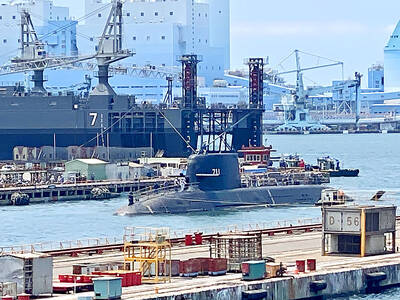
AGING: While Japan has 22 submarines, Taiwan only operates four, two of which were commissioned by the US in 1945 and 1946, and transferred to Taiwan in 1973 Taiwan would need at least 12 submarines to reach modern fleet capabilities, CSBC Corp, Taiwan chairman Chen Cheng-hung (陳政宏) said in an interview broadcast on Friday, citing a US assessment. CSBC is testing the nation’s first indigenous defense submarine, the Hai Kun (海鯤, Narwhal), which is scheduled to be delivered to the navy next month or in July. The Hai Kun has completed torpedo-firing tests and is scheduled to undergo overnight sea trials, Chen said on an SET TV military affairs program. Taiwan would require at least 12 submarines to establish a modern submarine force after assessing the nation’s operational environment and defense

A white king snake that frightened passengers and caused a stir on a Taipei MRT train on Friday evening has been claimed by its owner, who would be fined, Taipei Rapid Transit Corp (TRTC) said yesterday. A person on Threads posted that he thought he was lucky to find an empty row of seats on Friday after boarding a train on the Bannan (Blue) Line, only to spot a white snake with black stripes after sitting down. Startled, he jumped up, he wrote, describing the encounter as “terrifying.” “Taipei’s rat control plan: Release snakes on the metro,” one person wrote in reply, referring
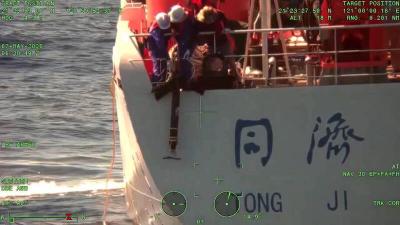
The coast guard today said that it had disrupted "illegal" operations by a Chinese research ship in waters close to the nation and driven it away, part of what Taipei sees a provocative pattern of China's stepped up maritime activities. The coast guard said that it on Thursday last week detected the Chinese ship Tongji (同濟號), which was commissioned only last year, 29 nautical miles (54km) southeast of the southern tip of Taiwan, although just outside restricted waters. The ship was observed lowering ropes into the water, suspected to be the deployment of scientific instruments for "illegal" survey operations, and the coast
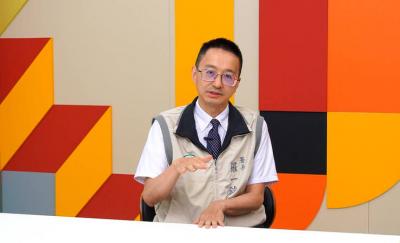
Taiwan’s two cases of hantavirus so far this year are on par with previous years’ case numbers, and the government is coordinating rat extermination work, so there should not be any outbreaks, Centers for Disease Control (CDC) Director-General Philip Lo (羅一鈞) said today in an interview with the Liberty Times (the Taipei Times’ sister newspaper). An increase in rat sightings in Taipei and New Taipei City has raised concerns about the spread of hantavirus, as rats can carry the disease. In January, a man in his 70s who lived in Taipei’s Daan District (大安) tested positive posthumously for hantavirus, Taiwan’s


 RSS
RSS