


Railway buffs next week would have the opportunity to view an electric locomotive recently procured by the Taiwan Railways Administration (TRA) when it is unveiled in Pingtung County, the state-run agency said yesterday.
The TRA said it would display one of 68 E500 electric locomotives at its Chaozhou Rolling Stock Depot in the county on Saturday, and people would have an opportunity to take photographs.
The 68 locomotives, manufactured by Japan’s Toshiba Infrastructure Systems & Solutions Corp, were delivered on Sept. 17 and are expected to begin commercial operations as Juguang and Ziqiang express trains in April next year, the agency said.
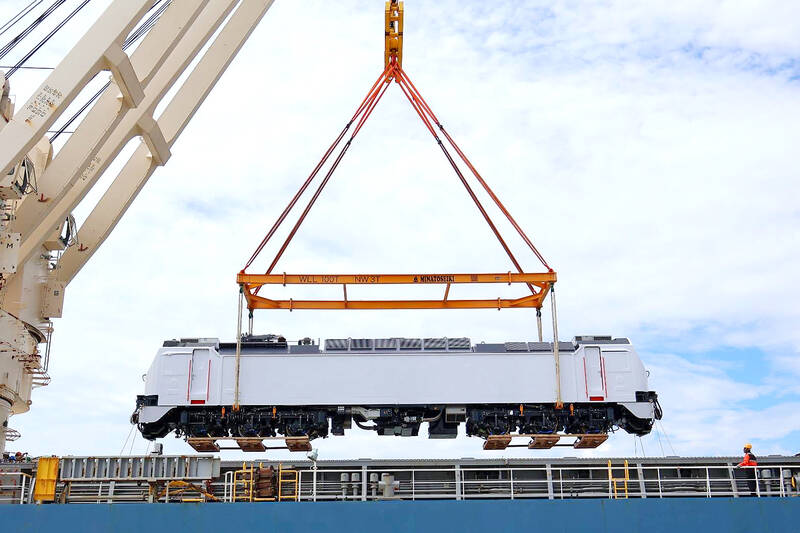
Photo courtesy of the Taiwan Railways Administration
The procurement of the locomotives is part of the TRA’s NT$100 billion (US$3.09 billion) investment plan, which focuses mainly on the purchase of approximately 1,300 new rolling-stock units from 2015 to next year.
Under the plan, TRA had ordered 102 locomotives — 68 electric E500s from Toshiba and 34 diesel-electric R200s from Stadler Rail of Switzerland.
The Stadler trains, which would be used for freight and military purposes, were unveiled in July and are likely to start operations by the end of this year, the TRA said.
When the Stadler contract was signed in 2019, the Swiss manufacturer said it was its first major tender for rolling stock in the Asia-Pacific region from its base in Europe.
“The locomotives will be used in demanding mountainous topography — similar to that of Switzerland — and in extreme climatic conditions,” then-Stadler CEO Thomas Ahlburg was quoted as saying in a news release at the time.

‘OBNOXIOUS MAN’: The KMT’s Chen Ching-hui moved into Chung Chia-pin’s path atop the podium and reached for him before he grabbed at her legs with both hands Democratic Progressive Party Legislator Chung Chia-pin (鍾佳濱) yesterday said he slipped and lost his balance, and did not know who was around him, after jumping onto the speaker’s podium at the legislature in Taipei. He apologized after a collision with Chinese Nationalist Party (KMT) Legislator Chen Ching-hui (陳菁徽), who moved to intercept him as he mounted the podium. There was pushing and shoving when the session started in the morning as KMT lawmakers attempted to block access to the podium to shield Legislative Speaker Han Kuo-yu (韓國瑜) so he could preside over the session. Video footage showed Chung step on a chair and

Police officers yesterday morning apprehended the prime suspect of a triple homicide case, after raiding the suspect’s hideout in Taichung. They transported the suspect to New Taipei City for questioning and recorded his statement last night. The suspect, identified as a 24-year-old man surnamed Chang (張), is believed to have used his hands to strangle his wife, surnamed Chen (陳), 29, along with his three-year-old son from a previous marriage and his wife’s mother, 69. The three dead bodies were wrapped in blankets when they were discovered inside their apartment in New Taipei City’s Sanchong District (三重) on Saturday. Chang was holding a

Hungarian Member of Parliament Tompos Marton said he considers Taiwan to be a better alternative to China as a strategic partner. Marton, who is the vice president of the opposition Momentum Party, made the remarks in an interview with the Central News Agency on Sunday. He draped a Republic of China flag across his shoulders to protest Chinese President Xi Jinping’s (習近平) visit to the capital city, Budapest, on Thursday last week, and openly voiced support for Taiwan on social media. He said in the interview that he wanted to remind the world that there were alternatives to China, and that “Taiwan has

A female physician at New Taipei City’s Shuang Ho Hospital was bullied and made to work for 32 consecutive hours by a senior colleague while pregnant before later having a miscarriage, an internal investigation found, the hospital said on Monday. The perpetrator has been removed from his post, the hospital said. The attending physician in the hospital’s Medical Imaging Department, identified by the pseudonym Y, earlier on Monday told reporters that she had been bullied by a male senior colleague who arranged shifts in her department. In January, shortly after she became pregnant, Y asked the department director if she could avoid overnight


 RSS
RSS