


The Taiwan People’s Party (TPP) on Tuesday proposed two methods of conducting polls to determine whether the TPP’s Ko Wen-je (柯文哲) or the Chinese Nationalist Party’s (KMT) Hou You-yi (侯友宜) is the strongest candidate to run against Vice President William Lai (賴清德), the Democratic Progressive Party (DPP) presidential candidate, in the Jan. 13 presidential election.
The TPP also called for Hon Hai Precision Industry Co founder Terry Gou (郭台銘), an independent presidential hopeful, to be included in the polls.
The proposals were unveiled at a news conference at TPP headquarters by former Taipei deputy mayor Vivian Huang (黃珊珊), Ko’s campaign manager.
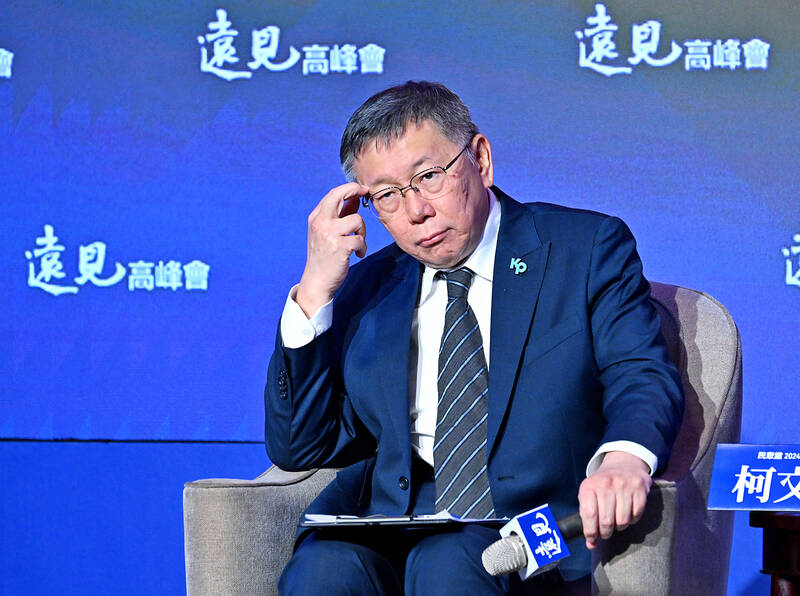
Photo: Liu Shin-de, Taipei Times
The move came after the TPP, an opposition party formed in 2019 by Ko, on Sunday rejected the KMT’s proposal a day earlier that an open primary be held to determine who would be the opposition’s candidate if the two parties join forces.
The two parties originally said they would schedule a second meeting by noon on Sunday last week to discuss the matter, but that plan has been put on hold.
With less than 90 days remaining to the presidential election in January, recent polls indicate a likely win for Lai, while Hou and Ko compete to claim second place, and Gou trails in last place.
According the polls, cooperation between Ko and Hou could be crucial for an opposition candidate to win the presidential election.
The TPP’s proposals suggest that five pollsters would be hired to conduct polls with 3,000 samples each, half conducted by landline and the other half through mobile phones, or all via mobile phone.
However, to avoid any manipulation, the pollsters commissioned would only be announced at a later time, and the survey time frame would not be made public.
Individuals receiving such information would need to sign a nondisclosure agreement, and the polls should be counted null, if anyone breaches the confidentiality agreement, the proposals suggest.
According to the TPP’s first proposal, Hou, Ko and Gou would be pitted against Lai, and their support in this setting contributes to 50 percent of the final score.
Respondents would also be asked whom they would back if the election were a three-way race between Hou, Ko and Gou, and the responses would account for the other 50 percent of the final score.
The second proposal suggests Ko, Hou and Gou be pitted against Lai individually, and whoever receives the highest support be the candidate, regardless of his success against Lai in the polls.
The deadline for political parties to register their presidential candidate with the Central Election Commission is Nov. 24, and the KMT’s proposal to hold an open primary is too time-consuming and costly to carry out, Huang said, adding that the method would also leave the presidential hopefuls underrepresented.
Asked about the TPP’s proposed polling methods, King Pu-tsung (金溥聰), Hou’s campaign executive officer, told reporters that the TPP was “domineering” by expecting the KMT to go along with its proposals.
If the TPP attempts to force its plans on the KMT, there is no need to discuss the next step, King said.
Since the two parties are both seeking to form an alliance, he hopes they can work out an acceptable compromise, King added.


UPGRADE: The Kang Ding-class frigate is replacing its Chaparall missiles with Tien Chien II and Hua Yang VLS, which would provide it with long-range, 360° air defense Taiwan plans to produce 1,200 to 1,376 Hai Chien II missiles (海劍二, Sea Sword II) — also known as TC-2N — to serve as the standard air defense system of the navy’s surface combatant fleet, a source said yesterday. Last week, the Hai Chien II, the naval version of the Tien Kung II missile (天劍二, Sky Sword II), completed a live-fire test in waters off the National Chungshan Institute of Science and Technology’s Jiupeng facility (九鵬) in Pingtung County’s Manjhou Township (滿州). The MIM72 Chaparral and other dated air defense missiles that currently arm Taiwanese ships have inadequate range to combat Chinese

REASONS FOR TRAVEL: An assistant professor said that proposed amendments to penalize drivers if they used drugs overseas would not deter people from traveling People who operate a motor vehicle under the influence of marijuana would have their driver’s license revoked, even if they used the substance while overseas, the Ministry of Transportation and Communications said yesterday, citing proposed amendments to the Road Traffic Management and Penalty Act (道路交通管理處罰條例). The amendments would also authorize the government to revoke the licenses of people determined to have used Category 1 or Category 2 narcotics, even if they were not operating a vehicle while under the influence of drugs, as well as ban them from taking the license test for three years, the ministry said. People aged 18 or
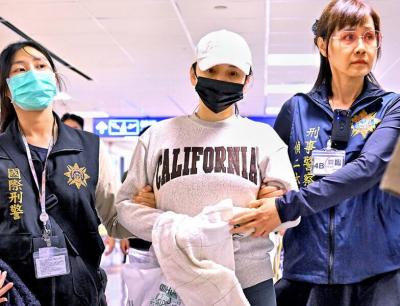
Johanne Liou (劉喬安), a Taiwanese woman who shot to unwanted fame during the Sunflower movement protests in 2014, returned to Taiwan last night after being deported from the US. She is to stand trial in Taiwan for charges involving embezzlement, fraud and drug crimes. The Criminal Investigation Bureau (CIB) said it took her into custody at Taiwan Taoyuan International Airport and would first question her before transferring her to the New Taipei District Prosecutors’ Office. She was arrested upon disembarking a flight from San Francisco that landed shortly before 7pm. Liou absconded to the US in 2019 after jumping bail
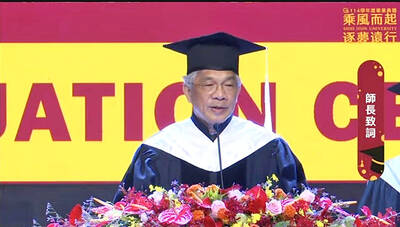
Shih Hsin University President Chen Ching-he (陳清河) yesterday issued a public apology for comments made in his commencement speech last week, stating that he has asked the school to suspend his duties and halt his wages for two months as a show of contrition. At the commencement ceremony on May 30, Chen said, “If you don’t manage your time well, or your own emotions, or your health, then I am telling every one of you — put a quick end to ‘you,’ because the world has no need for ‘you.’” The comments have sparked significant controversy online, and Chen through an open


 RSS
RSS