

Thousands of Chinese fans of Mandopop king Jay Chou (周杰倫) gathered on Sunday evening outside Shanghai Stadium before the final concert of the Taiwanese singer’s four-day run in the Chinese city.
Currently on the “Jay Chou Carnival World Tour 2023,” Chou has been performing at his Shanghai stop since Thursday.
Tickets to the four concerts, being held at the outdoor stadium with an 80,000 person capacity, were sold out in seconds when they became available online in the middle of last month.

Photo: CNA
Locals have described the concerts as catering to “80,000 inside [the stadium] and 100,000 outside” to express the sheer volume of “tailgaters” participating in the event around the stadium.
Those who had gathered outside the stadium were not tailgaters in the traditional sense, but were there simply to catch a glimpse of the concert’s flashing lights and hear snippets of Chou’s performance, which lasted about three hours every night.
Many of tailgaters were sporting Chou memorabilia, while others tried to gain access to commercial and residential buildings around the stadium to try and see some of the show.
The concert was one of the hottest topics on Chinese micro-blogging service Sina Weibo, with some residents around the concert venue jokingly offering their balconies as alternative nosebleed seats.
Chou’s Shanghai shows were such a big draw that local police were on high alert, setting up alternative pedestrian routes and barricades to direct traffic around the stadium.
To guarantee the rights of ticket holders, Chou’s Shanghai concert adopted a real-name system, which requires the person who purchased a set of tickets to be present when their group enters the stadium.
The system was used to try to prevent scalpers from grabbing a large number of tickets and reselling them at a profit.
On Chou’s stop in Tianjin, local media reported that tickets with a face value of 2,000 yuan (US$273.52) ended up being sold for 100,000 yuan by scalpers.
Chou is well known in countries with large Mandarin-speaking populations — including communities in the West where other Chinese languages such as Cantonese are spoken — as one of the most gifted Mandarin singer-songwriters of his generation.
Aside from creating famous songs such as Nocturne (夜曲) and Love Before BC (愛在西元前), Chou has also worked with renowned actors.
Hollywood actor Danny Trejo starred in Chou’s music video for Double Blade (雙刀), and the Taiwanese star wrote the theme song for martial arts superstar Jet Li’s (李連杰) kung fu masterpiece Fearless (霍元甲).
Many English-speaking audiences know Chou for costarring alongside Canadian comedian Seth Rogen in the 2011 The Green Hornet reboot as “Kato,” a character popularized by martial arts legend Bruce Lee (李小龍).
He also appeared in 2006’s Curse of the Golden Flower (滿城盡帶黃金甲), starring Hong Kong’s Chow Yun Fat (周潤發).

‘FRIENDSHIP FLEET’: A CGA official is scheduled to meet with the president of the Pacific nation, while one of the ships is to host a banquet and National Day event Two Coast Guard Administration (CGA) patrol vessels have docked at Malakal Harbor in Palau as part of an expedition exercise and diplomatic visit, during which a senior official is expected to meet with Palauan President Surangel Whipps Jr, the agency said yesterday. The two vessels, the 4,000-tonne-class Chiayi and the 1,000-tonne-class Penghu, set sail for Palau from Taiwan last week and arrived on Tuesday at Malakal Harbor, the CGA’s Fleet Branch said in a statement. The journey marks the second time the CGA has dispatched a “friendship fleet” to another country, after it sent its first-ever goodwill fleet, comprising the Hualien and

Two executives of drone supplier Jiin Ming Industry Co (錦明實業) have been detained and held incommunicado over the company's alleged use of prohibited China-made chips and camera lenses in drones supplied under recent military contracts, the Taoyuan District Prosecutors' Office said today. In a statement, prosecutors said they raided the offices of Jiin Ming — headquartered in Taoyuan — as well as those of its subsidiaries and its suppliers on Thursday last week. The raids followed a report that the company had breached its procurement contracts by putting the prohibited components into drones delivered to the military. During the raids, prosecutors summoned

The Coast Guard Administration (CGA) today said that two of its patrol vessels have docked at Palau's Malakal Harbor as part of an expedition exercise and diplomatic visit, during which a senior official is expected to meet with the Palauan president. The two vessels, the 4,000-tonne-class Chiayi (嘉義) and the 1,000-tonne-class Penghu (澎湖), set sail for Palau from Taiwan last week and arrived at Malakal Harbor yesterday, the CGA's Fleet Branch said in a statement. The journey marked the second time the CGA has dispatched a "Friendship Fleet" to another country, after it sent its first-ever goodwill fleet, comprising the Hualien (花蓮)
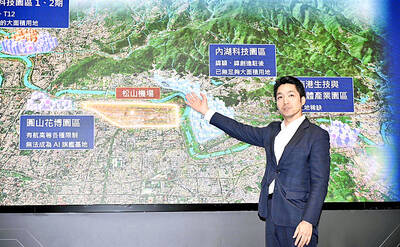
DETAILED PLAN NEEDED: Relocating the airport would affect not just travelers, but also undermine national defense and emergency medical services, a legislator said Taipei Mayor Chiang Wan-an (蔣萬安) yesterday proposed relocating Taipei International Airport (Songshan airport) and turning the site into an artificial intelligence (AI) park, drawing opposition from politicians across party lines. Chiang’s plan would turn the 300 hectares into an AI park featuring tech clusters, residential communities and green space. The industrial cluster would host 200 domestic enterprises, generate NT$12 trillion (US$376.47 billion) in output, and accommodate 65,000 jobs and 35,000 residents, he said. Cabinet spokeswoman Michelle Lee (李慧芝) said the Executive Yuan was surprised by the announcement, as the Taipei City Government did not discuss the proposal with the central government before making


 RSS
RSS