


There are substitutes for the seven types of drugs Taiwan imports from Israel, so people do not need to worry about a potential shortage amid war in the Middle East, the Food and Drug Administration (FDA) said yesterday.
The agency also reported that grapes from Japan were found to contain residue of an unauthorized pesticide.
Concerns have risen about possible effects on drug supplies from Israel after Hamas on Saturday launched a surprise attack on the nation, with Jerusalem on Sunday declaring war on the Palestinian militant group.
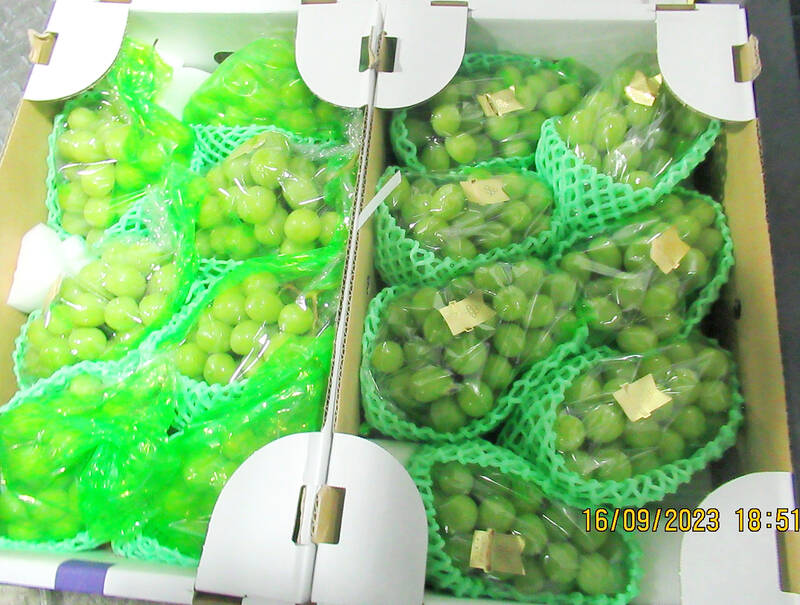
Photo: Chiu Chih-jou, Taipei Times
There are nine FDA-approved licenses for drugs manufactured in Israel, with seven still valid, but they are all generic drugs that Taiwan manufactures, the FDA said.
The seven include drugs to treat a skin infection, idiopathic Parkinson’s disease and relapsing or remitting multiple sclerosis, FDA Deputy Director Cheng Hwei-fang (陳惠芳) said.
As there are alternatives, the situation in Israel would not affect supply in the short term, Cheng said.
However, Israel is one of the world’s biggest manufacturers of generic drugs and also supplies ingredients, said Huang Yen-ju (黃彥儒), spokesman for the Federation of Taiwan Pharmacists’ Associations, adding that if the war is long, it might affect global supplies.
BORDER CHECKS
Separately, the FDA yesterday said 11 items have failed recent border inspections: grapes from Japan, shelled coconuts and two types of mangosteen from Thailand, two types of instant noodles from Vietnam, fried chicken sauce from South Korea, sorghum from Australia, and mung beans and two types of chili sauce from Indonesia.
A batch of Japanese grapes were found to have residue of pesticide cyclaniliprole, which is only approved for apples, Asian pears and tea, FDA Deputy Director Lin Chin-fu (林金富) said.
The batch had a residue concentration of 0.01 parts per million, with 250kg of grapes to be returned or destroyed, Lin said.
Three batches of the grapes have failed the inspection within a six-month period, so inspections would be conducted batch-by-batch until five consecutive batches pass, Lin said, adding that the five batches would be held to a standard three times stricter than normal.
Five batches of instant noodles from a Vietnamese company failed inspections over six months, so the inspection rate for goods imported by the company has been made batch-by-batch, he said.
Nine batches of mangosteen imported by six Thai companies failed inspections over six months, so the inspection rate for those companies has been increased, he added.
Additional reporting by CNA

Considering that most countries issue more than five denominations of banknotes, the central bank has decided to redesign all five denominations, the bank said as it prepares for the first major overhaul of the banknotes in more than 24 years. Central bank Governor Yang Chin-lung (楊金龍) is expected to report to the Legislative Yuan today on the bank’s operations and the redesign’s progress. The bank in a report sent to the legislature ahead of today’s meeting said it had commissioned a survey on the public’s preferences. Survey results showed that NT$100 and NT$1,000 banknotes are the most commonly used, while NT$200 and NT$2,000

The Centers for Disease Control (CDC) yesterday reported the first case of a new COVID-19 subvariant — BA.3.2 — in a 10-year-old Singaporean girl who had a fever upon arrival in Taiwan and tested positive for the disease. The girl left Taiwan on March 20 and the case did not have a direct impact on the local community, it said. The WHO added the BA.3.2 strain to its list of Variants Under Monitoring in December last year, but this was the first imported case of the COVID-19 variant in Taiwan, CDC Deputy Director-General Lin Ming-cheng (林明誠) said. The girl arrived in Taiwan on

South Korea is planning to revise its controversial electronic arrival card, a step Taiwanese officials said prompted them to hold off on planned retaliatory measures, a South Korean media report said yesterday. A Yonhap News Agency report said that the South Korean Ministry of Foreign Affairs is planning to remove the “previous departure place” and “next destination” fields from its e-arrival card system. The plan, reached after interagency consultations, is under review and aims to simplify entry procedures and align the electronic form with the paper version, a South Korean ministry official said. The fields — which appeared only on the electronic form

The Ministry of Foreign Affairs (MOFA) is suspending retaliation measures against South Korea that were set to take effect tomorrow, after Seoul said it is updating its e-arrival system, MOFA said today. The measures were to be a new round of retaliation after Taiwan on March 1 changed South Korea's designation on government-issued alien resident certificates held by South Korean nationals to "South Korea” from the "Republic of Korea," the country’s official name. The move came after months of protests to Seoul over its listing of Taiwan as "China (Taiwan)" in dropdown menus on its new online immigration entry system. MOFA last week


 RSS
RSS