


The government owes the public an apology for its failures over the past seven years and President Tsai Ing-wen’s (蔡英文) Double Ten National Day address was “arrogant from start to finish,” the Chinese Nationalist Party (KMT) said in a statement yesterday.
Tsai’s speech “creates a grand satire of the people’s impoverishment and the threat of war,” the KMT said.
The domestic policy achievements Tsai touted in her speech were failures, it said, adding that lives were lost needlessly in the COVID-19 pandemic, controversy surrounded the indigenous submarine program, public servants were “defamed” due to pension reform and there have been numerous power outages.
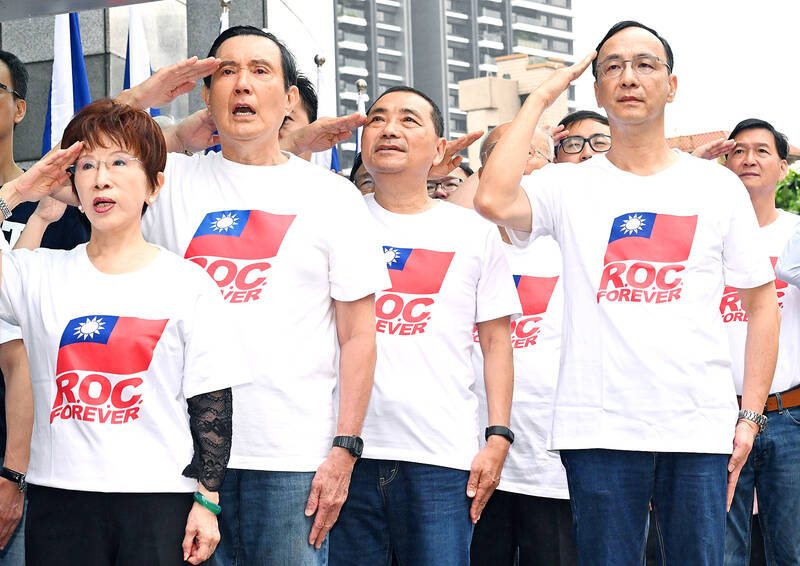
Photo: Lien Cheng-hui, Taipei Times
Instead of facing her poor domestic record, Tsai leaned on her diplomatic performance, utilizing “illusory intellectual language” to whitewash her lack of achievement, it said.
The international standing of the Republic of China (ROC) has actually diminished during the seven years under the Democratic Progressive Party (DPP), the KMT said, citing nine diplomatic allies that cut official ties and failure to secure invitations to the World Health Assembly and International Civil Aviation Organization.
The DPP administration brought cross-strait relations to their coldest point in 20 years, it said, adding that its policies are the main reason that Taiwanese face the threat of war.
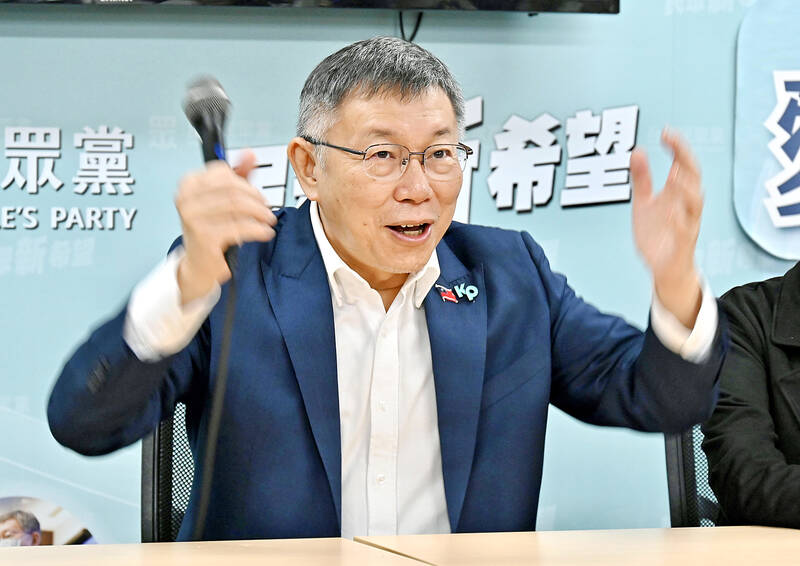
Photo: Tu Chien-rong, Taipei Times
Voters should usher in a change of power, as allowing the DPP to continue “would not only harm the ROC, but also the future of 23 million Taiwanese, and of global peace and stability,” it added.
Earlier yesterday, the KMT held its own flag-raising ceremony at its headquarters in Taipei, as party heavyweights joined former president Ma Ying-jeou (馬英九) in boycotting the government’s Double Ten National Day event over the use of “Taiwan” in its English title.
Ma, KMT Chairman Eric Chu (朱立倫), New Taipei City Mayor Hou You-yi (侯友宜) and Taipei Mayor Chiang Wan-an (蔣萬安) were among the party members at the morning event before they attended ceremonies in other areas governed by the KMT.
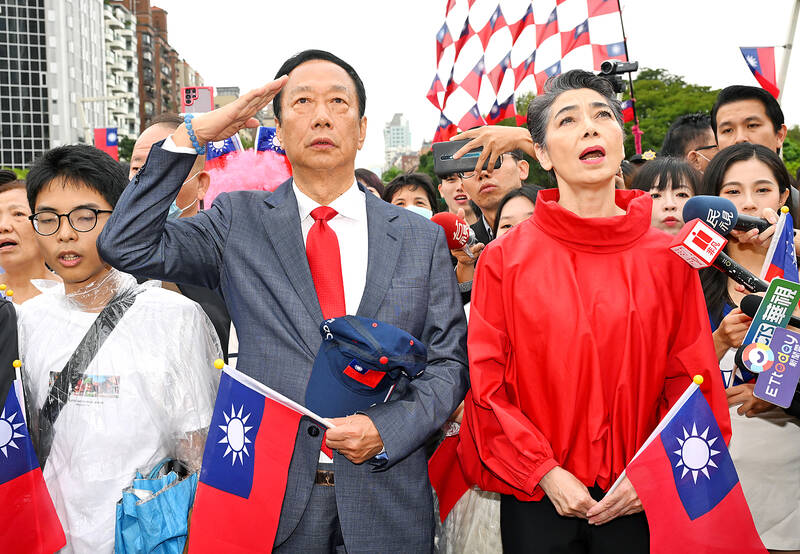
Photo: Tien Yu-hua, Taipei Times
Taiwan People’s Party Chairman Ko Wen-je (柯文哲), KMT Legislator Sufin Siluko (廖國棟), New Power Party Chairwoman Claire Wang (王婉瑜) and People First Party Chairman James Soong (宋楚瑜) participated in the main flag-raising ceremony outside the Presidential Office Building in Taipei.
Vice President William Lai (賴清德) vowed in a post on Facebook in response to Tsai’s final National Day speech as president to keep Taiwan peaceful, democratic and prosperous.
Lai is the DPP’s presidential nominee and the frontrunner in next year’s election, according to opinion polls.
The DPP is a responsible ruling party dedicated to stable development, and one that remembers its mission and values, Lai wrote, adding that the nation is walking on the right path thanks to the shared labor of 23 million Taiwanese.
Lai agreed with the formula to maintain peace Tsai spoke about, saying that fostering Taiwan’s international stature, solidifying a national consensus for dealing with Beijing and developing a mutually acceptable framework of interaction would be the keys to peaceful coexistence.
The nation remains committed to enabling both sides of the Taiwan Strait to become contributors to peace and stability in the region, he said.
Under his leadership, Taiwan would emphasize solidarity between democratic forces, solidarity across the political divide and solidarity with the global alliance for democracy in continuation of the president’s “four commitments,” Lai wrote.
Tsai’s four commitments are to maintain a free and democratic constitutional system, ensure Taiwan and China will not be subordinate to each other, resist annexation or encroachment on national sovereignty, and guarantee that Taiwanese alone will decide the nation’s future.
Lai reiterated that military deterrence, economic security, partnerships with other democratic countries, and principled and firm leadership would be the basis of Taiwan’s national security if he is elected.
“Supporters of Taiwan and the Republic of China must band together under the common denominator of national consensus of the Republic of China, Taiwan to safeguard our free and democratic way of life,” he wrote.
The guidance of the DPP government in the past seven years was not free of mistakes, but it has corrected all its errors with all possible haste in a spirit of gratitude for its supporters and critics, Lai said.
The National Hope Project of his campaign platform would seek to transform emerging challenges into opportunities for the nation to stay on its path of a free, democratic, prosperous and just society, he said.
Separately, Ko, the TPP’s presidential candidate, said that Taipei’s professed dedication to the “status quo” is at odds with its accusations that its opponents are colluding with China.
The part of Tsai’s speech he most agreed with was the last segment, in which the president affirmed that she would step down next year and that the nation would live on, Ko said.
Hon Hai Precision Industry Co founder Terry Gou (郭台銘), an independent presidential candidate, also attended the main ceremony.
The signatures his campaign has garnered to launch his presidential bid are evidence that Taiwanese are tired of conventional politics and want a government with an enterprising spirit, Gou told reporters on the sidelines of the ceremony.
For numerous Taiwanese businesspeople living abroad and other expatriates, the nation’s flag and anthem are a reminder of home, and an exhortation that they and their compatriots must strive side-by-side toward a better future, he said.
The honor and unity behind these symbols of the nation enabled Taiwan to prevail against challenges and build its high-tech economy, which helps protects its sovereignty, he said.
A renewed spirit is needed to overcome the crisis of energy transition and artificial intelligence the nation faces, Gou said.
“I salute the martyrs of the revolution, the hardworking civil servants and all my fellow citizens with my most sincere respect in our common pursuit to realize a peaceful, prosperous and honestly governed Taiwan,” he said.
Additional reporting by Lin Che-yuan and CNA

UPGRADE: The Kang Ding-class frigate is replacing its Chaparall missiles with Tien Chien II and Hua Yang VLS, which would provide it with long-range, 360° air defense Taiwan plans to produce 1,200 to 1,376 Hai Chien II missiles (海劍二, Sea Sword II) — also known as TC-2N — to serve as the standard air defense system of the navy’s surface combatant fleet, a source said yesterday. Last week, the Hai Chien II, the naval version of the Tien Kung II missile (天劍二, Sky Sword II), completed a live-fire test in waters off the National Chungshan Institute of Science and Technology’s Jiupeng facility (九鵬) in Pingtung County’s Manjhou Township (滿州). The MIM72 Chaparral and other dated air defense missiles that currently arm Taiwanese ships have inadequate range to combat Chinese

REASONS FOR TRAVEL: An assistant professor said that proposed amendments to penalize drivers if they used drugs overseas would not deter people from traveling People who operate a motor vehicle under the influence of marijuana would have their driver’s license revoked, even if they used the substance while overseas, the Ministry of Transportation and Communications said yesterday, citing proposed amendments to the Road Traffic Management and Penalty Act (道路交通管理處罰條例). The amendments would also authorize the government to revoke the licenses of people determined to have used Category 1 or Category 2 narcotics, even if they were not operating a vehicle while under the influence of drugs, as well as ban them from taking the license test for three years, the ministry said. People aged 18 or

HEAVY WEATHER: Typhoon Jangmi is due to crash straight into the Ryukyus as airlines look to shift flights to larger aircraft or cancel flights to Okinawa entirely Taiwan’s international air carriers announced flight adjustments over the weekend as Typhoon Jangmi is forecast to hit the Ryukyu Islands today and tomorrow. The Central Weather Administration (CWA) upgraded Jangmi from a tropical storm to a typhoon at 8am yesterday, with the eye located 580km south of Naha city. It was moving north at 19kph. Today, China Airlines’ CI-120, CI-121, CI-122 and CI-123 flights between Taoyuan and Naha, Okinawa, have been canceled as well as CI-132 and CI-133 between Kaohsiung and Naha. EVA Air’s BR-112, BR-113, BR-186 and BR-185 flights between Taoyuan and Naha are also canceled. Low-cost carrier Tigerair Taiwan canceled IT-230,
Johanne Liou (劉喬安), a Taiwanese woman who shot to unwanted fame during the Sunflower movement protests in 2014, returned to Taiwan last night after being deported from the US. She is to stand trial in Taiwan for charges involving embezzlement, fraud and drug crimes. The Criminal Investigation Bureau (CIB) said it took her into custody at Taiwan Taoyuan International Airport and would first question her before transferring her to the New Taipei District Prosecutors’ Office. She was arrested upon disembarking a flight from San Francisco that landed shortly before 7pm. Liou absconded to the US in 2019 after jumping bail


 RSS
RSS