


The air force should continue its project to build high-explosion-resistant hangars by changing the specifications of hangars or increasing the budget if it has trouble finding a contractor, retired air force lieutenant general Chang Yen-ting (張延廷) said.
Chang made the remarks after being asked to comment on a report published by the Legislative Yuan’s Budget Center, which discussed the project to preserve Taiwan’s air defense capabilities in the event of a war.
The project aimed to spend NT$4.392 billion (US$136.37 million) on building 36 high-explosion-resistant hangars at Ching Chuan Kang Air Base from 2020 to 2026, with each hangar designed to accommodate one fighter jet, the report said
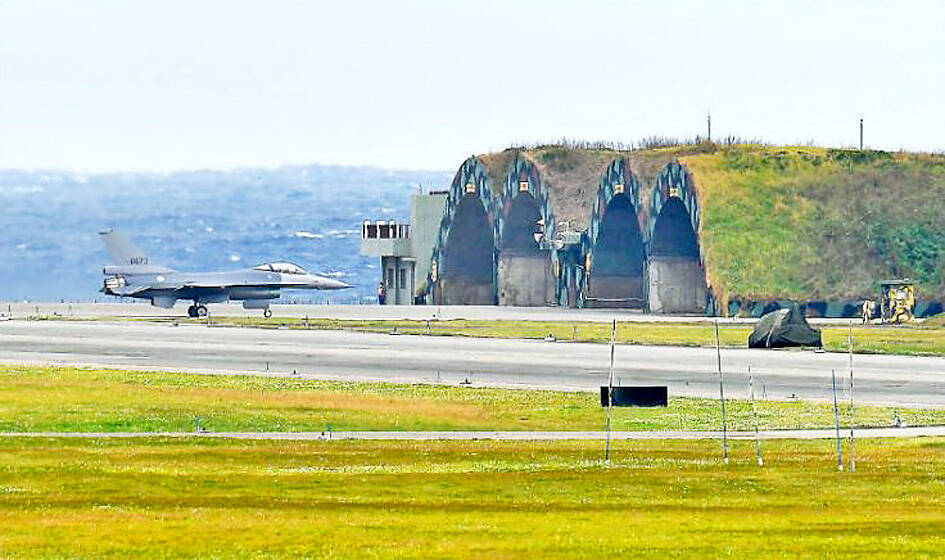
Photo: Taipei Times file
However, it twice failed to attract bidders in 2021. The Ministry of National Defense changed the scope to 24 hangars, with the aim of completing the project by 2027, but still no contractors participated in the bid last month, the report said.
Most air force hangars that are in use were built using traditional methods, which might not be able to withstand fierce attacks from guided missiles, cruise missiles and long-range rocket launchers from China, it said.
“Though it is necessary to build high-explosion-resistant hangars, it is questionable whether having only 24 of them built instead of 36 would still meet the wartime demands,” the report said.
Chang said that the upper part of old air force hangers is covered by earthwork and turf, but roots would often grow into the concrete, causing cracks and leaks.
“Leaks could form stalactites in hangars and can even drip onto the wings of fighter planes. Therefore, it is necessary to build new bomb-resistant hangars,” Chang said.
However, given the rising costs of construction materials and the difficulty of recruiting workers, the air force should consider adjusting the specifications of high-explosion-resistant hangars or increasing the budget to complete its original plan of having 36 new hangars built, he said.

FUKUOKA SITUATION: Japanese media reported that the pathogen is expected to be identified by the summer, while the CDC downplayed the idea that it was hMPV A “mysterious cold-like illness” reported in Japan’s Fukuoka Prefecture does not seem to be a new disease, but Japanese authorities have been asked about the situation, the Centers for Disease Control (CDC) said yesterday. The Fukuoka Prefectural Medical Association on Wednesday told a news conference that a “mystery cold” that has become a hot topic on social media is “highly likely to be caused by some kind of viral infection,” Japan’s KBC News reported. “Many people are experiencing symptoms starting with a sore throat, followed by a runny nose, phlegm and a severe cough,” KBC News reported, citing association officials. Health authorities are

Nvidia Corp CEO Jensen Huang (黃仁勳) arrived in Taiwan yesterday ahead of upcoming AI and technology events, saying he plans to meet with clients and Taiwan Semiconductor Manufacturing Co Chairman C.C. Wei (魏哲家) during his visit. After landing at Taipei Songshan Airport, Huang posed for photos with fans and handed out Yakult drinks to reporters and supporters waiting at the scene, saying he has “a lot to do” during the trip. Asked about reports that Nvidia’s planned headquarters site in Taipei’s Beitou Shilin Technology Park could break ground on May 27, Huang said that if the company holds an event, he would

The Ministry of Finance this afternoon announced the winning numbers for the March-April uniform invoice lottery. The winning number for the NT$10 million (US$318,060) special prize is 19531471, and the winning number for the NT$2 million grand prize is 85941329. Three numbers were drawn for the NT$200,000 first prize: 07225810, 20231230 and 83518781. Those with receipts matching the last seven digits of any of the first-prize numbers will win the NT$40,000 second prize, while those matching the last six digits will win the NT$10,000 third prize. Those whose receipts match the last five digits of the first-prize numbers can claim the NT$4,000 fourth prize,
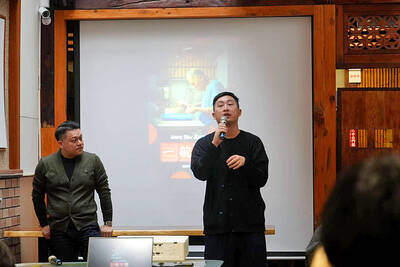
Taiwan Travelogue (臺灣漫遊錄), which earlier this week became the first Taiwanese novel to win the International Booker Prize, is to be adapted into a television series through a Taiwan-Japan coproduction, producer Chang Chen-yu (張辰漁) said yesterday. Chang, a producer at World Softest Production Film Co, wrote on Facebook that the company had been searching for projects with international appeal that retain a strong Taiwanese identity after colleagues and Japanese partners strongly recommended the novel. After reading the book, Chang said he immediately decided to pursue the screen rights. “A great story has the power to transcend time and borders, and connect countless people,”


 RSS
RSS