


Two Taiwanese defense academics offered their insights into the design of Taiwan’s first Indigenous Defense Submarine (IDS), the Hai Kun (海鯤), or “Narwhal” which made its debut on Thursday and was dubbed a milestone in Taiwan’s efforts to produce domestic submarines and achieve “defense autonomy.”
Su Tzu-yun (蘇紫雲) and Shu Hsiao-huang (舒孝煌) from the government-funded think tank Institute for National Defense and Security Research, both attended the launch ceremony at a shipyard in Kaohsiung belonging to CSBC Corp, Taiwan. The contractor for the IDS project said they believe the prototype is primarily based on the body of Japan’s Soryu-class submarines, while its sail, the superstructure that rises from the submarine’s deck, bears similarities to the UK’s Astute-class submarines.
CSBC chairman Cheng Wen-lon (鄭文 隆) said that the IDS prototype carries the pennant number “711” and features an X-shaped rudder, a departure from the cross-shaped rudder seen on previous models, giving it an edge over Taiwan’s other submarines in active service.
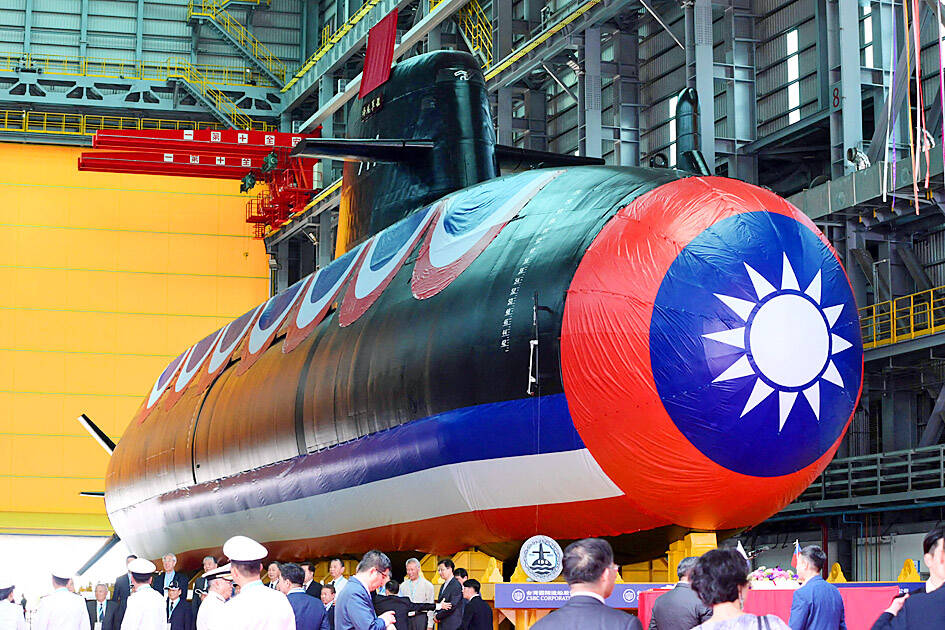
Photo: AFP
‘x’
Su said the Narwhal’s X-shaped tail and two horizontal stabilizers resemble the designs of Israeli’s Dolphin-class diesel-electric submarine.
The “X” shape has proven more maneuverable than the traditional cruciform shape. Meanwhile, the horizontal stabilizers provide better stability, handling and stealth, and allows for quicker emergency floats and dives, he said.
At Thursday’s ceremony, the bow of the submarine, along with the torpedo tubes and other critical components, were concealed beneath a Taiwanese flag. Cheng said this measure was taken to prevent the disclosure of many confidential parts of the submarine for security reasons, pending further testing.
When asked why the navy chose to cover the Narwhal’s tail during the ceremony, Shu said that “enemy forces” could estimate the prototype’s underwater speed and acoustic fingerprints by observing its number of propellers, their angles and structural designs.
Besides its weapons system and propeller designs, both Su and Shu said it was important to closely monitor the indigenous submarine’s sonar system, which was also concealed for security reasons.
SONAR
The academics said that modern submarines, including the Narwhal, have a bow array sonar as main sonar sensor, and a passive “incept sonar” system to detect sound waves approaching it.
The Narwhal also boasts a flank sonar array mounted symmetrically on the port and starboard sides, enhancing detection characteristics at low frequencies thanks to the increased array aperture.
The flank sonar array provides the submarine with “eyes on its two sides,” significantly expanding its range capabilities and performance, Shu added.
Meanwhile, Su discussed his understanding of why the designers of the IDS prototype opted for the traditional deep-cycle flooded/wet lead-acid battery over the more advanced air-independent propulsion system, a marine propulsion technology that allows a non-nuclear submarine to operate without access to atmospheric oxygen.
Though the wet lead-acid battery has a shorter lifespan, it is more stable and reliable to operate, which is a priority for Taiwan’s first IDS, he said.
Retired admiral Huang Shu-kuang (黃曙光) said that following the ceremony, the prototype would undergo a harbor acceptance test, followed by a sea acceptance test, and is expected to be delivered to the navy before the end of 2024.

FUKUOKA SITUATION: Japanese media reported that the pathogen is expected to be identified by the summer, while the CDC downplayed the idea that it was hMPV A “mysterious cold-like illness” reported in Japan’s Fukuoka Prefecture does not seem to be a new disease, but Japanese authorities have been asked about the situation, the Centers for Disease Control (CDC) said yesterday. The Fukuoka Prefectural Medical Association on Wednesday told a news conference that a “mystery cold” that has become a hot topic on social media is “highly likely to be caused by some kind of viral infection,” Japan’s KBC News reported. “Many people are experiencing symptoms starting with a sore throat, followed by a runny nose, phlegm and a severe cough,” KBC News reported, citing association officials. Health authorities are

Nvidia Corp CEO Jensen Huang (黃仁勳) arrived in Taiwan yesterday ahead of upcoming AI and technology events, saying he plans to meet with clients and Taiwan Semiconductor Manufacturing Co Chairman C.C. Wei (魏哲家) during his visit. After landing at Taipei Songshan Airport, Huang posed for photos with fans and handed out Yakult drinks to reporters and supporters waiting at the scene, saying he has “a lot to do” during the trip. Asked about reports that Nvidia’s planned headquarters site in Taipei’s Beitou Shilin Technology Park could break ground on May 27, Huang said that if the company holds an event, he would

The Ministry of Finance this afternoon announced the winning numbers for the March-April uniform invoice lottery. The winning number for the NT$10 million (US$318,060) special prize is 19531471, and the winning number for the NT$2 million grand prize is 85941329. Three numbers were drawn for the NT$200,000 first prize: 07225810, 20231230 and 83518781. Those with receipts matching the last seven digits of any of the first-prize numbers will win the NT$40,000 second prize, while those matching the last six digits will win the NT$10,000 third prize. Those whose receipts match the last five digits of the first-prize numbers can claim the NT$4,000 fourth prize,
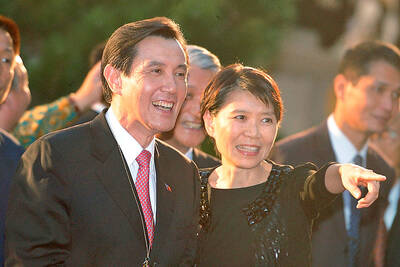
Former president Ma Ying-jeou (馬英九) yesterday expressed “shock and regret” over a statement issued by his wife without his consent, and rejected her assertion that his eldest sister, Ma Yi-nan (馬以南), would manage his medical care or act as his spokesperson amid an ongoing embezzlement probe into his foundation. Ma Ying-jeou in a statement said he was shocked by a statement by his wife, Chou Mei-ching (周美青), regarding his affairs. Ma Yi-nan “must not” be in charge of his healthcare and other personal affairs, nor can she be allowed to represent the Ma family, the former president said. He said he was also


 RSS
RSS