


Local governments need to step up enforcement of building codes to address the pervasive spread of illegally constructed additions, a legislative report released this week said.
The report from the Legislative Yuan’s Budget Center said the latest available data indicate that local governments in the past few years have been lagging in their efforts to crack down on and remove illegal structures.
The number of cases involving illegal structures nationwide has increased by 52,084 from 664,288 at the end of 2017 to 716,372 at the end of July, the report said, citing Ministry of the Interior data.
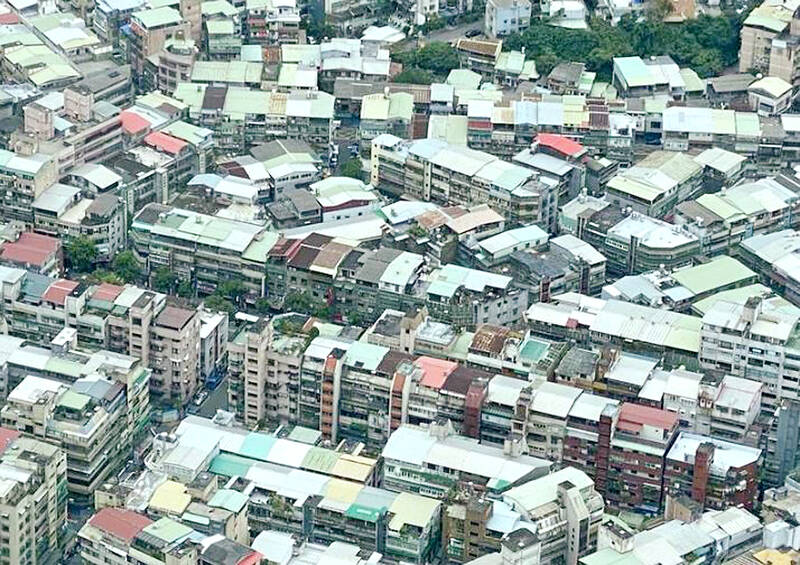
Photo: Taipei Times
New Taipei City has the most listed cases at 186,073, making up 25.97 percent of the total, followed by Kaohsiung with 119,200, Taichung with 102,917 and Taipei with 82,525, the data showed.
Illegal buildings and structures have been a blight on urban centers for decades, endangering public safety and tainting city skylines with their unsightly, dilapidated appearance, ministry officials have said.
From 2019 to July this year, only New Taipei City, Tainan and Kaohsiung had reported a decline in cases of illegal buildings and structures, while in other areas reports have increased, the data showed.
Taichung has the most new cases, 13,445 more than in 2019, followed by Taoyuan with 5,959 new cases, Pingtung County with 4,136 and Hsinchu City with 2,270, records show.
Kaohsiung has reported the highest decline in listed illegal cases at 2,533, followed by a 1,181 decrease in cases by New Taipei City.
Strong enforcement is needed to ensure people’s safety, and to protect against fires and other disasters due to illegal structures, the report said, adding that the closure rate of illegal structure cases has been low in the past few years.
From 2017 to last year, about 30,303 to 43,743 cases were resolved each year, or about 4.44 percent to 6.58 percent of all cases, interior ministry data showed.
As of July, about 20,227 cases have been resolved, while last year 5.38 percent were resolved, much less than 2017’s 6.58 percent, the report said.
Local governments need to improve their efficiency in addressing cases of illegal structures, with improved enforcement and the demolition of structures when necessary, it said.
The authorities that oversee the agencies responsible for building code enforcement should incorporate the resolution rate of cases into annual performance reviews of civil servants and officials, it added.
Under the Regulations for the Handling of Illegal Structures (違章建築處理辦法) and the Building Act (建築法), building owners and developers must apply for approval from local authorities and receive a building permit before construction. Any construction or addition to a building made without a permit is considered illegal, including shelters on roofs, balcony or patio extensions, or the addition of a mezzanine.


UPGRADE: The Kang Ding-class frigate is replacing its Chaparall missiles with Tien Chien II and Hua Yang VLS, which would provide it with long-range, 360° air defense Taiwan plans to produce 1,200 to 1,376 Hai Chien II missiles (海劍二, Sea Sword II) — also known as TC-2N — to serve as the standard air defense system of the navy’s surface combatant fleet, a source said yesterday. Last week, the Hai Chien II, the naval version of the Tien Kung II missile (天劍二, Sky Sword II), completed a live-fire test in waters off the National Chungshan Institute of Science and Technology’s Jiupeng facility (九鵬) in Pingtung County’s Manjhou Township (滿州). The MIM72 Chaparral and other dated air defense missiles that currently arm Taiwanese ships have inadequate range to combat Chinese

REASONS FOR TRAVEL: An assistant professor said that proposed amendments to penalize drivers if they used drugs overseas would not deter people from traveling People who operate a motor vehicle under the influence of marijuana would have their driver’s license revoked, even if they used the substance while overseas, the Ministry of Transportation and Communications said yesterday, citing proposed amendments to the Road Traffic Management and Penalty Act (道路交通管理處罰條例). The amendments would also authorize the government to revoke the licenses of people determined to have used Category 1 or Category 2 narcotics, even if they were not operating a vehicle while under the influence of drugs, as well as ban them from taking the license test for three years, the ministry said. People aged 18 or
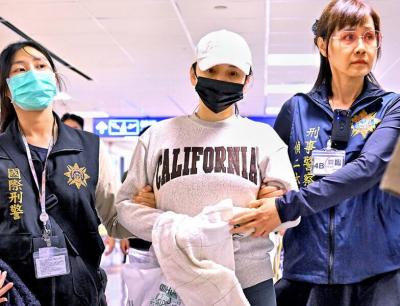
Johanne Liou (劉喬安), a Taiwanese woman who shot to unwanted fame during the Sunflower movement protests in 2014, returned to Taiwan last night after being deported from the US. She is to stand trial in Taiwan for charges involving embezzlement, fraud and drug crimes. The Criminal Investigation Bureau (CIB) said it took her into custody at Taiwan Taoyuan International Airport and would first question her before transferring her to the New Taipei District Prosecutors’ Office. She was arrested upon disembarking a flight from San Francisco that landed shortly before 7pm. Liou absconded to the US in 2019 after jumping bail

Shih Hsin University President Chen Ching-he (陳清河) yesterday issued a public apology for comments made in his commencement speech last week, stating that he has asked the school to suspend his duties and halt his wages for two months as a show of contrition. At the commencement ceremony on May 30, Chen said, “If you don’t manage your time well, or your own emotions, or your health, then I am telling every one of you — put a quick end to ‘you,’ because the world has no need for ‘you.’” The comments have sparked significant controversy online, and Chen through an open


 RSS
RSS