


Rights advocates yesterday called for changes in regulations on uniforms for police and revisions to the Public Servants’ Safety and Health Protection Act (公務人員安全及衛生防護辦法) after a police officer in Taichung died in July allegedly from heat exhaustion.
Democratic Progressive Party (DPP) Legislator Lin Shu-fen (林淑芬), accompanied by representatives from the Taiwan Police Union and the National Association for Firefighters’ Rights, demanded that the Ministry of Labor’s measures to prevent heat injuries should apply to all public servants and that government agencies should be fined for failing to protect employees.
Lin also said the National Police Agency (NPA) should propose similar heat-injury preventive measures as stated under the act, and that Taiwan’s police force should follow Germany’s lead and abolish standing regulations on changing uniforms based on seasons.
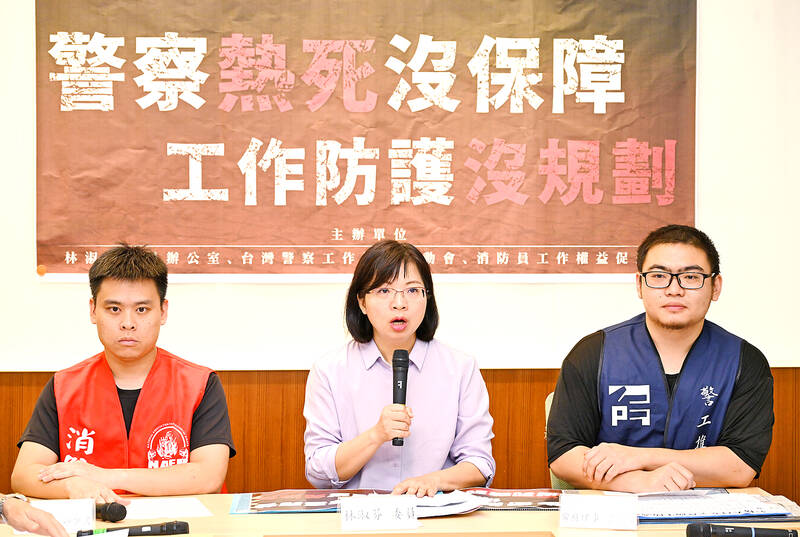
Photo: Tien Yu-hua, Taipei Times
Heat injuries are a severe threat to the health of police officers on duty and in the field, but current laws on preventing heat-related injuries are lagging behind times, Lin said.
Heat-injury prevention measures should focus on the work environment and field work hours should be adjusted to promote and enforce the concept of heat-injury prevention, she said.
Lin urged the Civil Service Protection and Training Commission to make a list of public agencies at the most risk of heat injuries and prioritize efforts to assist such agencies by drafting and implementing measures that would protect workers against heat injuries.
Taiwan Police Union member Hsiao Jen-hao (蕭仁豪) said that the death of a police officer in July was not an isolated incident, and yet the government is apathetic to the potential dangers of heat injuries.
Abolishing unreasonable, unrealistic uniform regulations can provide a simple solution, as well as sorely needed guarantees for officers’ health, he said.
National Association for Firefighters’ Rights deputy director Cheng Shao-shu (鄭少書) said it was odd that the top-bottom system of the NPA failed to address concerns over heat injuries for its officers, especially when they could reference preventive measures that firefighters have implemented.
The Civil Service Protection and Training Commission said it was mulling amendments to the Public Servants’ Safety and Health Protection Act to include specific sections on dangerous missions for police and firefighters.
The NPA said it would announce before Oct. 16 — when officers usually change their seasonal uniforms — that they can decide to wear short or long-sleeved uniforms.

Yangmingshan National Park authorities yesterday urged visitors to respect public spaces and obey the law after a couple was caught on a camera livestream having sex at the park’s Qingtiangang (擎天崗) earlier in the day. The Shilin Police Precinct in Taipei said it has identified a suspect and his vehicle registration number, and would summon him for questioning. The case would be handled in accordance with public indecency charges, it added. The couple entered the park at about 11pm on Thursday and began fooling around by 1am yesterday, the police said, adding that the two were unaware of the park’s all-day live

Fast food chain McDonald's is to raise prices by up to NT$5 on some products at its restaurants across Taiwan, starting on Wednesday next week, the company announced today. The prices of all extra value meals and sharing boxes are to increase by NT$5, while breakfast combos and creamy corn soup would go up by NT$3, the company said in a statement. The price of the main items of those meals, if ordered individually, would remain the same. Meanwhile, the price of a medium-sized lemon iced tea and hot cappuccino would rise by NT$3, extra dipping sauces for chicken nuggets would go up
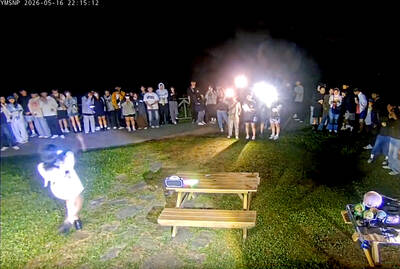
Yangmingshan National Park’s Qingtiangang (擎天崗) nature area has gone viral after a park livestream camera observed a couple in the throes of intimate congress, which was broadcast live on YouTube, drawing large late-night crowds and sparking a backlash over noise, bright lights and disruption to wildlife habitat. The area’s livestream footage appeared to show a couple engaging in sexual activity on a picnic table in the park on Friday last week, with the uncensored footage streamed publicly online. The footage quickly spread across social media, prompting a tide of visitors to travel to the site to “check in” and recreate the

Minister of Digital Affairs Lin Yi-ching (林宜敬) yesterday cited regulatory issues and national security concerns as an expert said that Taiwan is among the few Asian regions without Starlink. Lin made the remarks on Facebook after funP Innovation Group chief executive officer Nathan Chiu (邱繼弘) on Friday said Taiwan and four other countries in Asia — China, North Korea, Afghanistan and Syria — have no access to Starlink. Starlink has become available in 166 countries worldwide, including Ukraine, Malaysia, the Philippines and Vietnam, in the six years since it became commercial, he said. While China and North Korea block Starlink, Syria is not


 RSS
RSS