


The Taipei Department of Health yesterday confirmed that it had received a report that actress Tammy Lai (賴佩霞), the running mate of independent presidential candidate Terry Gou (郭台銘), had allegedly been charging for one-on-one counseling sessions without a license.
Since Hon Hai Precision Industry Co founder Gou announced Lai as his running mate on Thursday, the authenticity of Lai’s education and expertise has sparked speculation among political pundits and online.
One political pundit said Lai’s official Web site, titled “Dr Lai Pei-hsia,” lists “mental consultant” under her experience and says she offers paid counseling sessions and spiritual lessons, although she has only received a certificate in hypnosis for a 12-day course from the National Guild of Hypnotists.
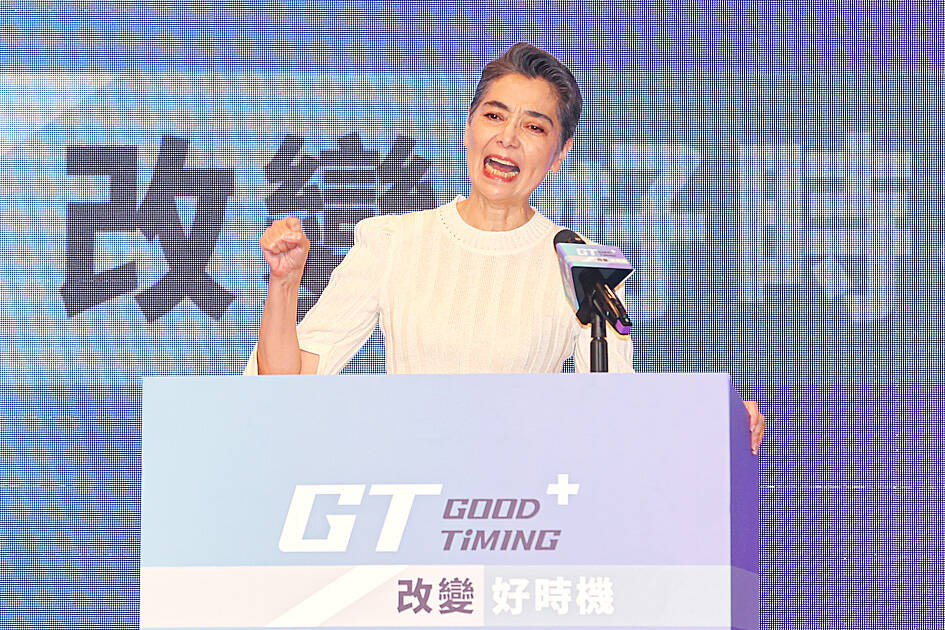
Photo: CNA
A licensed psychologist asked whether Lai had been providing psychotherapy or counseling without a license, as she offered 80-minute one-on-one sessions for NT$23,000 and other workshops relating to mental health, also at relatively high prices, and used psychotherapy terms to describe the services.
The Taiwan Counseling Psychologist Union on Sunday issued a statement giving pointers to people who are in need of counseling.
People who need counseling are advised to search the Ministry of Health and Welfare’s medical affairs personnel inquiry system (ma.mohw.gov.tw/masearch/SearchDOC-101-1.aspx) to ensure the service provider is a licensed psychologist, it said.
However, only a nurse could be found when searching for “Lai Pei-hsia” in the inquiry system.
The union also said that people who want to become psychologist must follow the Psychologists Act (心理師法), completed the relevant master’s program and internship and pass the Ministry of Examination’s national exam to receive a certificate, then join a local psychologist association and register with a facility approved by the health ministry.
Psychologists are governed by the act and ethical guidelines, as well as the local associations, it said, adding that people who do not have the qualifications but offer psychologist services can be penalized or sent to prison.
Author Hedy Lee (李文) yesterday shared on Facebook screenshots of Lai’s official Web site, and wrote that she has reported Lai to the Taipei Department of Health on suspicion of contravening the Psychologists Act and Physicians’ Act (醫師法).
Lee said she had noticed that the wording on Lai’s Web site had been changed over the past few days.
Lai in a video on Facebook yesterday said that she received qualifications as psychological counselor and corporate trainer in China in 2011, but she had never practiced in Taiwan, so she is a coach for top executives.
The Taipei Department of Health yesterday confirmed that it received a report, saying its initial assessment found that there was no direct evidence that Lai had contravened the Psychologists Act, although it would look into the case to determine whether Lai’s Web site had been misleading.

Considering that most countries issue more than five denominations of banknotes, the central bank has decided to redesign all five denominations, the bank said as it prepares for the first major overhaul of the banknotes in more than 24 years. Central bank Governor Yang Chin-lung (楊金龍) is expected to report to the Legislative Yuan today on the bank’s operations and the redesign’s progress. The bank in a report sent to the legislature ahead of today’s meeting said it had commissioned a survey on the public’s preferences. Survey results showed that NT$100 and NT$1,000 banknotes are the most commonly used, while NT$200 and NT$2,000

The Centers for Disease Control (CDC) yesterday reported the first case of a new COVID-19 subvariant — BA.3.2 — in a 10-year-old Singaporean girl who had a fever upon arrival in Taiwan and tested positive for the disease. The girl left Taiwan on March 20 and the case did not have a direct impact on the local community, it said. The WHO added the BA.3.2 strain to its list of Variants Under Monitoring in December last year, but this was the first imported case of the COVID-19 variant in Taiwan, CDC Deputy Director-General Lin Ming-cheng (林明誠) said. The girl arrived in Taiwan on

South Korea is planning to revise its controversial electronic arrival card, a step Taiwanese officials said prompted them to hold off on planned retaliatory measures, a South Korean media report said yesterday. A Yonhap News Agency report said that the South Korean Ministry of Foreign Affairs is planning to remove the “previous departure place” and “next destination” fields from its e-arrival card system. The plan, reached after interagency consultations, is under review and aims to simplify entry procedures and align the electronic form with the paper version, a South Korean ministry official said. The fields — which appeared only on the electronic form

The Ministry of Foreign Affairs (MOFA) is suspending retaliation measures against South Korea that were set to take effect tomorrow, after Seoul said it is updating its e-arrival system, MOFA said today. The measures were to be a new round of retaliation after Taiwan on March 1 changed South Korea's designation on government-issued alien resident certificates held by South Korean nationals to "South Korea” from the "Republic of Korea," the country’s official name. The move came after months of protests to Seoul over its listing of Taiwan as "China (Taiwan)" in dropdown menus on its new online immigration entry system. MOFA last week


 RSS
RSS