


Noted authors and Morrison Lee (李孟居), who served a 22-month prison sentence in China on espionage charges, yesterday urged presidential election candidates to propose measures to guarantee the personal safety of Taiwanese visiting China, to avoid further cases of “hostage diplomacy.”
Authors Li Ang (李昂) and Chu Yu-hsun (朱宥勳) joined Lee and other figures in the arts and humanities at a news conference in Taipei protesting China’s arrest of Gusa Press (八旗文化) editor-in-chief Lee Yanhe (李延賀), also known by his penname Fucha (富察).
For those in a democratic country who abide by the rule of law, China’s arrest of Lee was illegal, Support Fucha Signature Drive member Joshua Wang (王家軒) said.
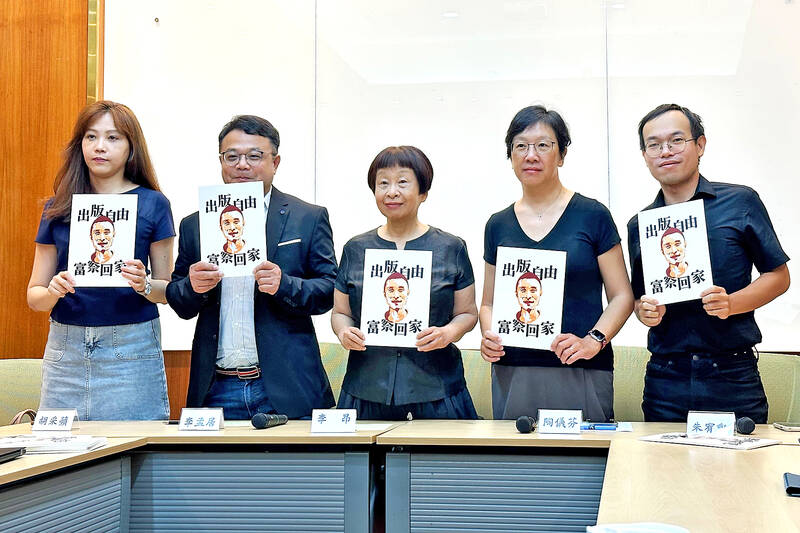
Photo: Chen Cheng-yu, Taipei Times
The incident has caused people who have business dealings in China to face significant stress, as they now see that Beijing can arrest people for political reasons and not legal violations, he said.
The Support Fucha Signature Drive group has more than 300 members, Li said.
Cross-strait efforts in promoting academic and cultural interactions have been plagued with uncertainties, and Chinese customs officers have been questioning people, she said.
She urged all four presidential candidates to give due attention to such issues and to say what measures they would take to help protect Taiwanese visiting China for academic interactions.
She said she hoped to hear back from the candidates by Thursday next week, which would mark a full half-year since Fucha had been arrested.
There are many other Taiwanese detained in China, Morrison Lee said, adding that he hoped the presidential candidates would have the courage to call China out on its “illicit” actions.
Taiwan could be the base of an international support platform to help those who have been “disappeared” by the Chinese government, Morrison Lee said.
He urged China’s Taiwan Affairs Office to provide a list of “sensitive topics and phrases,” adding that without such action, no one would dare visit China again.
Morrison Lee also urged Taipei Mayor Chiang Wan-an (蔣萬安) to include human rights issues in next year’s Twin-City Forum.
“There must be interaction across the Taiwan Strait, and the overhanging shadow must be removed. We hope that a politician with guts would be able to achieve this goal,” Morrison Lee added.
Chu said that there was little that Taiwan could do to change China’s policies, but the presidential candidates could express their stance on such matters.
“If one is arrested and persecuted for no reason when on an exchange, you [the candidates] must side with us, the people of culture and the humanities, instead of first asking if we crossed a red line and said something we should not have,” he said.
Chen Shih-kai (陳世凱), spokesman of Democratic Progressive Party presidential candidate William Lai’s (賴清德) office, said the party is dedicated to upholding Taiwanese sovereignty, democracy and liberty.
The party is dedicated to maintaining peace and stability in the Taiwan Strait, the act of which contributes to the protection of the basic human rights of Taiwanese, he said.
In light of the Fucha case and similar incidents, he said that the Mainland Affairs Council has prepared a list of actions that might cause problems with Chinese national security agencies.
The council has repeatedly urged people not to visit China unless necessary to minimize the possibility of one’s personal liberties and freedom being oppressed, he added.
Additional reporting by CNA

Considering that most countries issue more than five denominations of banknotes, the central bank has decided to redesign all five denominations, the bank said as it prepares for the first major overhaul of the banknotes in more than 24 years. Central bank Governor Yang Chin-lung (楊金龍) is expected to report to the Legislative Yuan today on the bank’s operations and the redesign’s progress. The bank in a report sent to the legislature ahead of today’s meeting said it had commissioned a survey on the public’s preferences. Survey results showed that NT$100 and NT$1,000 banknotes are the most commonly used, while NT$200 and NT$2,000

The Centers for Disease Control (CDC) yesterday reported the first case of a new COVID-19 subvariant — BA.3.2 — in a 10-year-old Singaporean girl who had a fever upon arrival in Taiwan and tested positive for the disease. The girl left Taiwan on March 20 and the case did not have a direct impact on the local community, it said. The WHO added the BA.3.2 strain to its list of Variants Under Monitoring in December last year, but this was the first imported case of the COVID-19 variant in Taiwan, CDC Deputy Director-General Lin Ming-cheng (林明誠) said. The girl arrived in Taiwan on

South Korea is planning to revise its controversial electronic arrival card, a step Taiwanese officials said prompted them to hold off on planned retaliatory measures, a South Korean media report said yesterday. A Yonhap News Agency report said that the South Korean Ministry of Foreign Affairs is planning to remove the “previous departure place” and “next destination” fields from its e-arrival card system. The plan, reached after interagency consultations, is under review and aims to simplify entry procedures and align the electronic form with the paper version, a South Korean ministry official said. The fields — which appeared only on the electronic form

The Ministry of Foreign Affairs (MOFA) is suspending retaliation measures against South Korea that were set to take effect tomorrow, after Seoul said it is updating its e-arrival system, MOFA said today. The measures were to be a new round of retaliation after Taiwan on March 1 changed South Korea's designation on government-issued alien resident certificates held by South Korean nationals to "South Korea” from the "Republic of Korea," the country’s official name. The move came after months of protests to Seoul over its listing of Taiwan as "China (Taiwan)" in dropdown menus on its new online immigration entry system. MOFA last week


 RSS
RSS