


As more girls who received human papillomavirus (HPV) vaccines have won their vaccine injury compensation lawsuits, Taiwan Women’s Link secretary-general Huang Sue-ying (黃淑英) and Democratic Progressive Party Legislator Lin Shu-fen (林淑芬) yesterday urged the Ministry of Health and Welfare not to appeal the cases.
From 2019 to last year, there were 46 vaccine injury compensation applications for suspected adverse reactions to HPV vaccines, Huang said.
Thirty-nine of the applications have been reviewed, with the majority of them involving girls under the age of 16 who were diagnosed with an autoimmune disease after receiving an HPV vaccination, she said.

Photo: Tien Yu-hua, Taipei Times
Of those who sought assistance from Taiwan Women’s Link, most were girls aged 11 to 16, and 10 had been diagnosed with rheumatoid arthritis, Huang said.
They experienced muscle weakness, joint pain or full body aches after receiving the vaccine, but most reviews found no causal effect between the HPV vaccine and their illness, she said.
The father of one of the girls said his daughter received the second dose of the HPV vaccine in September 2019, when she was in eighth grade, and she was diagnosed with rheumatoid arthritis shortly afterward.
Although the court in August ruled in their favor, they know the ministry is likely to file an appeal, so his family would have to continue an unfair fight, he said.
His daughter is permanently in pain and has been bullied at school because of her condition, so they hope the ministry will not appeal the case, he said.
Huang said the girls did not have a family history of rheumatoid arthritis, and although the causal relationship between the disease and the HPV vaccination cannot be proven, they were healthy before getting vaccinated.
As there is uncertainty in medicine, the ministry cannot say their illness has absolutely nothing to do with vaccination, she added.
Only five people have received vaccine injury compensation so far, but the ministry’s vaccine injury compensation working group has changed its review methods, incorporating “uncertain” relationships into the category of “not associated,” which is unfair to the victims, Lin said.
Vaccine injury compensation is based on the Communicable Disease Control Act (傳染病防治法), which aims to compensate individuals for sacrifices made to benefit the whole population, so appealing the cases is against the original spirit of the act, she said.
The ministry empathizes with the girls and their families, but the rules cannot satisfy everyone, and each of the compensation applications was carefully reviewed, resulting in five cases receiving compensation, Ministry senior specialist Chang Yu-lin (張育綾) said.
The method for determining the causal relationship is mainly based on the WHO’s standards, she said.
The ministry continues to appeal the cases because partial content of the court verdicts would cause reviews to become difficult in the future, so it is not targeting individuals, Chang said.

Yangmingshan National Park authorities yesterday urged visitors to respect public spaces and obey the law after a couple was caught on a camera livestream having sex at the park’s Qingtiangang (擎天崗) earlier in the day. The Shilin Police Precinct in Taipei said it has identified a suspect and his vehicle registration number, and would summon him for questioning. The case would be handled in accordance with public indecency charges, it added. The couple entered the park at about 11pm on Thursday and began fooling around by 1am yesterday, the police said, adding that the two were unaware of the park’s all-day live

Fast food chain McDonald's is to raise prices by up to NT$5 on some products at its restaurants across Taiwan, starting on Wednesday next week, the company announced today. The prices of all extra value meals and sharing boxes are to increase by NT$5, while breakfast combos and creamy corn soup would go up by NT$3, the company said in a statement. The price of the main items of those meals, if ordered individually, would remain the same. Meanwhile, the price of a medium-sized lemon iced tea and hot cappuccino would rise by NT$3, extra dipping sauces for chicken nuggets would go up
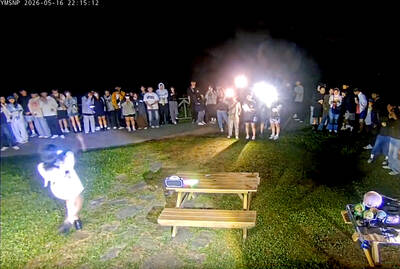
Yangmingshan National Park’s Qingtiangang (擎天崗) nature area has gone viral after a park livestream camera observed a couple in the throes of intimate congress, which was broadcast live on YouTube, drawing large late-night crowds and sparking a backlash over noise, bright lights and disruption to wildlife habitat. The area’s livestream footage appeared to show a couple engaging in sexual activity on a picnic table in the park on Friday last week, with the uncensored footage streamed publicly online. The footage quickly spread across social media, prompting a tide of visitors to travel to the site to “check in” and recreate the

Minister of Digital Affairs Lin Yi-ching (林宜敬) yesterday cited regulatory issues and national security concerns as an expert said that Taiwan is among the few Asian regions without Starlink. Lin made the remarks on Facebook after funP Innovation Group chief executive officer Nathan Chiu (邱繼弘) on Friday said Taiwan and four other countries in Asia — China, North Korea, Afghanistan and Syria — have no access to Starlink. Starlink has become available in 166 countries worldwide, including Ukraine, Malaysia, the Philippines and Vietnam, in the six years since it became commercial, he said. While China and North Korea block Starlink, Syria is not


 RSS
RSS