


A large audience gathered on Thursday to listen to female executives from leading semiconductor companies share their experience working in a traditionally male-dominated industry and offer advice to those hoping to follow in their footsteps.
The “Women in Semiconductors” panel was part of the “Talent Program” held at the three-day Semicon Taiwan expo in Taipei, where different aspects of the industry were discussed, including the value of vocational education and talent development.
Lee Yi-hsin (李儀欣), head of rewards data intelligence at consultancy WTW Taiwan, introduced the five-member panel by giving a general overview of the job market.

Photo courtesy of SEMI
Lee said that 90 percent of companies in Taiwan are “having difficulties filling tech-related openings.”
Citing a survey conducted by the company this year, she said that the gender ratio in Taiwan’s high-tech, including semiconductor, industries changes dramatically as one moves up the ranks, with fewer and fewer women in higher positions.
“Only 12 percent of executives in the high-tech industry are women, and the semiconductor industry is worse with only 6 percent,” Lee said.
This is in contrast to the operator level, where the ratio is about 50-50 in both the high-tech and semiconductor industries, she added.
Moreover, “men in the high-tech and semiconductor industries earn about 9 percent and 7 percent more [respectively] in annual compensation than their female counterparts,” she said.
On how to smash this glass ceiling, the five panelists agreed that women should not feel the pressure to “frame themselves” and conform to certain stereotypes.
Shirley Pan (潘先俐), area sales director at Texas Instruments, said that despite being an electrical engineering graduate, she found sales more fulfilling.
“Don’t confine yourself to a pre-set mindset and you’ll have more room to grow,” she said.
Elaine Yang (楊文華), senior director of human resources at Lam Research, who studied business administration, was the only panelist with a non-engineering educational background.
“I believe that the semiconductor industry needs all kinds of talent. I know many sales staff or even some engineers at Lam Research who do not have a technical background; the point is that you need to look for a company that offers well-designed job training programs,” Yang said.
Zhou Yuan-yuan (周圓圓), global business director of Dupont, said it was important to find a “suitable” workplace where women can hone their skills.
“This means a company that values diversity and inclusion, which is demonstrated by how much effort it puts into removing ‘unconscious biases,’ such as implicitly believing some jobs are not for women, in its hiring and promoting processes,” she said.
Zhou also urged women to “speak up” and “self-promote,” saying she often saw women who are knowledgeable, but unable to confidently express their views.
Technological advances have also helped alleviate concerns about physically taxing tasks that women used to shy away from or were not open to them.
Mindy Lin (林敏玉), deputy general manager of quality and reliability assurance at United Microelectronics Corp, said that, for example, going into fabs requires wearing a “bunny suit” or full protective clothing, “which is quite uncomfortable,” but is now less so with the assistance of automation and new information technology.
Offering workplace advice to all young people, Sunny Li (李淑霞), vice president of human resources at ASE Inc, Kaohsiung, said that two skills are crucial, the first being “the ability to self-reflect” and the second having solid communication skills.
Asked about #MeToo, the panelists agreed that the stance and culture of a company would determine whether victims receive proper assistance or not.
Semicon Taiwan was held at the Taipei Nangang Exhibition Center from Wednesday to yesterday, bringing together 950 exhibitors from across the world.

Actor Darren Wang (王大陸) was sentenced to six months in prison, commutable to a fine, by the New Taipei District Court today for contravening the Personal Data Protection Act (個人資料保護法) in a case linked to an alleged draft-dodging scheme. Wang allegedly paid NT$3.6 million (US$114,380) to an illegal group to help him evade mandatory military service through falsified medical documents, prosecutors said. He transferred the funds to Chen Chih-ming (陳志明), the alleged mastermind of a draft-evasion ring, although he lost contact with him as he was already in detention on fraud charges, they said. Chen is accused of helping a

SECURITY: Starlink owner Elon Musk has taken pro-Beijing positions, and allowing pro-China companies to control Taiwan’s critical infrastructure is risky, a legislator said Starlink was reluctant to offer services in Taiwan because of the nation’s extremely high penetration rates in 4G and 5G services, the Ministry of Digital Affairs said yesterday. The ministry made the comments at a meeting of the legislature’s Transportation Committee, which reviewed amendments to Article 36 of the Telecommunications Management Act (電信管理法). Article 36 bans foreigners from holding more than 49 percent of shares in public telecommunications networks, while shares foreigners directly and indirectly hold are also capped at 60 percent of the total, unless specified otherwise by law. The amendments, sponsored by Chinese Nationalist Party (KMT) Legislator Ko

The eastern extension of the Taipei MRT Red Line could begin operations as early as late June, the Taipei Department of Rapid Transit Systems said yesterday. Taipei Rapid Transit Corp said it is considering offering one month of free rides on the new section to mark its opening. Construction progress on the 1.4km extension, which is to run from the current terminal Xiangshan Station to a new eastern terminal, Guangci/Fengtian Temple Station, was 90.6 percent complete by the end of last month, the department said in a report to the Taipei City Council's Transportation Committee. While construction began in October 2016 with an
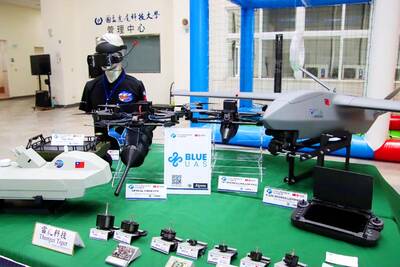
NON-RED SUPPLY: Boosting the nation’s drone industry is becoming increasingly urgent as China’s UAV dominance could become an issue in a crisis, an analyst said Taiwan’s drone exports to Europe grew 41.7-fold from 2024 to last year, with demand from Ukraine’s fight against Russian aggression the most likely driver of growth, a study showed. The Institute for Democracy, Society and Emerging Technology (DSET) in a statement on Wednesday said it found that many of Taiwan’s uncrewed aerial vehicle (UAV) sales were from Poland and the Czech Republic. These countries likely transferred the drones to Ukraine to aid it in its fight against the Russian invasion that started in 2022, it said. Despite the gains, Taiwan is not the dominant drone exporter to these markets, ranking second and fourth


 RSS
RSS