

The discovery on Thursday of bone fragments and personal effects in a burned-out train two years after the Taroko Express No. 408 derailment prompted Minister of Transportation and Communications Wang Kwo-tsai (王國材) to apologize yesterday.
The ministry has erred and will seek to ameliorate matters, Wang said after members of a group of family members of the people killed in the April 2, 2021, crash in Hualien County’s Sioulin Township (秀林) found bone fragments, and personal effects, including watches and cellphones, during an inspection of the Taiwan Railways Administration (TRA) cars.
Fourty-nine people were killed and more than 200 were injured in the crash.
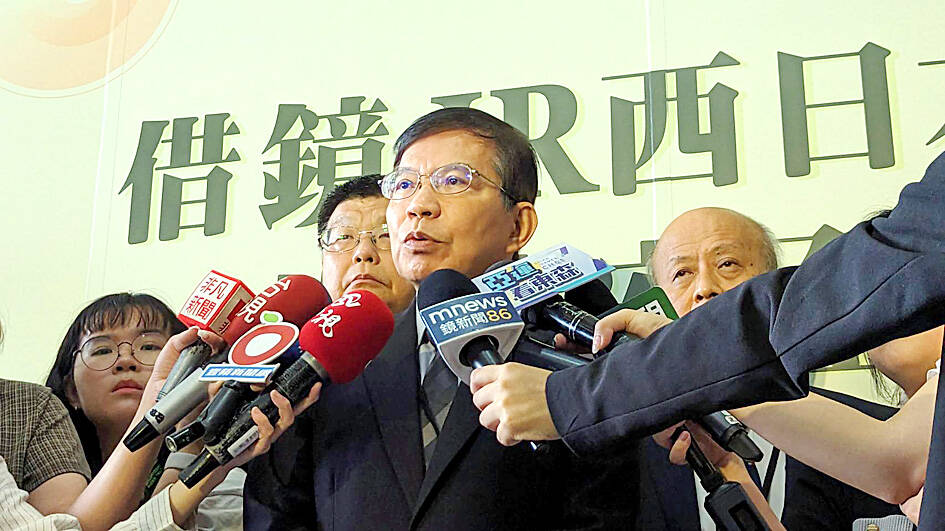
Photo: Cheng Wei-chi, Taipei Times
The ministry on Thursday invited experts on the derailment of a West Japan Railway Co train in Amagasaki on April 25, 2005 — which killed 107 people — as well as family members of those killed in the Sioulin derailment to look through the cars.
Members of the group said they were shocked the TRA had failed to collect everything from the cars.
The Railway Police Bureau and lawyers of the families yesterday combed through the cars and found four more bone fragments, suspected to be from a skull.
The Hualien District Prosecutors’ Office said that it has delivered the pieces to a forensics lab to determine who they were from.
The TRA has not conducted a sweep since the Taiwan Transportation Safety Board concluded their inspections, Wang said.
He said it was a grave matter and highly disrespectful to the deceased that the TRA had not conducted a full sweep.
Wang Wei-chun (王薇君), spokeswoman of Taroko Tears, a group for family members of those who died, said she hoped the discovery of the bones and personal items would help focus public attention on the need for TRA safety reforms.
Finding the items should be a warning to the Executive Yuan that its disaster prevention and processing procedures still need work, she said.
Now is not the time to be pointing fingers, she said, urging the authorities to quickly identify who the bones belonged to and deliver them to their proper resting place — 881 days after the incident.
Chen Peng-nian (陳鵬年), a Taroko Tears member who was in the crash, said many in the group were shocked and saddened at finding the bone fragments.
Chen said he understands how hard the search-and-rescue effort was, and that it was impossible that every body part would be accounted for.
However, the authorities should be more thorough, he added.
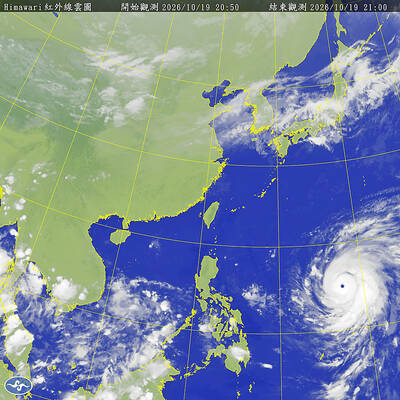
Typhoon Champi is forecast to turn northward earlier than previously expected, sparing Taiwan a direct hit but still bringing heavy rain to the north of the country on Friday and Saturday, the Central Weather Administration (CWA) said yesterday. Typhoon Champi had strengthened and increased in size over the past 12 hours, and as of yesterday afternoon, was packing sustained winds of 198kph near its center, CWA forecaster Cheng Chieh-jen (鄭傑仁) said. However, due to the weakening of a Pacific high-pressure system the storm is now expected to turn northward earlier than initially forecast, likely around Japan’s Ishigaki Island, Cheng said. As Champi brushes
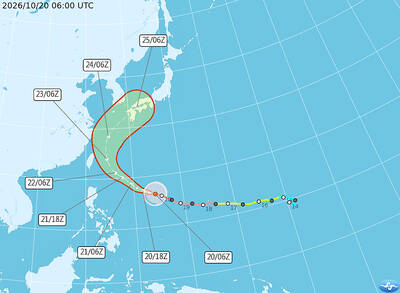
A sea warning for Typhoon Champi might be issued tonight, while the storm’s trajectory would determine whether a land warning is to be issued tomorrow night, the Central Weather Administration (CWA) said yesterday. As of 2pm yesterday, Champi was about 1,536km east-southeast of Taiwan proper’s southernmost point, Oluanpi (鵝鑾鼻), packing maximum sustained winds of 198kph, CWA forecaster Tseng Chao-cheng (曾昭誠) said. The storm was moving west-northwest at 23kph and was expected to strengthen over the next 24 hours before weakening slightly as it approaches cooler waters east of Taiwan, Tseng said. Champi is expected to turn north tomorrow, with the angle of the
A Chinese People's Liberation Army (PLA) Navy aircraft carrier group was being monitored after entering the western Pacific, the Ministry of National Defense said today, after Beijing yesterday criticized Taiwan for using a water cannon against a Chinese fishing boat near the Pratas Islands (Dongsha Islands, 東沙群島). A Chinese naval task group led by the aircraft carrier Liaoning (遼寧) yesterday sailed to the western Pacific for training, Chinese state-run Xinhua news agency quoted the PLA Navy as saying. “The drill is part of the annual routine training plan aimed at testing and improving the troops’ combat readiness and enhancing their ability to
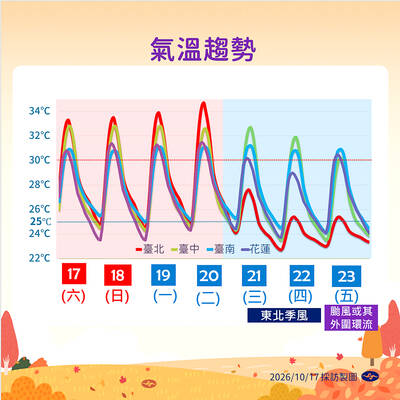
TYPHOON WATCH Champi closes to east Typhoon Champi could continue to strengthen and approach waters off eastern Taiwan by Thursday, with some forecast models suggesting it could move west and cross the nation, the Central Weather Administration (CWA) said yesterday. As of 2pm yesterday, Champi was 2,980km east-southeast of Oluanpi (鵝鑾鼻), Taiwan’s southernmost tip, and moving west at 22kph. It had maximum sustained winds of 162kph and a storm radius of 180km, CWA data showed. CWA forecaster Chang Cheng-chuan (張承傳) said Champi could intensify as it moves west before turning west-northwest toward Taiwan. The storm is expected to reach waters off eastern


 RSS
RSS