


Former Miaoli County commissioner Hsu Yao-chang (徐耀昌) on Tuesday said that he was leaving the Chinese Nationalist Party (KMT), the third senior KMT politician since May to stump for Hon Hai Precision Industry Co founder Terry Gou (郭台銘), who is mulling a presidential run.
Hsu’s decision came two days before the deadline set by the KMT for him to explain why he urged supporters not to vote for the party in next year’s presidential election at a Gou rally.
Prior to Hsu, KMT Nantou County Council Speaker Ho Shang-feng (何勝豐) and Changhua County Council Speaker Hsieh Dien-lin (謝典林) also voiced their support for Gou, who has yet to declare his candidacy, in May and last month respectively.
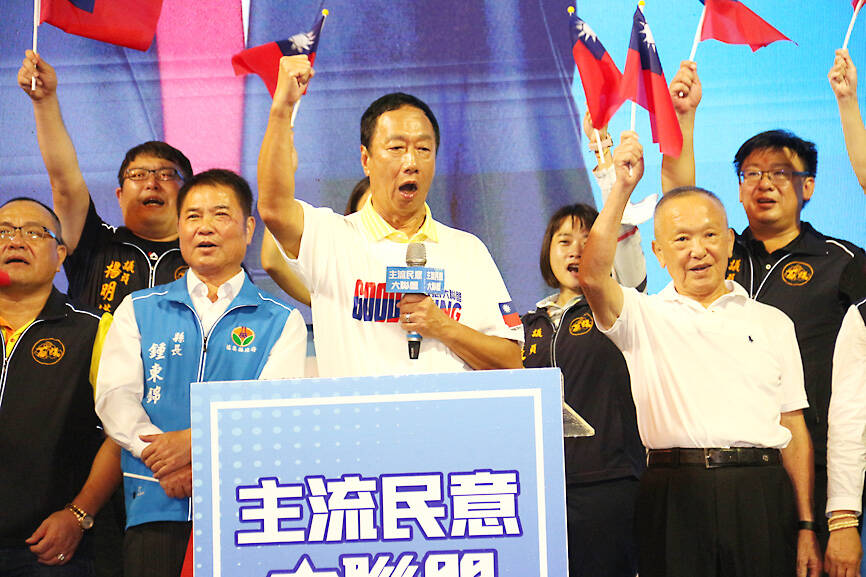
Photo: CNA
Via a social media post, Hsu criticized the KMT for its presidential candidate pick, New Taipei City Mayor Hou You-yi (侯友宜), who was drafted by the party on May 17 when Gou expressed an interest in seeking the party’s nomination, despite not being a party member.
The KMT nominated someone of whom its party members disapproved, who watched from the sidelines without campaigning for Han Kuo-yu (韓國瑜) of the KMT in the 2020 presidential election and who failed to support the KMT’s position in previous referendums, Hsu wrote.
Hsu, who lost in a poll-based KMT primary in May to run in the legislative election to be held in tandem with the presidential election in January next year, also said that the party has been corrupted by “backdoor politics” and has “failed to resonate with the public.”
Ashed to comment on Tuesday, Hou said he found it “regrettable” that Hsu has decided to leave the party, but “respects his decision.”
Hsu’s contributions to Miaoli when he was commissioner were “highly recognized,” Hou said, adding that he still hopes Hsu would stick with the KMT in the campaign.
The 68-year-old Hsu’s departure from the KMT is the latest sign of an emerging independent force in the former KMT stronghold, mainly as a result of past election grudges, KMT Miaoli County Councilor Tseng Wen-hsueh (曾玟學) said.
The independents are led by Miaoli County Commissioner Chung Tung-chin (鍾東錦), who was disqualified as a candidate by the KMT because of his criminal record, but quit the party and mounted a successful campaign as an independent in December last year, Tseng said.
Hsu entered politics as a township mayor representing the KMT in 1994 and switched to the People First Party in 2001 to serve three terms in the legislature before returning to the KMT in 2012 to win re-election.
He was elected commissioner in 2014 and re-elected for another four-year term.
At Gou’s rally on Aug. 10, Hsu and Chung stood side-by-side with Gou to support his initiative that the presidential candidates of opposition parties should form an alliance to defeat the Democratic Progressive Party (DPP).
In his remarks at the rally, Hsu called for people to “vote against not only the DPP, but also the KMT” in January’s elections as a way to force the two parties to engage in “self-reflection.”
Hsu first walked back his remarks, saying that he “misspoke” at the rally, when the KMT Disciplinary Committee on Monday last week demanded that he provide an explanation for his position by yesterday for the committee to review, but instead he decided to leave the party.

Considering that most countries issue more than five denominations of banknotes, the central bank has decided to redesign all five denominations, the bank said as it prepares for the first major overhaul of the banknotes in more than 24 years. Central bank Governor Yang Chin-lung (楊金龍) is expected to report to the Legislative Yuan today on the bank’s operations and the redesign’s progress. The bank in a report sent to the legislature ahead of today’s meeting said it had commissioned a survey on the public’s preferences. Survey results showed that NT$100 and NT$1,000 banknotes are the most commonly used, while NT$200 and NT$2,000

The Centers for Disease Control (CDC) yesterday reported the first case of a new COVID-19 subvariant — BA.3.2 — in a 10-year-old Singaporean girl who had a fever upon arrival in Taiwan and tested positive for the disease. The girl left Taiwan on March 20 and the case did not have a direct impact on the local community, it said. The WHO added the BA.3.2 strain to its list of Variants Under Monitoring in December last year, but this was the first imported case of the COVID-19 variant in Taiwan, CDC Deputy Director-General Lin Ming-cheng (林明誠) said. The girl arrived in Taiwan on

South Korea is planning to revise its controversial electronic arrival card, a step Taiwanese officials said prompted them to hold off on planned retaliatory measures, a South Korean media report said yesterday. A Yonhap News Agency report said that the South Korean Ministry of Foreign Affairs is planning to remove the “previous departure place” and “next destination” fields from its e-arrival card system. The plan, reached after interagency consultations, is under review and aims to simplify entry procedures and align the electronic form with the paper version, a South Korean ministry official said. The fields — which appeared only on the electronic form

The Ministry of Foreign Affairs (MOFA) is suspending retaliation measures against South Korea that were set to take effect tomorrow, after Seoul said it is updating its e-arrival system, MOFA said today. The measures were to be a new round of retaliation after Taiwan on March 1 changed South Korea's designation on government-issued alien resident certificates held by South Korean nationals to "South Korea” from the "Republic of Korea," the country’s official name. The move came after months of protests to Seoul over its listing of Taiwan as "China (Taiwan)" in dropdown menus on its new online immigration entry system. MOFA last week


 RSS
RSS