


The new Ministry of Environment officially started operations on Tuesday after a plaque-unveiling ceremony and inauguration of its first minister, Shieu Fuh-sheng (薛富盛).
The ministry was upgraded from the Environmental Protection Administration (EPA) established in 1987 after a law to redesignate the EPA a ministry cleared the legislature on May 9 and was promulgated by President Tsai Ing-wen (蔡英文) on May 24.
Addressing the plaque-unveiling ceremony, Tsai said the ministry is determined to respond to global trends and expressed confidence it would work with various sectors of society to help accelerate the nation’s transition to netzero emissions.
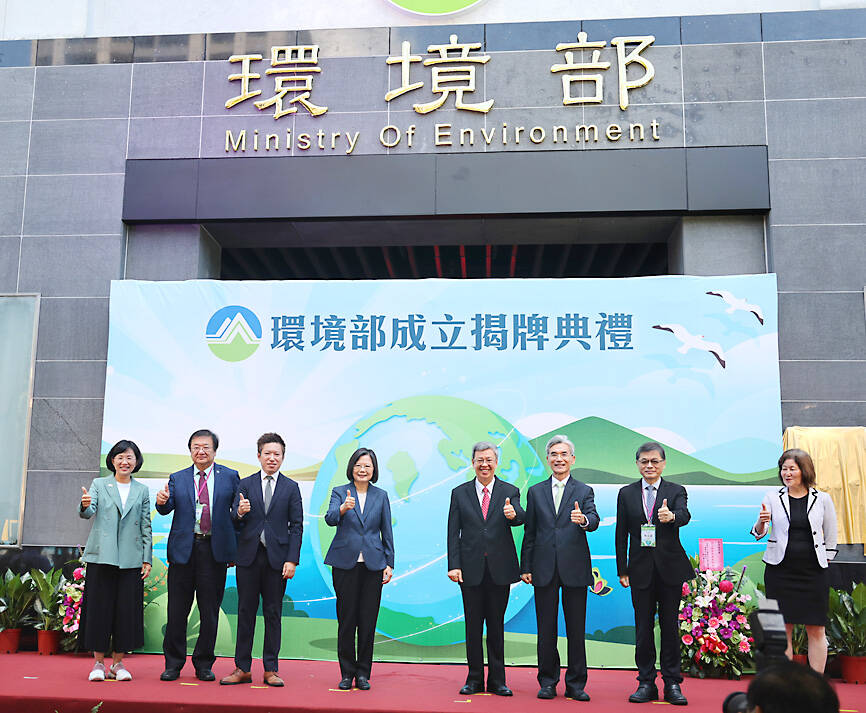
Photo: CNA
Tsai also praised Shieu for his promotion of research into the circular economy as president of National Chung Hsing University in Taichung from August 2015 to last month.
During his time there, Shieu led the establishment of the country’s first academy dedicated to the circular economy at the university’s Nantou campus, Tsai added.
Shieu said that environmental sustainability is not just a mission but also a grave challenge facing the world, adding that he would strive to tackle the challenge and combat climate change in his new position.
Shieu also outlined his vision for upgrading the nation’s management strategies for pollution, from control to prevention and improving environmental education, while working closely with domestic academic and research institutions and the business sector to confront environment challenges and jointly protect the homeland.
Four specialized agencies — the Climate Change Agency, the Resource Recycling Agency, the Chemical Substance Management Agency, and the Environmental Management Agency — and a National Environmental Research Institute have been established under the Ministry of Environment.
The new minister also said he would visit Keelung Mayor George Hsieh (謝國樑) to discuss Taiwan Power Co’s plan to build a liquefied natural gas receiving station on Keelung’s northern coast, which is opposed by environmental groups and local political figures, including Hsieh, who believe the project poses a threat to biodiversity.

More than half of the bamboo vipers captured in Tainan in the past few years were found in the city’s Sinhua District (新化), while other districts had smaller catches or none at all. Every year, Tainan captures about 6,000 snakes which have made their way into people’s homes. Of the six major venomous snakes in Taiwan, the cobra, the many-banded krait, the brown-spotted pit viper and the bamboo viper are the most frequently captured. The high concentration of bamboo vipers captured in Sinhua District is puzzling. Tainan Agriculture Bureau Forestry and Nature Conservation Division head Chu Chien-ming (朱健明) earlier this week said that the

NAMING SPAT: The foreign ministry called on Denmark to propose an acceptable solution to the erroneous nationality used for Taiwanese on residence permits Taiwan has revoked some privileges for Danish diplomatic staff over a Danish permit that lists “Taiwan” as “China,” Eric Huang (黃鈞耀), head of the Ministry of Foreign Affairs’ Department of European Affairs, told a news conference in Taipei yesterday. Reporters asked Huang whether the Danish government had responded to the ministry’s request that it correct the nationality on Danish residence permits of Taiwanese, which has been listed as “China” since 2024. Taiwan’s representative office in Denmark continues to communicate with the Danish government, and the ministry has revoked some privileges previously granted to Danish representatives in Taiwan and would continue to review
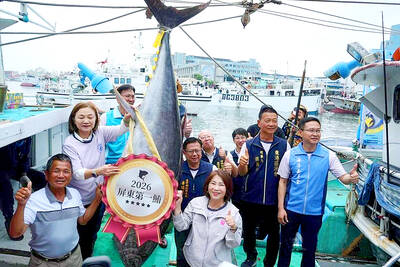
The first bluefin tuna of the season, brought to shore in Pingtung County and weighing 190kg, was yesterday auctioned for NT$10,600 (US$333.5) per kilogram, setting a record high for the local market. The auction was held at the fish market in Donggang Fishing Harbor, where the Siaoliouciou Island-registered fishing vessel Fu Yu Ching No. 2 delivered the “Pingtung First Tuna” it had caught for bidding. Bidding was intense, and the tuna was ultimately jointly purchased by a local restaurant and a local company for NT$10,600 per kilogram — NT$300 ,more than last year — for a total of NT$2.014 million. The 67-year-old skipper

China has reserved offshore airspace over the Yellow Sea and East China Sea from March 27 to May 6, issuing alerts that are usually used to warn of military exercises, although no such exercises have been announced, the Wall Street Journal (WSJ) reported on Sunday. Reserving such a large area for 40 days without explanation is an “unusual step,” as military exercises normally only last a few days, the paper said. The alerts, known as notice to air missions (NOTAMs), “are intended to inform pilots and aviation authorities of temporary airspace hazards or restrictions,” the article said. The airspace reserved in the alert


 RSS
RSS