


The Chinese government has signed one-month contracts with Paraguayan media outlets to promote negative coverage of Vice President William Lai’s (賴清德) visit next week to the South American country, as it seeks to discredit Taiwan and affect its presidential election in January, national security sources said on condition of anonymity.
That includes content supporting Beijing’s claim that Taiwan is part of China, accusing Taiwan of hurting Paraguay’s stability and “welcoming” China for the sake of Paraguay’s advancement, they said on Wednesday.
The Ministry of Foreign Affairs (MOFA) condemned the actions, calling them part of China’s “cognitive warfare to interfere” with Lai’s trip.
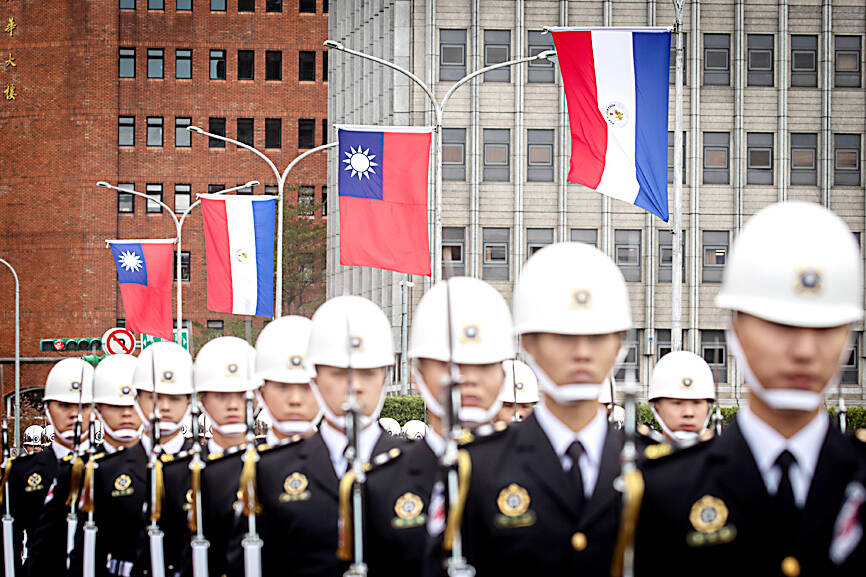
Photo: Ritchie B. Tongo, EPA-EFE
“China has been bribing media over the past two weeks to release false reports that smear Taiwan’s diplomatic efforts in an attempt to suppress Taiwan’s diplomatic space,” it said in a statement.
The Chinese Ministry of Foreign Affairs did not immediately respond to a request for comment.
When Lai transits through the US, Beijing has mobilized the Alliance for China’s Peaceful Reunification and Chinese expatriates to protest, a national security official said yesterday on condition of anonymity, citing intelligence sources.
When Lai arrives in New York and San Francisco, Chinese demonstrators would stage rallies, while pro-Beijing ads would appear in local Chinese-language newspapers, they said.
At the same time, Beijing-controlled media in Taiwan are expected to generate skepticism about Lai as they attempt to frame the presidential election next year as a choice between war and peace, the official said.
In response to China’s announcement that it would hold military drills in the East China Sea from today, the Ministry of National Defense yesterday said that the Chinese People’s Liberation Army (PLA) is likely to stage its own response to Lai’s visit by making a show of the upcoming Eastern Theater Command’s annual exercise.
These drills’ purpose would be to interfere with Taiwan’s election and intimidate voters into choosing candidates preferred by Beijing, the ministry said.
The PLA’s deployment of warships and military aircraft near Taiwan were frequently conducted in conjunction with Beijing’s cognitive warfare efforts in mind, it said, adding that it uses false reporting to amplify the effect of the drills.
Its most likely course of action is to conduct a beefed-up version of its so-called “preparedness patrols” in April and send even more ships and airplanes near Taiwan, national security sources said.
Taipei is closely monitoring the PLA’s movements with the expectation that some display of military force would come with the exercise, they said.
“If China uses this [Lai’s trip] to take provocative action, it will be China that damages regional peace and security, not Taiwan or the United States,” MOFA spokesman Jeff Liu (劉永健) told reporters.
Taipei-based diplomats were divided on China’s likely reaction, eight diplomatic and foreign security sources said.
One said Beijing’s and Washington’s bid to improve relations could temper China’s response.
However, a senior foreign security source said Beijing would have to put on a show of force given its angry denouncements of the trip.
“They have pretty much backed themselves into a corner and will have to do something,” the source told Reuters.
Additional reporting by Bloomberg, Reuters and Wu Su-wei

Yangmingshan National Park authorities yesterday urged visitors to respect public spaces and obey the law after a couple was caught on a camera livestream having sex at the park’s Qingtiangang (擎天崗) earlier in the day. The Shilin Police Precinct in Taipei said it has identified a suspect and his vehicle registration number, and would summon him for questioning. The case would be handled in accordance with public indecency charges, it added. The couple entered the park at about 11pm on Thursday and began fooling around by 1am yesterday, the police said, adding that the two were unaware of the park’s all-day live
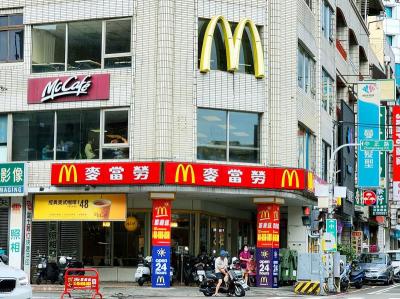
Fast food chain McDonald's is to raise prices by up to NT$5 on some products at its restaurants across Taiwan, starting on Wednesday next week, the company announced today. The prices of all extra value meals and sharing boxes are to increase by NT$5, while breakfast combos and creamy corn soup would go up by NT$3, the company said in a statement. The price of the main items of those meals, if ordered individually, would remain the same. Meanwhile, the price of a medium-sized lemon iced tea and hot cappuccino would rise by NT$3, extra dipping sauces for chicken nuggets would go up
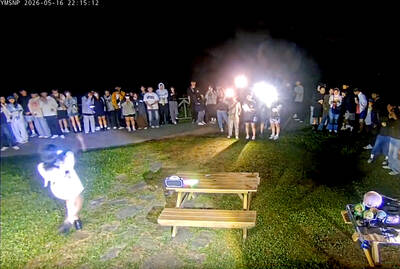
Yangmingshan National Park’s Qingtiangang (擎天崗) nature area has gone viral after a park livestream camera observed a couple in the throes of intimate congress, which was broadcast live on YouTube, drawing large late-night crowds and sparking a backlash over noise, bright lights and disruption to wildlife habitat. The area’s livestream footage appeared to show a couple engaging in sexual activity on a picnic table in the park on Friday last week, with the uncensored footage streamed publicly online. The footage quickly spread across social media, prompting a tide of visitors to travel to the site to “check in” and recreate the

Minister of Digital Affairs Lin Yi-ching (林宜敬) yesterday cited regulatory issues and national security concerns as an expert said that Taiwan is among the few Asian regions without Starlink. Lin made the remarks on Facebook after funP Innovation Group chief executive officer Nathan Chiu (邱繼弘) on Friday said Taiwan and four other countries in Asia — China, North Korea, Afghanistan and Syria — have no access to Starlink. Starlink has become available in 166 countries worldwide, including Ukraine, Malaysia, the Philippines and Vietnam, in the six years since it became commercial, he said. While China and North Korea block Starlink, Syria is not


 RSS
RSS