


The Ministry of Foreign Affairs yesterday vowed to assist with the evacuation of two Taiwanese living in Niger amid a military takeover in the west African nation.
The ministry on July 27 issued a “red” travel warning for Niger, advising against all unnecessary travel and for the immediate return of those in the country if possible.
The situation in Niger is still unstable, with the French, Italian and other governments evacuating their citizens, Department of West Asian and African Affairs Director-General Anthony Ho (賀忠義) said yesterday.

Photo: Reuters
There are two Taiwanese residing in Niger, both of whom are safe at the moment, Ho said, adding that the ministry is arranging for their return and would make an announcement after they leave.
The new junta on Sunday closed the airspace over Niger, complicating air travel.
The ministry would continue to monitor the situation in Niger and across the region, Ho said, reiterating the ministry’s warning against travel to the nation.
Taiwanese requiring assistance are advised to contact the emergency line of the Taipei Representative Office in France, which is responsible for Niger affairs, on 33-680-074-994 or toll-free in Taiwan on 0800-085-095, the ministry said.
The junta yesterday declared a new Cabinet, two weeks after it overthrew Nigerien President Mohamed Bazoum on July 26.

US climber Alex Honnold is to attempt to scale Taipei 101 without a rope and harness in a live Netflix special on Jan. 24, the streaming platform announced on Wednesday. Accounting for the time difference, the two-hour broadcast of Honnold’s climb, called Skyscraper Live, is to air on Jan. 23 in the US, Netflix said in a statement. Honnold, 40, was the first person ever to free solo climb the 900m El Capitan rock formation in Yosemite National Park — a feat that was recorded and later made into the 2018 documentary film Free Solo. Netflix previewed Skyscraper Live in October, after videos

NUMBERS IMBALANCE: More than 4 million Taiwanese have visited China this year, while only about half a million Chinese have visited here Beijing has yet to respond to Taiwan’s requests for negotiation over matters related to the recovery of cross-strait tourism, the Tourism Administration said yesterday. Taiwan’s tourism authority issued the statement after Chinese-language daily the China Times reported yesterday that the government’s policy of banning group tours to China does not stop Taiwanese from visiting the country. As of October, more than 4.2 million had traveled to China this year, exceeding last year. Beijing estimated the number of Taiwanese tourists in China could reach 4.5 million this year. By contrast, only 500,000 Chinese tourists are expected in Taiwan, the report said. The report

Temperatures are forecast to drop steadily as a continental cold air mass moves across Taiwan, with some areas also likely to see heavy rainfall, the Central Weather Administration (CWA) said. From today through early tomorrow, a cold air mass would keep temperatures low across central and northern Taiwan, and the eastern half of Taiwan proper, with isolated brief showers forecast along Keelung’s north coast, Taipei and New Taipei City’s mountainous areas and eastern Taiwan, it said. Lows of 11°C to 15°C are forecast in central and northern Taiwan, Yilan County, and the outlying Kinmen and Lienchiang (Matsu) counties, and 14°C to 17°C
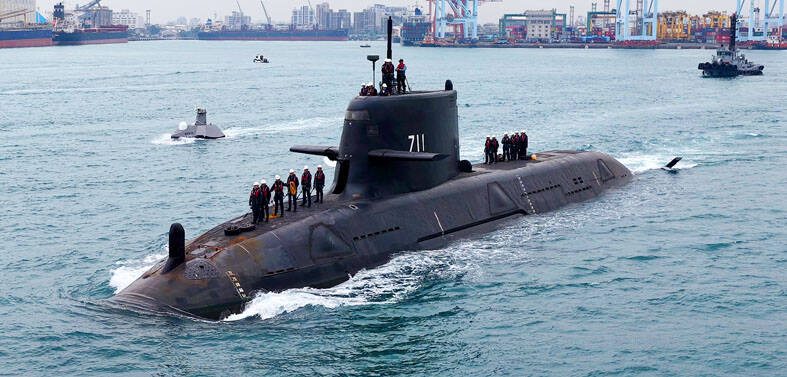
STEERING FAILURE: The first boat of its class is experiencing teething issues as it readies for acceptance by the navy, according to a recent story about rudder failure The Hai Kun (海鯤), the nation’s first locally built submarine, allegedly suffered a total failure of stern hydraulic systems during the second round of sea acceptance trials on June 26, and sailors were forced to manually operate the X-rudder to turn the submarine and return to port, news Web site Mirror Daily reported yesterday. The report said that tugboats following the Hai Kun assisted the submarine in avoiding collisions with other ships due to the X-rudder malfunctioning. At the time of the report, the submarine had completed its trials and was scheduled to begin diving and surfacing tests in shallow areas. The X-rudder,


 RSS
RSS