


The annual Chimei Music Festival is to focus on classical music used in movies and showcase Chimei Museum’s vast collection of string instruments, the museum in Tainan said in a statement.
The fourth edition of the festival is to begin in September under the title “Classical Music & Cinema,” it said.
This year’s festival takes public culture onto the stage, focusing on the seemingly different aesthetic forms of classical music and film.
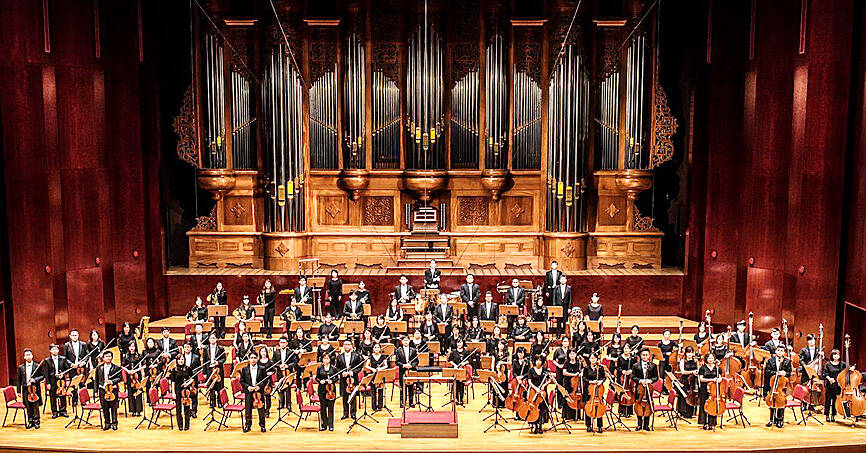
Photo courtesy of the National Taiwan Symphony Orchestra
One lecture and four concerts would seek to stimulate the imagination of the audience, classical music commentator and festival producer Chiao Yuan-pu (焦元溥) said.
This is a shift away from the focus of past festivals on classical composers such as Ludwig van Beethoven and Wolfgang Amadeus Mozart , as well as Frederic Chopin and Franz Liszt of the romantic period.
The festival is to begin on Sept. 9 with a two-hour talk by Chiao on how classical music has been used by filmmakers and how film scores have been influenced as a result, he said in a promotional video posted on the museum’s Web site.
The opening event is to be followed by four concerts scheduled for October and early November, with Chiao giving a talk before each of the performances, sharing stories behind the music used in the movies with the audience, the museum said.
The first concert on Oct. 7 is a recital performed by pianist Evan Wong (汪奕聞), who is to play works composed by Beethoven, Chopin, Liszt and French composer Claude Debussy, which are featured in movies such as The Legend of 1900 and Everything Everywhere All at Once, the museum said.
The second concert on Oct. 14 is to be headlined by clarinetist Lai Chun-yen (賴俊諺), an associate principal of the National Symphony Orchestra, it said.
Fan Chen-lin (范珍綾) and bandoneon player Lee Chen-chung (李承宗) are to join Lai to play Mozart’s Clarinet Concerto in A major, K. 622: II. Adagio in the 1985 film Out of Africa, as well as George Gershwin’s Rhapsody in Blue and Summertime from his opera Porgy and Bess.
The trio are to end the concert with Oblivion and Libertango by Argentine tango composer Astor Piazzolla, who was also a bandoneon player himself, the museum said.
The third concert is to be performed by a trio formed by members of the Southern Taiwan Chamber Music Society, including pianist Wu Ya-hsin (吳亞欣), violinist Hsueh Chi-chang (薛志璋) and cellist Victor Coo (高炳坤).
The three concerts are to be held at the museum in Tainan, while the fourth is to take place at the National Kaohsiung Center for the Arts in the southern port city on Nov. 4, it said.
The concert is to be performed by the National Taiwan Symphony Orchestra with Japanese conductor Eiji Oue and guest violinist William Wei (魏靖儀), playing two works by Russian composer Pyotr Ilyich Tchaikovsky, fantasy overture Romeo and Juliet and Violin Concerto in D Major, Op. 35, as well as Beethoven’s Symphony No. 7 in A Major, Op. 92, the museum said.
The museum said it is to provide Stradivari’s violin “Wirth” and eight string instruments produced by Ansaldo Poggi between 1928 and 1967 in its collection for the Nov. 4 concert.

Considering that most countries issue more than five denominations of banknotes, the central bank has decided to redesign all five denominations, the bank said as it prepares for the first major overhaul of the banknotes in more than 24 years. Central bank Governor Yang Chin-lung (楊金龍) is expected to report to the Legislative Yuan today on the bank’s operations and the redesign’s progress. The bank in a report sent to the legislature ahead of today’s meeting said it had commissioned a survey on the public’s preferences. Survey results showed that NT$100 and NT$1,000 banknotes are the most commonly used, while NT$200 and NT$2,000

The Centers for Disease Control (CDC) yesterday reported the first case of a new COVID-19 subvariant — BA.3.2 — in a 10-year-old Singaporean girl who had a fever upon arrival in Taiwan and tested positive for the disease. The girl left Taiwan on March 20 and the case did not have a direct impact on the local community, it said. The WHO added the BA.3.2 strain to its list of Variants Under Monitoring in December last year, but this was the first imported case of the COVID-19 variant in Taiwan, CDC Deputy Director-General Lin Ming-cheng (林明誠) said. The girl arrived in Taiwan on

South Korea is planning to revise its controversial electronic arrival card, a step Taiwanese officials said prompted them to hold off on planned retaliatory measures, a South Korean media report said yesterday. A Yonhap News Agency report said that the South Korean Ministry of Foreign Affairs is planning to remove the “previous departure place” and “next destination” fields from its e-arrival card system. The plan, reached after interagency consultations, is under review and aims to simplify entry procedures and align the electronic form with the paper version, a South Korean ministry official said. The fields — which appeared only on the electronic form

The Ministry of Foreign Affairs (MOFA) is suspending retaliation measures against South Korea that were set to take effect tomorrow, after Seoul said it is updating its e-arrival system, MOFA said today. The measures were to be a new round of retaliation after Taiwan on March 1 changed South Korea's designation on government-issued alien resident certificates held by South Korean nationals to "South Korea” from the "Republic of Korea," the country’s official name. The move came after months of protests to Seoul over its listing of Taiwan as "China (Taiwan)" in dropdown menus on its new online immigration entry system. MOFA last week


 RSS
RSS