


The Ma Ying-jeou Foundation is to advocate for the launch of a “cross-strait university principal forum” to enable more opportunities for educators from both sides of the Taiwan Strait to exchange views on higher education, former president Ma Ying-jeou (馬英九) said yesterday.
Ma made the remarks through a statement as a group of Chinese students in Taiwan for a nine-day exchange program at the invitation of the foundation wrapped up their visit yesterday afternoon.
The student program was just the beginning, Ma said in a statement, adding that he hopes the exchanges can be conducted annually to help Taiwanese and Chinese understand each other more and promote peace and stability in the Strait.
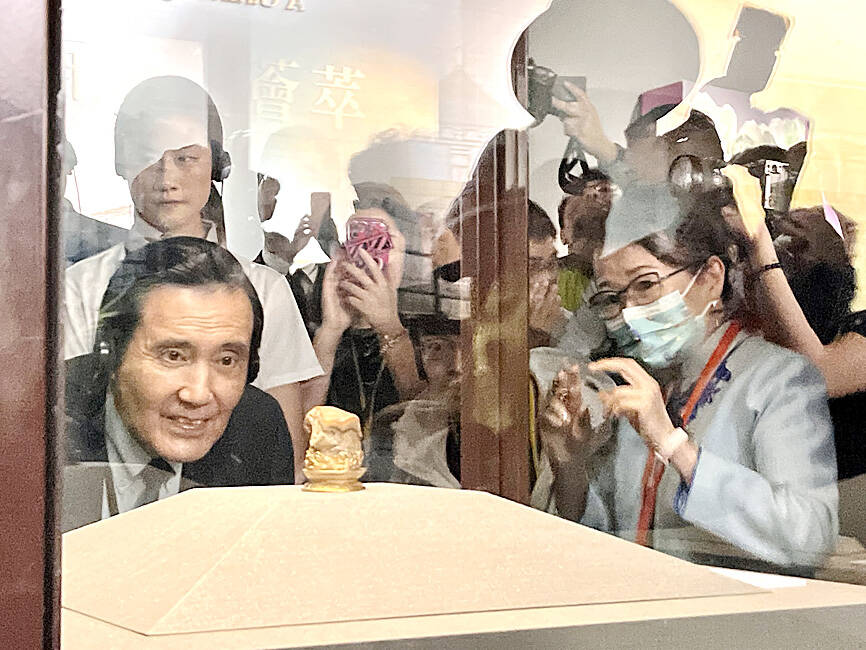
Photo: CNA
The group of 37 lecturers and students from five universities in China arrived on July 15. They were led by former Peking University president Hao Ping (郝平).
The lecturers and students were from Peking University, Tsinghua University, Fudan University, Wuhan University and Hunan University, the foundation said.
Chao Chun-shan (趙春山), an honorary professor at Tamkang University’s Graduate Institute of China Studies, said that many of the students described the Taiwanese they met as friendly, which was contrary to the impression they had received online.
Speaking to the media after an event for the group at the Courtyard by Marriott in Taipei on Saturday, Chao said that cross-strait exchanges are significant as they promote understanding between Taiwanese and Chinese.
“Through mutual visits, people from both sides can see each other’s genuine face, instead of the deliberately promoted, caricatured, purpose-driven and overly political side. Seeing each other’s ordinary daily life is the true purpose of communication,” he said.
If such exchanges continue, there would be peace across the Taiwan Strait, he added.
Additional reporting by Shih Hsiao-kuang

The military has spotted two Chinese warships operating in waters near Penghu County in the Taiwan Strait and sent its own naval and air forces to monitor the vessels, the Ministry of National Defense (MND) said. Beijing sends warships and warplanes into the waters and skies around Taiwan on an almost daily basis, drawing condemnation from Taipei. While the ministry offers daily updates on the locations of Chinese military aircraft, it only rarely gives details of where Chinese warships are operating, generally only when it detects aircraft carriers, as happened last week. A Chinese destroyer and a frigate entered waters to the southwest
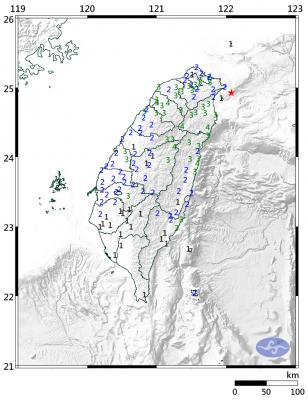
A magnitude 6.1 earthquake struck off the coast of Yilan County at 8:39pm tonight, the Central Weather Administration (CWA) said, with no immediate reports of damage or injuries. The epicenter was 38.7km east-northeast of Yilan County Hall at a focal depth of 98.3km, the CWA’s Seismological Center said. The quake’s maximum intensity, which gauges the actual physical effect of a seismic event, was a level 4 on Taiwan’s 7-tier intensity scale, the center said. That intensity level was recorded in Yilan County’s Nanao Township (南澳), Hsinchu County’s Guansi Township (關西), Nantou County’s Hehuanshan (合歡山) and Hualien County’s Yanliao (鹽寮). An intensity of 3 was

Japanese Prime Minister Sanae Takaichi’s comment last year on Tokyo’s potential reaction to a Taiwan-China conflict has forced Beijing to rewrite its invasion plans, a retired Japanese general said. Takaichi told the Diet on Nov. 7 last year that a Chinese naval blockade or military attack on Taiwan could constitute a “survival-threatening situation” for Japan, potentially allowing Tokyo to exercise its right to collective self-defense. Former Japan Ground Self-Defense Force general Kiyofumi Ogawa said in a recent speech that the remark has been interpreted as meaning Japan could intervene in the early stages of a Taiwan Strait conflict, undermining China’s previous assumptions
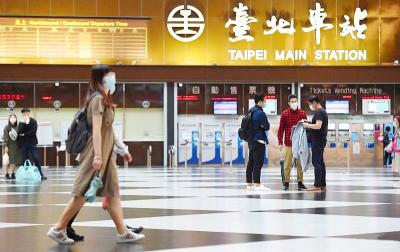
Taiwan Railways Corp (TRC) today announced that Shin Kong Mitsukoshi has been selected as the preferred bidder to operate the Taipei Railway Station shopping mall, replacing the current operator, Breeze Development Co Ltd. Among eight qualified firms that delivered presentations and were evaluated by a review committee, Shin Kong Mitsukoshi was ranked first, while Breeze was named the runner-up, the rail company said in a statement. Contract negotiations are to proceed in accordance with regulations, it said, adding that if negotiations with the top bidder fail, it could invite the second-ranked applicant to enter talks. Breeze in a statement today expressed doubts over


 RSS
RSS