


The operations of a liquefied natural gas (LNG) receiving terminal in Taichung have returned to normal after technical glitches on Friday night, state-owned refiner CPC Corp, Taiwan said yesterday.
The company said it would inspect the facility to determine the cause of the incident.
Technical problems with the terminal’s safety instrumented system at about 8:10pm suspended natural gas output from the facility, leading to a decline in power supply from the Tatan Power Plant in Taoyuan’s Guanyin District (觀音), which generates electricity using natural gas from the Taichung LNG receiving terminal, CPC said.
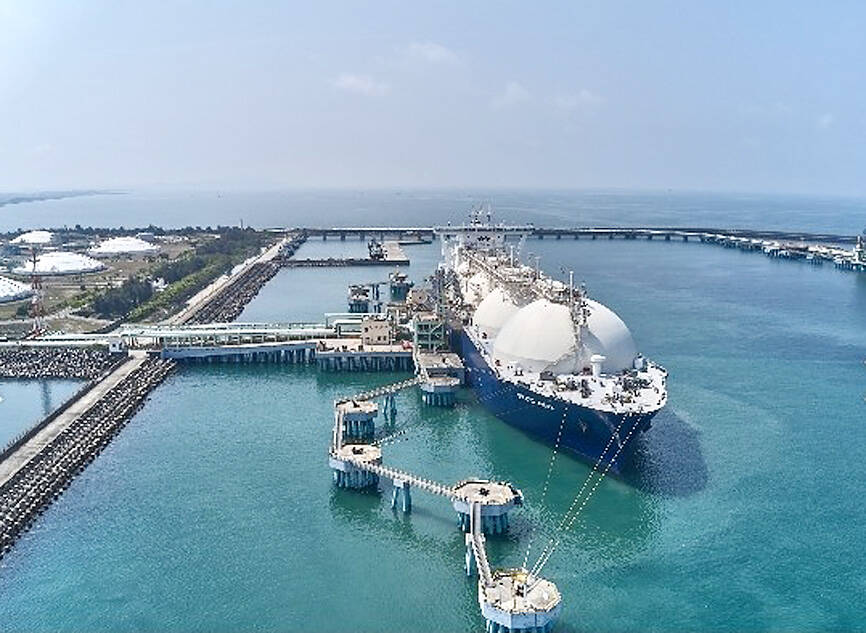
Photo courtesy of CPC Corp, Taiwan
A safety instrumented system is a set of hardware and software controls that can shut down a chemical, nuclear, electrical or mechanical system, or part of it, if a hazardous condition is detected.
In response to the technical problems at the terminal and reduced power supplies from the two power plants, CPC immediately set up an emergency task force to investigate the incident.
Engineers enabled the facility to gradually resume operations at about 8:58pm, with output returning to normal at about 11:29pm, it said.
CPC said it worked with Taiwan Power Co (Taipower), the sole state-run power supplier, to stabilize electricity supply across the country during the incident.
After the glitches at the Taichung terminal, power from the Tatan Power Plant dropped about 2.5 gigawatts (GW), while the electricity supply from privately owned Haihu Power Plant in Taoyuan’s Lujhu District (蘆竹) fell about 0.9GW, Taipower said.
In response, Taipower boosted electricity production from hydraulic generators and pumped-storage hydropower equipment by 1.1GW, it said.
As the reduced supply from Tatan and Haihu largely affected users in northern Taiwan, the company increased electricity production at the Hsieh-he Power Plant in Keelung by 0.55GW and activated turbo generators at the Guosheng Nuclear Power Plant in New Taipei City’s Wanli District (萬里), it said.
It also increased electricity generation by 0.3GW at the Talin Power Plant in Kaohsiung, and activated turbo generators at the Ma-anshan Nuclear Power Plant in Pingtung County’s Hengchun Township (恆春), it added.
Before the incident in Taichung, the nation’s operating reserve margin — the amount of additional power that can be called upon quickly to meet electricity demand in Taiwan — was at about 13 percent, Taipower said.
As the glitches occurred during off-peak hours, the operating reserve margin was at more than 15 percent, which meant that the power supply remained stable, it said.
With the Taichung LNG receiving terminal back to normal, people do not need to worry about supply issues, it added.
Ahead of the technical problems, the LNG receiving terminal sent about 900 tonnes of natural gas per hour to northern Taiwan for power production, and after the safety instrumented system was repaired, the volume rose to about 1,000 tonnes, the CPC said.
It said that the construction of a third LNG receiving terminal planned in Tatan should be completed as soon as possible to boost natural gas volume and stabilize the power supply in Taiwan.

Considering that most countries issue more than five denominations of banknotes, the central bank has decided to redesign all five denominations, the bank said as it prepares for the first major overhaul of the banknotes in more than 24 years. Central bank Governor Yang Chin-lung (楊金龍) is expected to report to the Legislative Yuan today on the bank’s operations and the redesign’s progress. The bank in a report sent to the legislature ahead of today’s meeting said it had commissioned a survey on the public’s preferences. Survey results showed that NT$100 and NT$1,000 banknotes are the most commonly used, while NT$200 and NT$2,000

The Centers for Disease Control (CDC) yesterday reported the first case of a new COVID-19 subvariant — BA.3.2 — in a 10-year-old Singaporean girl who had a fever upon arrival in Taiwan and tested positive for the disease. The girl left Taiwan on March 20 and the case did not have a direct impact on the local community, it said. The WHO added the BA.3.2 strain to its list of Variants Under Monitoring in December last year, but this was the first imported case of the COVID-19 variant in Taiwan, CDC Deputy Director-General Lin Ming-cheng (林明誠) said. The girl arrived in Taiwan on

South Korea is planning to revise its controversial electronic arrival card, a step Taiwanese officials said prompted them to hold off on planned retaliatory measures, a South Korean media report said yesterday. A Yonhap News Agency report said that the South Korean Ministry of Foreign Affairs is planning to remove the “previous departure place” and “next destination” fields from its e-arrival card system. The plan, reached after interagency consultations, is under review and aims to simplify entry procedures and align the electronic form with the paper version, a South Korean ministry official said. The fields — which appeared only on the electronic form

The Ministry of Foreign Affairs (MOFA) is suspending retaliation measures against South Korea that were set to take effect tomorrow, after Seoul said it is updating its e-arrival system, MOFA said today. The measures were to be a new round of retaliation after Taiwan on March 1 changed South Korea's designation on government-issued alien resident certificates held by South Korean nationals to "South Korea” from the "Republic of Korea," the country’s official name. The move came after months of protests to Seoul over its listing of Taiwan as "China (Taiwan)" in dropdown menus on its new online immigration entry system. MOFA last week


 RSS
RSS