


Taiwan would observe the responses of other countries to the WHO’s recent classification of the artificial sweetener aspartame as “possibly carcinogenic to humans,” but would not change its regulations at this time, the Food and Drug Administration (FDA) said on Friday.
In an assessment released on Friday, the WHO said that while the sweetener had been classified as possibly carcinogenic, its consumption was still safe within a daily limit of 40mg per kilogram of a person’s body weight.
Aspartame is an artificial sweetener used mainly in Diet Coke, Pepsi Zero Sugar and other diet sodas, as well as in chewing gum, ice cream and yogurt, among other products.

Photo: AFP
At a news conference in Taipei, FDA Deputy Director Lin Chin-fu (林金富) said the agency would not change its regulations on aspartame at this time, adding that there was no need for people to alter their intake.
The agency would monitor the responses of other countries to the WHO’s classification of the artificial sweetener, Lin said.
Products in Taiwan that contain the sweetener must carry a label that says they are not suitable for people with phenylketonuria — a congenital disease in which the body cannot break down the amino acid phenylalanine — or they must indicate that phenylalanine is an ingredient, he said.
In a telephone interview with the Central News Agency on Friday, Yen Tsung-hai (顏宗海), head of the Clinical Poison Center at Linkou Chang Gung Memorial Hospital, said that the WHO’s categorization of aspartame was based on studies that showed an increase in the risk of cancer in animals, but that there was limited evidence of the sweetener causing cancer in humans.
The findings, released by the WHO’s International Agency for Research on Cancer and its Joint Expert Committee on Food Additives, identified a possible link between aspartame and a type of liver cancer called hepatocellular carcinoma, after reviewing three large human studies in the US and Europe that examined artificially sweetened beverages.
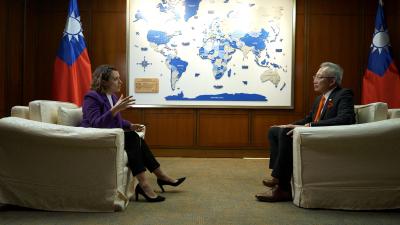
“China is preparing to invade Taiwan,” Deputy Minister of Foreign Affairs Francois Wu (吳志中) said in an exclusive interview with British media channel Sky News for a special report titled, “Is Taiwan ready for a Chinese invasion?” the Ministry of Foreign Affairs said today in a statement. The 25-minute-long special report by Helen Ann-Smith released yesterday saw Sky News travel to Penghu, Taoyuan and Taipei to discuss the possibility of a Chinese invasion and how Taiwan is preparing for an attack. The film observed emergency response drills, interviewed baseball fans at the Taipei Dome on their views of US President

ECONOMIC BENEFITS: The imports from Belize would replace those from Honduras, whose shrimp exports have dropped 67 percent since cutting ties in 2023 Maintaining ties with Taiwan has economic benefits, Ministry of Foreign Affairs officials said yesterday, citing the approval of frozen whiteleg shrimp imports from Belize by the Food and Drug Administration (FDA) as an example. The FDA on Wednesday approved the tariff-free imports from Belize after the whiteleg shrimp passed the Systematic Inspection of Imported Food, which would continue to boost mutual trade, the ministry said. Taiwan’s annual consumption of whiteleg shrimps stands at 30,000 tonnes, far exceeding domestic production, the ministry said. Taiwan used to fill the gap by importing shrimps from Honduras, but purchases slumped after Tegucigalpa severed diplomatic ties with Taiwan

The Executive Yuan yesterday approved a southwestern extension of the Sanying MRT Line from New Taipei to Bade District (八德) in Taoyuan, with a goal of starting construction by late 2026. The 4.03-kilometer extension, featuring three new stations, will run from the current terminus at Yingtao Fude Station (LB12) in New Taipei City to Dannan Station (LB14), where it will connect with Taoyuan’s Green Line, New Taipei City Metro Corp said in a statement. This extension will follow the completion of core Sanying Line, a 14.29-kilometer medium-capacity system linking Tucheng (土城), Sansia (三峽)
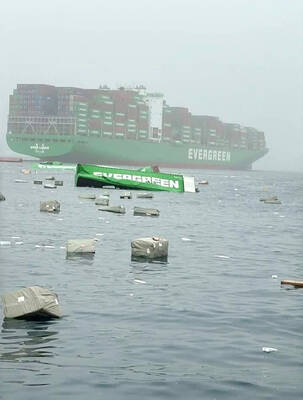
CARGO LOSS: About 50 containers at the stern of the ‘Ever Lunar’ cargo ship went overboard, prompting the temporary closure of the port and disrupting operations Evergreen Marine Corp, Taiwan’s largest container shipper, yesterday said that all crew members aboard the Ever Lunar (長月) were safe after dozens of containers fell overboard off the coast of Peru the previous day. The incident occurred at 9:40am on Friday as the Ever Lunar was anchored and waiting to enter the Port of Callao when it suddenly experienced severe rolling, Evergreen said in a statement. The rolling, which caused the containers to fall, might have been caused by factors including a tsunami triggered by an earthquake in Russia, poor winter sea conditions in South America or a sudden influx of waves,


 RSS
RSS