


By Chen Yun and Jason Pan
Sunflower movement activists returned to the site of their protest nine years ago at the Legislative Yuan to voice their opposition to negotiating with China on a cross-strait service trade agreement, as advocated by presidential aspirants of the major opposition parties.
Justin Wu (吳崢), also known as Wu Cheng, the media liaison section head of the 2014 movement, and Tseng Po-yu (曾柏瑜), a spokeswoman during the protests, led yesterday morning the activists at the front gate of the Legislative Yuan for the media briefing.
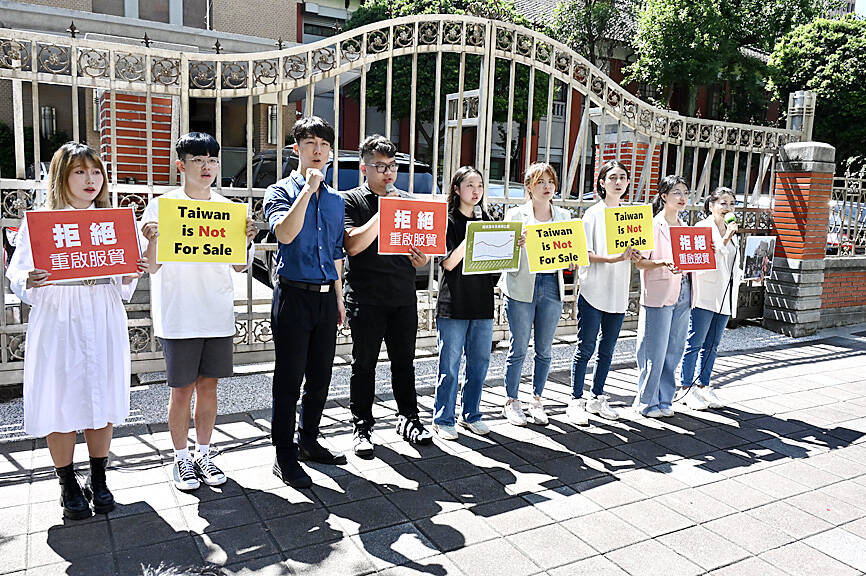
Photo: George Tsorng, Taipei Times
They were joined by Democratic Progressive Party (DPP) Legislator Michelle Lin (林楚茵), along with university students and DPP youth staffers, holding up placards that displayed, “Taiwan is not for sale” and “We refuse to restart the CSSTA” (the cross-strait service trade agreement).
Wu pointed out that during many years, Chinese Nationalist Party’s (KMT) cross-strait policy has centered on striving for closer relations, with the KMT’s endless cycle of pro-China mantras, such as “we must engage with China,” and “doing business with China,” but to the detriment of Taiwan’s citizens.
“Ko Wen-je (柯文哲) and Hou You-yi (侯友宜), as presidential candidates for their respective parties, should work to lead Taiwan and its citizens, to endeavor for the best interest for all Taiwan’s people. But their priority is based on political doctrine, that they are pro-China in all their policy considerations,” Wu said.
“Ko and Hou even are subservient, working to please China, fawning over Chinese leaders ... but it is years after the Sunflower movement, and we must not retread on that path, and we must not sacrifice Taiwan’s next youth generation, to take up the China-friendly policies of their respective parties,” he said.
When under the KMT government in the past, Taiwanese workers had low wages, and still wanted to open the doors for Chinese businesses and capital investment, by which China could take control of Taiwan’s service sectors and many industries, Wu added.
“At that time, with Ma Ying-jeou (馬英九) in power as president for which he and KMT’s economic policies had the basic monthly salary for young people at ‘22K’ [NT$22,000]. It made Taiwan’s college-level graduates to become ‘low-end labor workers’ for starting their job after finishing school. Then Ma and KMT pushed for CSSTA with China, which would worsen the conditions for young people and most workers in our society,” he said.
“Fortunately Taiwan’s young people, civic society groups, and DPP members stood up to fight against it, for the Sunflower movement to succeed in blocking off the cross-strait service trade agreement, stopping it from getting passed in the legislature,” Wu said.
“But now nearly a decade later, it is lamentable to see Ko and Hou are advocating to restart on negotiating with China for the CSSTA,” he added.
Formerly a member of the New Power Party (NPP) who ran under the party’s banner for a city council seat, Wu recently joined the DPP, so that the party would nominate him to run for a legislative seat in New Taipei City for the next year’s elections.
“They must explain to the public, why restart CSSTA talks one decade later? Why they want to treat Taiwan’s young people like this? If the cross-strait agreement gets approved, then China with its huge labor workforce will take over, leaving our yound people with lower wages,” Tseng said.
“The more Chinese youth coming to Taiwan for work under the CSSTA, that amount of Taiwanese youth will have no job,” she said. “Taiwan needs to reach into the worldwide markets, for internationalization to improve our nation’s economy ... China has not altered its ambition to invade Taiwan by force, and no matter how nice the exterior packaging, China is pushing for economic growth and market force to subjugate Taiwan under its rule.”
Tseng was formerly with the NPP and Green Party Taiwan, and has served as an independent city councilor in New Taipei City since last year, she became a DPP member in May.

Considering that most countries issue more than five denominations of banknotes, the central bank has decided to redesign all five denominations, the bank said as it prepares for the first major overhaul of the banknotes in more than 24 years. Central bank Governor Yang Chin-lung (楊金龍) is expected to report to the Legislative Yuan today on the bank’s operations and the redesign’s progress. The bank in a report sent to the legislature ahead of today’s meeting said it had commissioned a survey on the public’s preferences. Survey results showed that NT$100 and NT$1,000 banknotes are the most commonly used, while NT$200 and NT$2,000

The Centers for Disease Control (CDC) yesterday reported the first case of a new COVID-19 subvariant — BA.3.2 — in a 10-year-old Singaporean girl who had a fever upon arrival in Taiwan and tested positive for the disease. The girl left Taiwan on March 20 and the case did not have a direct impact on the local community, it said. The WHO added the BA.3.2 strain to its list of Variants Under Monitoring in December last year, but this was the first imported case of the COVID-19 variant in Taiwan, CDC Deputy Director-General Lin Ming-cheng (林明誠) said. The girl arrived in Taiwan on

South Korea is planning to revise its controversial electronic arrival card, a step Taiwanese officials said prompted them to hold off on planned retaliatory measures, a South Korean media report said yesterday. A Yonhap News Agency report said that the South Korean Ministry of Foreign Affairs is planning to remove the “previous departure place” and “next destination” fields from its e-arrival card system. The plan, reached after interagency consultations, is under review and aims to simplify entry procedures and align the electronic form with the paper version, a South Korean ministry official said. The fields — which appeared only on the electronic form

The Ministry of Foreign Affairs (MOFA) is suspending retaliation measures against South Korea that were set to take effect tomorrow, after Seoul said it is updating its e-arrival system, MOFA said today. The measures were to be a new round of retaliation after Taiwan on March 1 changed South Korea's designation on government-issued alien resident certificates held by South Korean nationals to "South Korea” from the "Republic of Korea," the country’s official name. The move came after months of protests to Seoul over its listing of Taiwan as "China (Taiwan)" in dropdown menus on its new online immigration entry system. MOFA last week


 RSS
RSS