


Taiwanese medical organizations should seek to improve cooperation with peers in the US, Premier Chen Chien-jen (陳建仁) told a forum in Taipei on Monday.
Chen made the statement during a speech at a forum on Taiwan-US cooperation in the medical field held by the North American Taiwanese Medical Association (NATMA).
NATMA makes important contributions to the Taiwanese community in the US, and is at the forefront of the fight for Taiwan to gain participation in the WHO, he said.
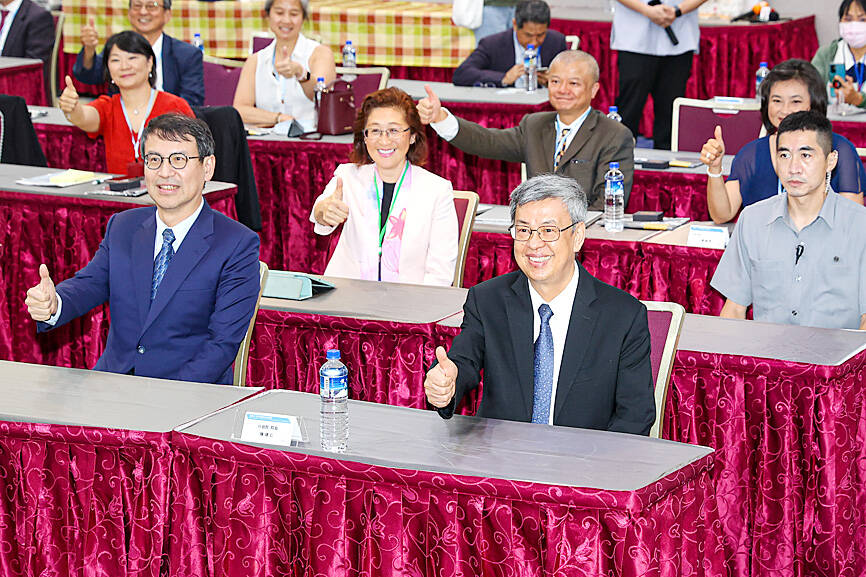
Photo: CNA
Commenting on a delegation to Taiwan of Taiwanese-American doctors led by NATMA, Chen said that such interactions could bolster bilateral cooperation in the medical industry.
Taiwan’s achievements in medical treatment could be shared with US healthcare professionals, he added.
For example, the Indigenous Peoples’ Health Care Act (原住民族健康法), passed last month, demonstrated Taiwan’s commitment to equal access to healthcare, Chen said.
In Numbeo’s global Health Care Index by Country, Taiwan has ranked first for four consecutive years due in part to its emphasis on equal access to high-quality healthcare, he said.
Despite Taiwan’s exclusion from the WHO, the country’s achievements in healthcare, which include providing medical assistance and training within the global community, its experience in combating the spread of infectious diseases during pandemics, and its research and development of vaccines and drugs show that “Taiwan can help,” he said.
Cooperation with the US improved during the COVID-19 pandemic through the signing of a memorandum of understanding (MOU) on medical exchanges signed in 2020, he said, adding that the MOU paved the way for further cooperation.
On a global scale, both countries could be good partners in bolstering health security, providing emergency medical care, preventing the spread of infectious diseases, achieving developments in digital health and combating chronic diseases, he said.
Taiwan is also playing an important role in the US’ cancer prevention and control plan, he added.
Chen described the US as being a leader in medical education and the medical industry as a whole, saying that the US and Taiwan shared this prowess in medicine.
Describing an area of the industry where Taiwan excels, Chen said that Taiwanese medical researchers understand the growing importance of artificial intelligence in the field of medical care.
Big data stored in databases by the National Health Insurance Administration have helped researchers study the relationship between genes and diseases, he said.
Taiwan and the US could make great advances in such research with greater cooperation, he said.

FUKUOKA SITUATION: Japanese media reported that the pathogen is expected to be identified by the summer, while the CDC downplayed the idea that it was hMPV A “mysterious cold-like illness” reported in Japan’s Fukuoka Prefecture does not seem to be a new disease, but Japanese authorities have been asked about the situation, the Centers for Disease Control (CDC) said yesterday. The Fukuoka Prefectural Medical Association on Wednesday told a news conference that a “mystery cold” that has become a hot topic on social media is “highly likely to be caused by some kind of viral infection,” Japan’s KBC News reported. “Many people are experiencing symptoms starting with a sore throat, followed by a runny nose, phlegm and a severe cough,” KBC News reported, citing association officials. Health authorities are

Nvidia Corp CEO Jensen Huang (黃仁勳) arrived in Taiwan yesterday ahead of upcoming AI and technology events, saying he plans to meet with clients and Taiwan Semiconductor Manufacturing Co Chairman C.C. Wei (魏哲家) during his visit. After landing at Taipei Songshan Airport, Huang posed for photos with fans and handed out Yakult drinks to reporters and supporters waiting at the scene, saying he has “a lot to do” during the trip. Asked about reports that Nvidia’s planned headquarters site in Taipei’s Beitou Shilin Technology Park could break ground on May 27, Huang said that if the company holds an event, he would

The Ministry of Finance this afternoon announced the winning numbers for the March-April uniform invoice lottery. The winning number for the NT$10 million (US$318,060) special prize is 19531471, and the winning number for the NT$2 million grand prize is 85941329. Three numbers were drawn for the NT$200,000 first prize: 07225810, 20231230 and 83518781. Those with receipts matching the last seven digits of any of the first-prize numbers will win the NT$40,000 second prize, while those matching the last six digits will win the NT$10,000 third prize. Those whose receipts match the last five digits of the first-prize numbers can claim the NT$4,000 fourth prize,
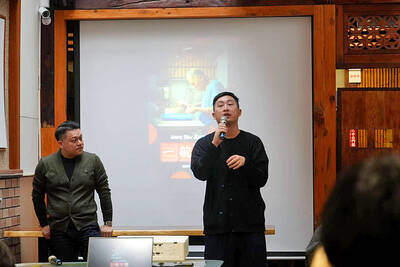
Taiwan Travelogue (臺灣漫遊錄), which earlier this week became the first Taiwanese novel to win the International Booker Prize, is to be adapted into a television series through a Taiwan-Japan coproduction, producer Chang Chen-yu (張辰漁) said yesterday. Chang, a producer at World Softest Production Film Co, wrote on Facebook that the company had been searching for projects with international appeal that retain a strong Taiwanese identity after colleagues and Japanese partners strongly recommended the novel. After reading the book, Chang said he immediately decided to pursue the screen rights. “A great story has the power to transcend time and borders, and connect countless people,”


 RSS
RSS