


The Mainland Affairs Council (MAC) yesterday said that Beijing was spouting futile propaganda after Chinese Communist Party (CCP) Politburo Standing Committee member Wang Huning (王滬寧) unveiled a plan to transform China’s Fujian Province into a showcase zone for “Taiwan’s economic integration into China.”
Wang made the remarks at the Straits Forum in Xiamen earlier in the day.
The MAC said the CCP has long used the forum to push its “united front” agenda against Taiwan.
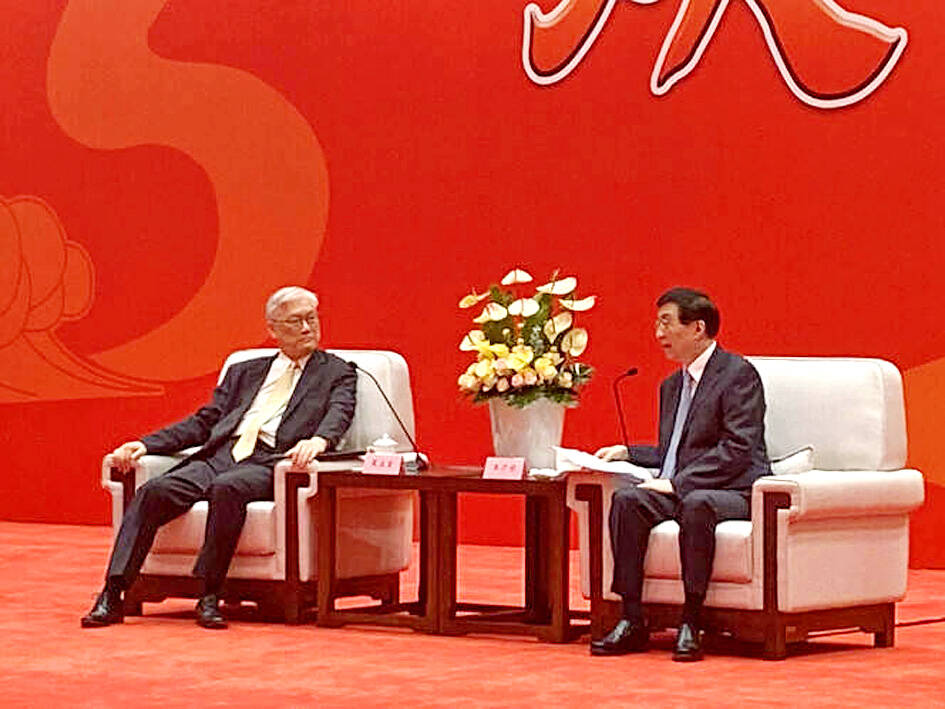
Photo courtesy of the KMT
Beijing’s ignorance of Taiwanese aspirations and its constant belittlement of the nation renders its propaganda campaign an exercise in futility, the council said.
China would be better served to halt its menacing military drills and display honest goodwill than wasting money and labor on ritualistic propaganda events to which Taiwanese are indifferent, it said.
Beijing can make a positive contribution to cross-strait relations by lifting restrictions on Chinese visiting or studying in Taiwan, the council said, adding that they would benefit from experiencing democracy and freedom.
The Straits Forum, an annual conference between China and Taiwan, started in 2009 with the aim of promoting grassroots interactions, economic and trade exchanges, and cultural integration.
Among those who attended this year’s forum were a delegation led by Chinese Nationalist Party (KMT) Vice Chairman Andrew Hsia (夏立言) and Chang Kai-chun (張凱鈞), chairman of the Taiwan People’s Party’s Taiwanese Businesspeople Affairs Committee.
The Democratic Progressive Party (DPP) said in a statement that the forum’s goal “to work together in realizing the goal of peacefully uniting the motherland” clearly states its intentions to bring about unification.
The forum is nothing but a large-scale “united front” rhetoric platform, the statement said.
The CCP claims it is initiating dialogue and trying to work with Taiwan, but it is also stepping up its military threats against Taiwan, the DPP said, adding that the strategy did not foster healthy and orderly interactions.
Hsia and Chang should be on the alert for Chinese political machinations, and must not inadvertently harm Taiwan’s interests and dignity, the DPP added.
Additional reporting by Chen Cheng-yu

Fast food chain McDonald's is to raise prices by up to NT$5 on some products at its restaurants across Taiwan, starting on Wednesday next week, the company announced today. The prices of all extra value meals and sharing boxes are to increase by NT$5, while breakfast combos and creamy corn soup would go up by NT$3, the company said in a statement. The price of the main items of those meals, if ordered individually, would remain the same. Meanwhile, the price of a medium-sized lemon iced tea and hot cappuccino would rise by NT$3, extra dipping sauces for chicken nuggets would go up

Yangmingshan National Park’s Qingtiangang (擎天崗) nature area has gone viral after a park livestream camera observed a couple in the throes of intimate congress, which was broadcast live on YouTube, drawing large late-night crowds and sparking a backlash over noise, bright lights and disruption to wildlife habitat. The area’s livestream footage appeared to show a couple engaging in sexual activity on a picnic table in the park on Friday last week, with the uncensored footage streamed publicly online. The footage quickly spread across social media, prompting a tide of visitors to travel to the site to “check in” and recreate the

Minister of Digital Affairs Lin Yi-ching (林宜敬) yesterday cited regulatory issues and national security concerns as an expert said that Taiwan is among the few Asian regions without Starlink. Lin made the remarks on Facebook after funP Innovation Group chief executive officer Nathan Chiu (邱繼弘) on Friday said Taiwan and four other countries in Asia — China, North Korea, Afghanistan and Syria — have no access to Starlink. Starlink has become available in 166 countries worldwide, including Ukraine, Malaysia, the Philippines and Vietnam, in the six years since it became commercial, he said. While China and North Korea block Starlink, Syria is not
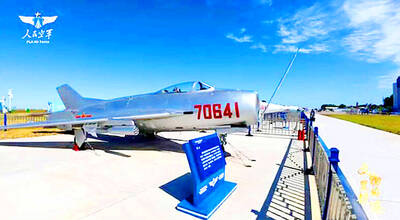
GROUNDED: A KMT lawmaker proposed eliminating drone development programs and freezing funding for counterdrone systems, despite China’s adoption of the technology China has deployed attack drones at air bases near the Taiwan Strait in a strategy aimed at overwhelming Taiwan’s air defense systems through saturation attacks, the Mainland Affairs Council (MAC) said. The council’s latest quarterly report on China said that satellite imagery and open-source intelligence indicate that the Chinese People’s Liberation Army (PLA) had converted retired J-6 fighter jets into J-6W drones, which the PLA has stationed at six air bases near Taiwan, five in China’s Fujian Province and one in Guangdong Province. The report cited J. Michael Dahm, a senior fellow at the US-based Mitchell Institute, as saying that China has


 RSS
RSS