

Two people yesterday came forward in support of veteran journalist Tung Cheng-yu’s (董成瑜) accusations of sexual harassment against Chinese Nationalist Party (KMT) Legislator Fu Kun-chi (傅?萁) during a social function in 2014.
Mirror Media managing director Pei Wei (裴偉) said in an interview that he had attended the event at Taipei Regent Hotel and saw what happened.
“To this day, Fu and people in the pan-blue camp have not apologized to the victim. This is most ironic, considering all the incidents that have come out in this wave of the #MeToo movement,” said Pei, who was the managing editor of Next Magazine at the time.
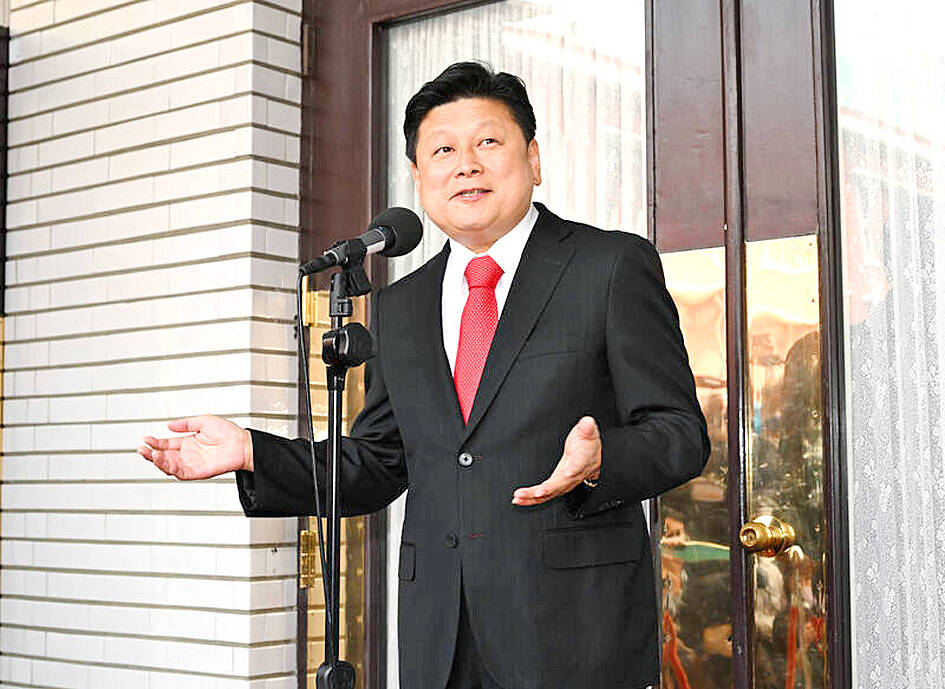
Photo: Taipei Times
Several KMT figures were also at the function, including former Taipei mayor Hau Lung-bin (郝龍斌), Pei said.
Pei said he heard Tung, then the deputy chief editor of Next Magazine, shouting in anger at Fu, who was the Hualien County commissioner at the time. He went to check what happened and spoke to other people at the function, including Tung.
“I confronted Fu about his actions against Tung, our magazine’s deputy chief editor. Fu was flustered, but he did not apologize,” Pei said.
Tung, currently the general manager of Mirror Fiction, went public with the allegations on June 3.
Tung said she and Fu were talking when he suddenly grabbed her hand. She resisted and slowly withdrew her hand, but Fu forcibly kissed her.
“Most women would likely bear it to save face, as he and several other men at the table were powerful politicians. But I did not. My immediate reaction was to push him and get away,” Tung said.
She recounted yelling loudly at Fu: “What are you doing? Please have some self-respect.”
Another witness was journalist Lee Tung-hao (李桐豪), who worked under Pei and Tung covering politics.
Lee yesterday posted a message saying he witnessed the incident.
Lee wrote that it was a special event ahead of the nine-in-one elections scheduled later that month. The elections included a tight race for Taipei mayor between then-independent candidate Ko Wen-je (柯文哲) and the KMT’s Sean Lien (連勝文).
Lee and Pei said they came forward because Fu had denied the incident.
“Throughout my two decades in politics, I have never used political power to sexually harass any woman or any subordinate... I respect and support gender equality, and if someone wants to accuse me of doing so, they should file a lawsuit,” Fu wrote.
Separately yesterday, independent Yunlin County Councilor Chen Fang-ying (陳芳盈) told a news briefing that media personality Chu Kai-hsiang (朱凱翔) had sexually harassed her, adding that he was a repeat offender and had harassed at least 10 women.
Chen was accompanied by other victims and female politicians, including a woman identified as “Z.”
Aside from sexual harassment, “Z” accused Chu of using cybertactics to smear her reputation in an attempt to silence her and other victims.
Meanwhile, the Taipei Public Works Department yesterday said that a security guard employed by its Parks and Street Lights Office has been dismissed from his job after an investigation over allegations of several incidents of sexual misconduct.
There was sufficient evidence to substantiate the allegations against him, the department said in a news release.
Several of the guard’s female accusers last week went public, saying supervisors at the parks office did not act on their complaints.
At a news conference, two of the accusers, who were joined by Taipei City Councilor Hung Wan-jen (洪婉臻), alleged that the security guard, a man in his 60s, verbally harassed and touched multiple female colleagues without their consent.
Hung said that six women have made allegations about being harassed since 2018.
The incident prompted Taipei Mayor Chiang Wan-an (蔣萬安) to launch an investigation, saying there is “definitely zero tolerance” for sexual misconduct.
The department said office Director Hwang Shwu-ru (黃淑如) also asked to be disciplined for her poor handling of the incident.
Taipei City Government spokesperson Yin Wei (殷瑋) said in conjunction with local non-governmental groups that the administration plans to set up next month a “#MeToo sexual harassment complaint and consultation hotline.”
Additional reporting by CNA

The National Police Agency’s Third Special Police Corps yesterday said that from May to July, it intercepted five smuggling operations from China, seizing more than 70,000 counterfeit Beyblades with an estimated infringement value of NT$34.45 million (US$1.08 million). It added that any bootleg unit that reached the local market could present hidden health hazards to players. Beyblades, a line of spinning toy tops used in competitive gaming and developed in Japan by toy company Takara Tomy, have become popular in Taiwan, making them a target for fraudsters. The Third Special Police Corps, dedicated to safeguarding maritime borders and trade lines,

Five customers who made purchases at 7-Eleven stores across Taiwan won the top NT$10 million (US$313,716) special prize in the July-August uniform invoice lottery, including one who spent just NT$27 on photocopying, the convenience store chain said today. The five special prize winners made their purchases at stores in Taoyuan, Taipei, Taichung and Kaohsiung, 7-Eleven operator President Chain Store Corp said. The five winning purchases included NT$29 spent on snacks at a store in Taoyuan's Zhongli District (中壢), NT$27 on photocopying at a store in Taipei's Zhongzheng District (中正), NT$139 on City Cafe coffee and daily necessities at a store in Taipei's
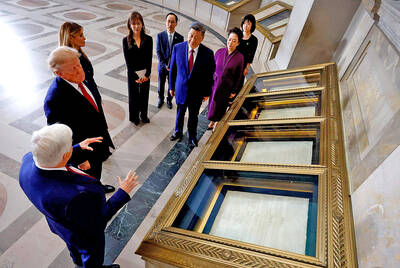
Chinese President Xi Jinping (習近平) reportedly cut short his visit to the National Archives in Washington after the Chinese delegation objected to plans to view the Treaty of San Francisco, sources in Washington’s media circles said. Xi and his wife, Peng Liyuan (彭麗媛), concluded their three-day state visit to the US on Friday after having tea with US President Donald Trump and first lady Melania Trump at the White House and visiting the archives. Chinese democracy advocates and members of pro-China groups gathered outside the venue during Xi’s visit, with the two groups exchanging competing slogans while police kept them separated. The US

TRICKY ISSUE: Taiwan’s defense of the ROC in WWII could conflict with the government’s narrative on Taiwanese history and identity, an academic said Chinese President Xi Jinping (習近平) had no standing to discuss US-China relations in World War II (WWII), as the People’s Republic of China did not exist at that time, Mainland Affairs Council (MAC) Deputy Minister Shen Yu-chung (沈有忠) said yesterday. Taipei would ensure that Washington has a clear understanding that it was the Republic of China (ROC), not the People’s Republic of China (PRC), that was a steadfast ally of the US in WWII, Shen said. Shen was referring to a White House fact sheet released on Friday about Xi’s meeting with US President Donald Trump in Washington. It said that “the two


 RSS
RSS