


The National Taiwan University (NTU) Student Association yesterday issued an apology on Facebook, after a student raised a banner at an event that was deemed hateful toward indigenous people.
The association has designated this month as “free speech month,” during which students are invited to hang banners on campus to have their messages heard.
One student’s banner used a play on an idiom meaning “to be very angry” (huo mao san zhang, 火冒三丈), in reference to a government policy that grants indigenous students an extra 35 percent in an evaluation system that exempts some students from admission tests when applying to universities.
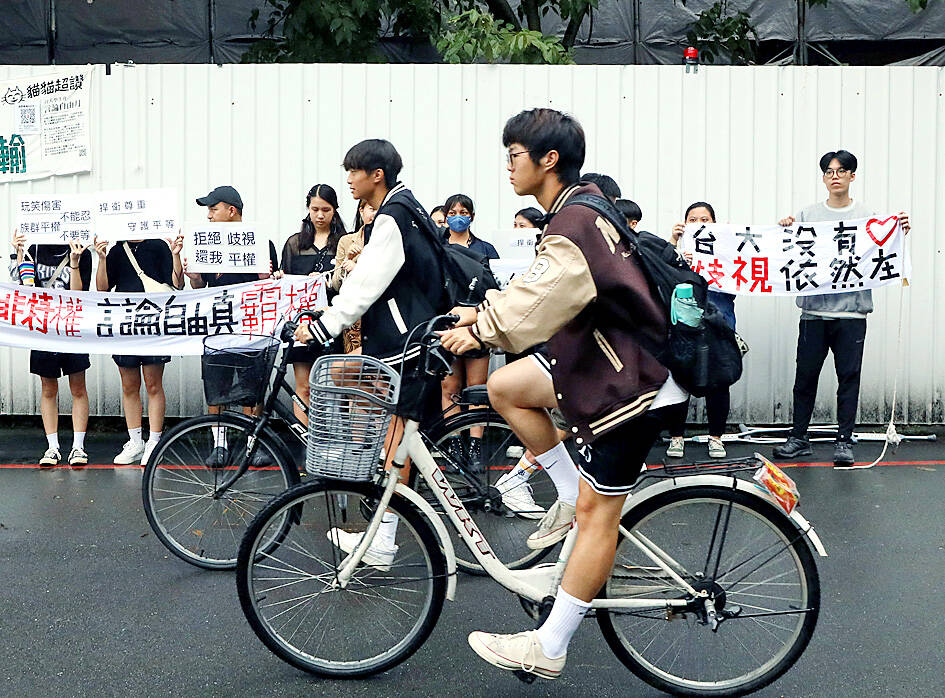
Photo: CNA
In their description of the banner submitted to the association, the student who made the banner wrote that “special privileges granted to indigenous peoples are an example of the government’s tyranny over the ‘people of the plains.’”
A group of indigenous students on Friday held a protest, where they called the banner’s message “discriminatory” and demanded an apology.
Another banner called for a ban on blood donations from gay men, which similarly resulted in complaints of discrimination.
The association yesterday said it had been negligent in organizing the event, as it had not created a mechanism to identify and prevent hate speech.
It said one mistake it later identified was that banners were not designed for their creators to explain their message in better detail.
The purpose of the event was to promote public discussion, but a failure to acknowledge the interpretive gap had exacerbated the inequality of power relations between ethnic groups, it said.
“It is also a serious deficiency of the student union that it has not been able to establish a sufficiently complete mechanism to actively promote dialogue in a substantive sense,” it wrote.
In related news, two candidates on the same ticket in an NTU student election could face penalties ranging from an official reprimand to expulsion, due to crude and discriminatory language they used in their campaign platform.
NTU said the two candidates in the Department of Economics’ student association elections had been referred to the university’s Gender Equality Committee over their offensive policy proposals, which were posted on the student association’s Facebook page.
Among the appeals in the students’ platform were statements such as “LGBTQ people and dogs are not allowed to play the online game Arena of Valor in the association’s office,” “Those who graduate without a boyfriend or girlfriend must be surgically sterilized,” and “People who have a body mass index of more than 20 will be prohibited from taking an elevator.”
The remarks caused a strong public backlash, including from the minister of education, prompting the candidates to apologize and suspend their election campaign on Sunday.
According to NTU, after receiving a case referral, the committee must decide within 20 days whether to hear it.
If it does accept the case, the committee assigns it to a working group to complete an investigation within two months, which it then submits, along with its recommended punishment, to NTU’s Student Rewards and Disciplinary Committee.

UPGRADE: The Kang Ding-class frigate is replacing its Chaparall missiles with Tien Chien II and Hua Yang VLS, which would provide it with long-range, 360° air defense Taiwan plans to produce 1,200 to 1,376 Hai Chien II missiles (海劍二, Sea Sword II) — also known as TC-2N — to serve as the standard air defense system of the navy’s surface combatant fleet, a source said yesterday. Last week, the Hai Chien II, the naval version of the Tien Kung II missile (天劍二, Sky Sword II), completed a live-fire test in waters off the National Chungshan Institute of Science and Technology’s Jiupeng facility (九鵬) in Pingtung County’s Manjhou Township (滿州). The MIM72 Chaparral and other dated air defense missiles that currently arm Taiwanese ships have inadequate range to combat Chinese

REASONS FOR TRAVEL: An assistant professor said that proposed amendments to penalize drivers if they used drugs overseas would not deter people from traveling People who operate a motor vehicle under the influence of marijuana would have their driver’s license revoked, even if they used the substance while overseas, the Ministry of Transportation and Communications said yesterday, citing proposed amendments to the Road Traffic Management and Penalty Act (道路交通管理處罰條例). The amendments would also authorize the government to revoke the licenses of people determined to have used Category 1 or Category 2 narcotics, even if they were not operating a vehicle while under the influence of drugs, as well as ban them from taking the license test for three years, the ministry said. People aged 18 or

HEAVY WEATHER: Typhoon Jangmi is due to crash straight into the Ryukyus as airlines look to shift flights to larger aircraft or cancel flights to Okinawa entirely Taiwan’s international air carriers announced flight adjustments over the weekend as Typhoon Jangmi is forecast to hit the Ryukyu Islands today and tomorrow. The Central Weather Administration (CWA) upgraded Jangmi from a tropical storm to a typhoon at 8am yesterday, with the eye located 580km south of Naha city. It was moving north at 19kph. Today, China Airlines’ CI-120, CI-121, CI-122 and CI-123 flights between Taoyuan and Naha, Okinawa, have been canceled as well as CI-132 and CI-133 between Kaohsiung and Naha. EVA Air’s BR-112, BR-113, BR-186 and BR-185 flights between Taoyuan and Naha are also canceled. Low-cost carrier Tigerair Taiwan canceled IT-230,
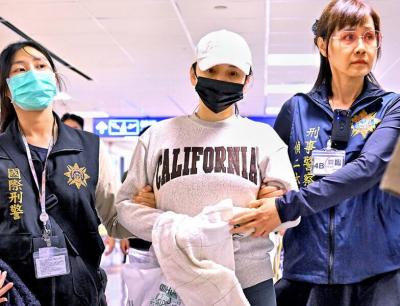
Johanne Liou (劉喬安), a Taiwanese woman who shot to unwanted fame during the Sunflower movement protests in 2014, returned to Taiwan last night after being deported from the US. She is to stand trial in Taiwan for charges involving embezzlement, fraud and drug crimes. The Criminal Investigation Bureau (CIB) said it took her into custody at Taiwan Taoyuan International Airport and would first question her before transferring her to the New Taipei District Prosecutors’ Office. She was arrested upon disembarking a flight from San Francisco that landed shortly before 7pm. Liou absconded to the US in 2019 after jumping bail


 RSS
RSS