


Taiwan High Speed Rail Corp (THSRC) and Hitachi Toshiba Supreme Consortium in Tokyo yesterday signed a procurement contract for next-generation high-speed trains.
THSRC’s board of directors in March passed a resolution authorizing management to spend about NT$28.5 billion (US$926.35 million) to procure 12 next-generation high-speed trains from the Japanese firm.
Representative to Japan Frank Hsieh (謝長廷), Deputy Minister of Transportation and Communications Allen Hu (胡湘麟) and executives from the two firms attended the ceremony.
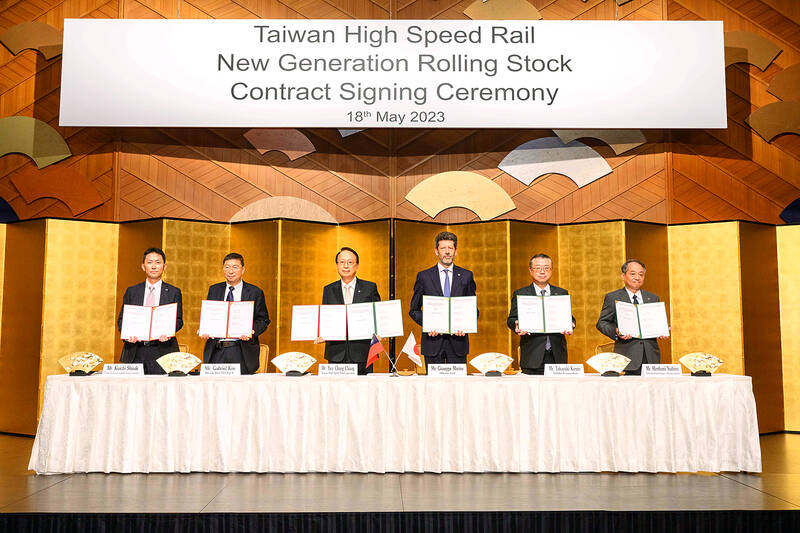
Photo courtesy of Taiwan High Speed Rail Corp
THSRC chairman Chiang Yao-chung (江耀宗) told the ceremony that high-speed rail services in Taiwan are a result of Japan’s Shinkansen system being successfully exported.
“Since Taiwan’s high-speed rail was launched in 2007, total passenger volume has exceeded 770 million,” Chiang said. “Operations have recovered rapidly as the COVID-19 pandemic has eased. Last month, the daily average of passengers accessing the system was 207,000, an all-time high,” he said.
“Modeled after the latest N700S, the new trains would enhance THSRC’s transport capacity and provide passengers with higher-quality services,” he said.
Next-generation rolling stock is expected to be delivered in batches starting in 2026 and the new trains are to begin operations in 2027, THSRC said.
Compared with the existing 700T trains, the new trains are more energy efficient, as they are lighter and are more streamlined, it said.
Each passenger seat would be equipped with a 110V charging socket, the company said.
Cabins would be equipped with full-color LCD information displays, arrival lights and two-tier luggage racks, the company said.
Chinese-language media reported that the first two tenders for the procurement contract failed because Japanese firms offered NT$5 billion per set of trains.
The deal was finalized after the price was reduced to NT$2.3 billion, the reports said.
Last year, Japanese House of Representatives member Keiji Furuya, chairman of the Japan-Republic of China Diet Members’ Consultative Council, raised the issue of THSRC’s procurement of new high-speed rail cars from Japan at a meeting with President Tsai Ing-wen (蔡英文).
The high-speed rail system “is a symbol of the solid friendship between Taiwan and Japan, for which the two countries must cooperate,” Furuya said at the time.

Kenting National Park service technician Yang Jien-fon (楊政峰) won a silver award in World Grand Prix Photography Awards Spring Season for his photograph of two male rat snakes intertwined in combat. Yang’s colleagues at Kenting National Park said he is a master of nature photography who has been held back by his job in civil service. The awards accept entries in all four seasons across six categories: architectural and urban photography, black-and-white and fine art photography, commercial and fashion photography, documentary and people photography, nature and experimental photography, and mobile photography. Awards are ranked according to scores and divided into platinum, gold and

More than half of the bamboo vipers captured in Tainan in the past few years were found in the city’s Sinhua District (新化), while other districts had smaller catches or none at all. Every year, Tainan captures about 6,000 snakes which have made their way into people’s homes. Of the six major venomous snakes in Taiwan, the cobra, the many-banded krait, the brown-spotted pit viper and the bamboo viper are the most frequently captured. The high concentration of bamboo vipers captured in Sinhua District is puzzling. Tainan Agriculture Bureau Forestry and Nature Conservation Division head Chu Chien-ming (朱健明) earlier this week said that the
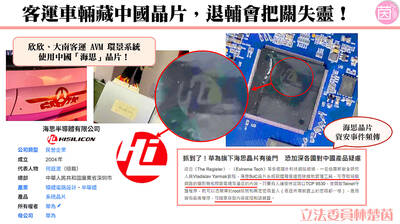
BREACH OF CONTRACT: The bus operators would seek compensation and have demanded that the manufacturer replace the chips with ones that meet regulations Two bus operators found to be using buses with China-made chips are to demand that the original manufacturers replace the systems and provide compensation for breach of contract, the Veterans Affairs Council said yesterday. Democratic Progressive Party Legislator Michelle Lin (林楚茵) yesterday said that Da Nan Bus Co and Shin-Shin Bus Co Ltd have fielded a total of 82 buses that are using Chinese chips. The bus models were made by Tron-E, while the systems provider was CYE Electronics, Lin said. Lin alleged that the buses were using chips manufactured by Huawei subsidiary HiSilicon Co, which presents a national security risk if the

The National Immigration Agency has banned two Chinese from returning to Taiwan, after they published social media content it described as disrespectful to national sovereignty. The agency imposed a two-month ban on a Chinese man surnamed Liang (梁) and a permanent ban on a woman surnamed Yang (楊), an influencer with 23 million followers, in October last year and last week respectively. Minister of the Interior Liu Shyh-fang (劉世芳) yesterday said on the sidelines of a legislative meeting that Chinese visitors to Taiwan are required to comply with the rules and regulations governing their entry permits. The government has handled the ban and


 RSS
RSS