


The Civil Aeronautics Administration yesterday asked Starlux Airlines to issue an explanation after more than 300 Taiwanese passengers were stranded at Narita International Airport in Japan on Saturday night due to flight delays caused by crosswinds and problems with the airline’s aircraft.
The airline said in a statement that Flight JX803 to Taipei was scheduled to take off from the Tokyo-area airport at 4:10pm on Saturday.
Due to an abnormality detected in the Airbus 350’s navigation system, it was obligated to conduct an inspection, which was not completed until 6:30pm, the airline said.
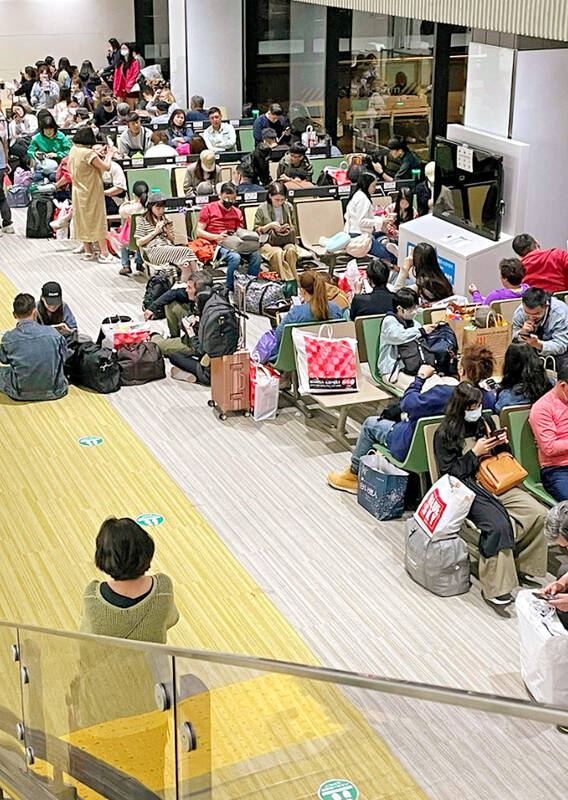
Photo courtesy of a reader
However, crosswinds disrupted flight operations at Narita that day, with many flights lining up for departure, the airline said.
As air traffic controllers continued to delay clearing JX803 for takeoff, potentially causing cabin crew to exceed their maximum working hours, the airline quickly dispatched two pilots to the airport to operate the flight, it said.
However, no flights were allowed to land or depart outside the airport’s operating hours, nor were passengers allowed to pass through customs, claim their luggage or leave the airport, the airline said.
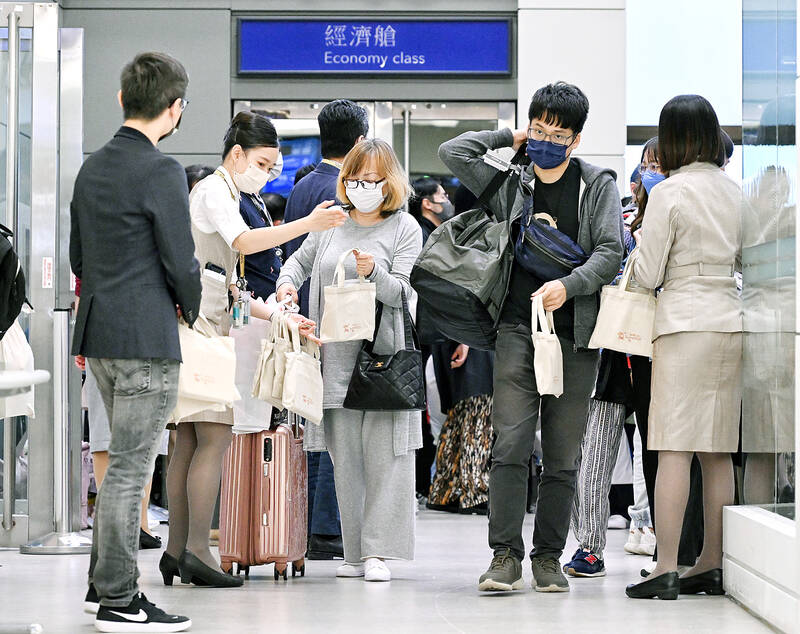
Photo: Tony Yao, Taipei Times
Starlux said it could only arrange for passengers to spend the night at the airport, providing them with sleeping bags, snacks and bottled water.
To facilitate the return of the passengers, 113 of the flight’s 302 passengers changed their tickets to return to Taiwan on EVA Airways flights, Starlux said.
The airline said it dispatched an Airbus A321 to bring back the remaining 189 passengers, who landed at Taiwan Taoyuan International Airport at 3:35pm yesterday.
Starlux Airlines chairman Chang Kuo-wei (張國煒) was among the four pilots dispatched by the airline to fly back the two A350s, the airline said.
“We are deeply sorry for the inconvenience, and passengers on flight JX803 will be entitled to a full refund of their round-trip tickets. We are doing everything we can to help them make other travel arrangements. We will also conduct a comprehensive review of the incident to make improvements,” the airline said in a statement.
The flight disruption also affected the airline’s flights to Los Angeles over the weekend.
Flight JX002 to the Californian city was rescheduled to depart at 11:40pm yesterday, while Flight JX001 was rescheduled to take off at 12:50am today.
The CAA weighed in on the disruptions in a statement yesterday.
“We asked Starlux Airlines to immediately explain how it handled the incident, including how flight operations were arranged and whether pilots took an appropriate course of action. The airline was also asked to review and address consumer protection issues arising from the cancelation and merger of flights,” the CAA said.
Prior to the delay of Flight JX803, Flight JX801 from Narita to Taoyuan, which was scheduled to take off at 1:55pm Saturday, was delayed because the arrival flight from Taoyuan was diverted to Nagoya airport due to cross winds. Even though the flight later completed its trip to Narita, Flight JX801 was canceled and merged with Flight JX803.
Chang apologized to the passengers who spent the night at Narita.
“The airport originally said it could allow flights to take off until 12:30am, but it later began a curfew at 12am. The management was under a lot of pressure as well, because noise caused by flights could trigger protests from residents near the airport,” Chang told reporters upon arrival at the Taoyuan.
Chang said the incidents occurred mainly because of the weather, but he said the airline’s handling of the issues was flawed as well.
Meanwhile, the Taoyuan Flight Attendants’ Union said Chang should apologize to crew members, accusing him of failing to take decisive action in time.
Flight attendants on routes between Taiwan and Japan often fly out and come back on the same day, causing many to work overtime, the union said.
The airline should have made personnel arrangements and communicated with passengers ahead of time, it said.

Yangmingshan National Park authorities yesterday urged visitors to respect public spaces and obey the law after a couple was caught on a camera livestream having sex at the park’s Qingtiangang (擎天崗) earlier in the day. The Shilin Police Precinct in Taipei said it has identified a suspect and his vehicle registration number, and would summon him for questioning. The case would be handled in accordance with public indecency charges, it added. The couple entered the park at about 11pm on Thursday and began fooling around by 1am yesterday, the police said, adding that the two were unaware of the park’s all-day live

A former soldier and an active-duty army officer were yesterday indicted for allegedly selling classified military training materials to a Chinese intelligence operative for a total of NT$79,440. The Taipei District Prosecutors’ Office indicted Chen Tai-yin (陳泰尹) and Lee Chun-ta (李俊達) for contravening the National Security Act (國家安全法) and the Anti-Corruption Act (貪污治罪條例). Chen left the military in September 2013 after serving alongside then-staff sergeant Lee, now an army lieutenant, at the 21st Artillery Command of the army’s Sixth Corps from 2011 to 2013, according to the indictment. Chen met a Chinese intelligence operative identified as “Wang” (王) through a friend in November
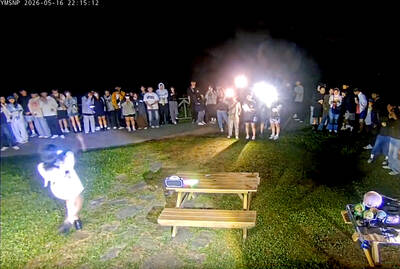
Yangmingshan National Park’s Qingtiangang (擎天崗) nature area has gone viral after a park livestream camera observed a couple in the throes of intimate congress, which was broadcast live on YouTube, drawing large late-night crowds and sparking a backlash over noise, bright lights and disruption to wildlife habitat. The area’s livestream footage appeared to show a couple engaging in sexual activity on a picnic table in the park on Friday last week, with the uncensored footage streamed publicly online. The footage quickly spread across social media, prompting a tide of visitors to travel to the site to “check in” and recreate the

Minister of Digital Affairs Lin Yi-ching (林宜敬) yesterday cited regulatory issues and national security concerns as an expert said that Taiwan is among the few Asian regions without Starlink. Lin made the remarks on Facebook after funP Innovation Group chief executive officer Nathan Chiu (邱繼弘) on Friday said Taiwan and four other countries in Asia — China, North Korea, Afghanistan and Syria — have no access to Starlink. Starlink has become available in 166 countries worldwide, including Ukraine, Malaysia, the Philippines and Vietnam, in the six years since it became commercial, he said. While China and North Korea block Starlink, Syria is not


 RSS
RSS