


An exhibition exploring the inner worlds of political prisoners during the White Terror era opens in Taipei today with an international award-winning virtual-
reality (VR) movie.
Inspired by and named after the VR movie The Man Who Couldn’t Leave (無法離開的人), the exhibition seeks to provide a glimpse of the “inner worlds” of several political prisoners who were deprived of their freedom and separated from their families, event producer Lin Mun-lee (林曼麗) told a news conference in Taipei on Thursday.
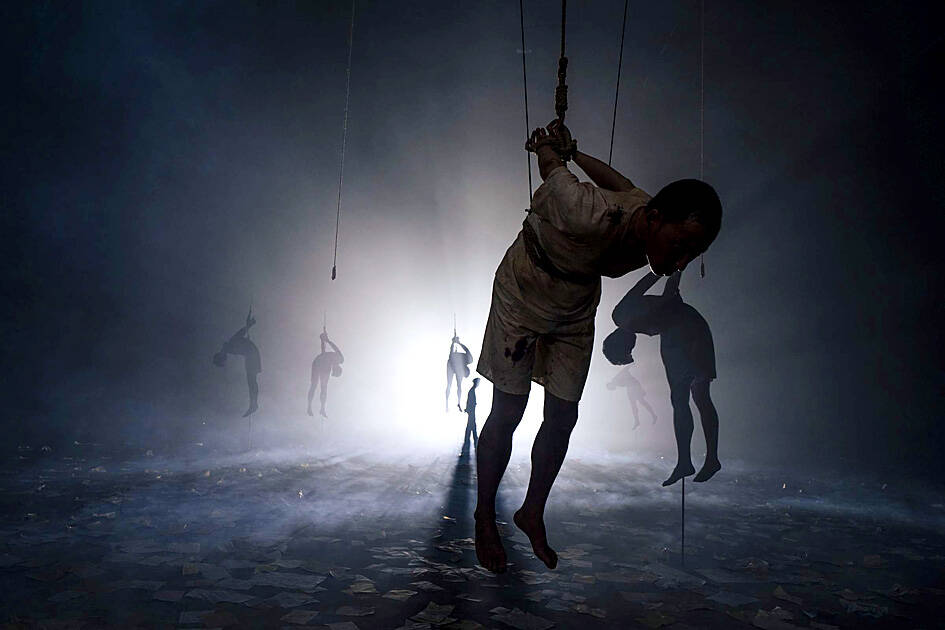
Photo courtesy of the Kaohsiung Film Archive
The exhibition, which runs until July 2 at the Museum of National Taipei University of Education, features copies of notes left behind by political prisoners from the White Terror era from 1949 to 1992 before they were executed by the then-Chinese Nationalist Party (KMT) government.
It also displays letters between political prisoners and their families, among other documents, photographs and objects preserved by their descendants.
In addition, works by two contemporary Taiwanese artists — sound recordings and music clips by Wang Yu-jun (王榆鈞) and woodcut artworks by Lee Chia-hung (李佳泓) — provide visitors with an “immersive” experience, Lin added.
The exhibition also displays footage used by director Singing Chen (陳芯宜) for her VR film, The Man Who Couldn’t Leave, to allow for a better understanding of how the 35-minute-long work was made.
The VR film, which won awards at the Venice Immersive in Italy and the NewImages Festival in France, will also be shown at the museum during the exhibition.
Commissioned by the National Human Rights Museum, Chen’s film brings together the traumatic experiences of political prisoners jailed at a prison on outlying Green Island (綠島) in the 1950s and discusses how those experiences continued to affect the prisoners or their families years after they were executed or released.
Speaking at the news conference, Chen said she was pleased that after touring more than 10 cities overseas, the VR film is finally being shown to a Taiwanese audience.
She cited Lin Chuan-kai (林傳凱), the exhibition’s adviser, as saying that the values of transitional justice should lie in the efforts to understand the state of mind of people who were politically persecuted and what they have been through.
While admission to the exhibition is free, those who wish to watch the VR film must purchase a ticket in advance. The VR film will be screened once every hour starting at 10:10am until the museum closes at 6pm, from Tuesday to Sunday, with each session available for 10 people.
The film is also showing at the Taiwan Film and Audiovisual Institute until July 2 and at the VR Film Lab in Kaohsiung until May 31.
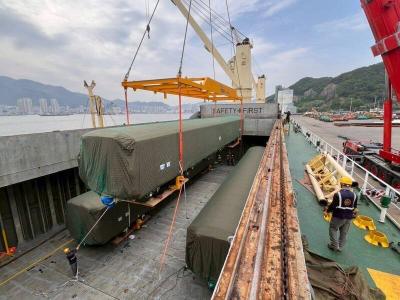
The first of 10 new high-capacity trains purchased from South Korea’s Hyundai Rotem arrived at the Port of Taipei yesterday to meet the demands of an expanding metro network, Taipei Rapid Transit Corp (TRTC) said yesterday. The train completed a three-day, 1,200km voyage from the Port of Masan in South Korea, the company said. Costing NT$590 million (US$18.79 million) each, the new six-carriage trains feature a redesigned interior based on "human-centric" transportation concepts, TRTC said. The design utilizes continuous longitudinal seating to widen the aisles and optimize passenger flow, while also upgrading passenger information displays and driving control systems for a more comfortable
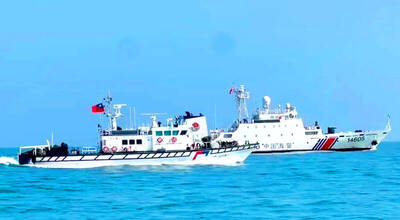
Instead of focusing solely on the threat of a full-scale military invasion, the US and its allies must prepare for a potential Chinese “quarantine” of Taiwan enforced through customs inspections, Stanford University Hoover fellow Eyck Freymann said in a Foreign Affairs article published on Wednesday. China could use various “gray zone” tactics in “reconfiguring the regional and ultimately the global economic order without a war,” said Freymann, who is also a nonresident research fellow at the US Naval War College. China might seize control of Taiwan’s links to the outside world by requiring all flights and ships entering or leaving Taiwan
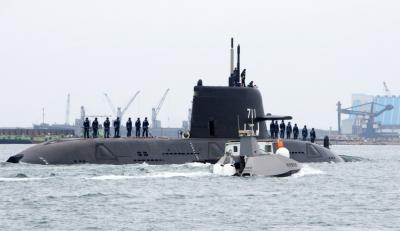
Taiwan's first indigenous defense submarine, the SS-711 Hai Kun (海鯤, or Narwhal), departed for its 13th sea trial at 7am today, marking its seventh submerged test, with delivery to the navy scheduled for July. The outing also marked its first sea deployment since President William Lai (賴清德) boarded the submarine for an inspection on March 19, drawing a crowd of military enthusiasts who gathered to show support. The submarine this morning departed port accompanied by CSBC Corp’s Endeavor Manta (奮進魔鬼魚號) uncrewed surface vessel and a navy M109 assault boat. Amid public interest in key milestones such as torpedo-launching operations and overnight submerged trials,
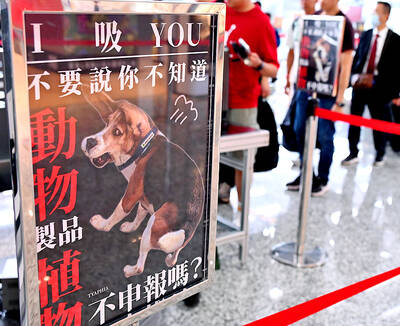
Quarantine awareness posters at Taiwan Taoyuan International Airport have gone viral for their use of wordplay. Issued by the airport branch of the Animal and Plant Health Inspection Agency, the posters feature sniffer dogs making a range of facial expressions, paired with advisory messages built around homophones. “We update the messages for holidays and campaign needs, periodically refreshing materials to attract people’s attention,” quarantine officials said. “The aim is to use the dogs’ appeal to draw focus to quarantine regulations.” A Japanese traveler visiting Taiwan has posted a photo on X of a poster showing a quarantine dog with a


 RSS
RSS