


The Cabinet on Thursday pledged NT$1 billion (US$32.5 million) to fund a program to ease labor shortages in the tourism, hospitality, logistics and agricultural sectors.
The program aims to help recruit 20,000 workers over one year by giving payments to workers or providing subsidies to employers, Workforce Development Agency Director-General Tsai Meng-liang (蔡孟良) said.
Tsai said that the affected sectors face difficulty recruiting enough workers because of low salaries, distant workplaces or poor working environments.

Photo: Chung Li-hua, Taipei Times
The Ministry of Labor said it seeks to increase the labor participation rate of people aged 55 to 64, which is lower than in Japan and South Korea.
Tsai said the ministry would consult with industry associations to identify job opportunities and use its employment services to help match suitable workers with employers.
The Cabinet program includes monthly cash payments to workers younger than 45 of NT$6,000 each over one year if they find a full-time job through the program, Tsai said.
Workers aged 45 to 65 would receive NT$10,000 per month, he added.
The payments would be increased by NT$3,000 if their job is in a remote area, such as Hualien and Taitung counties, and outlying islands.
People aged 45 to 65 who take up a part-time job would receive NT$5,000 per month, plus NT$1,500 if the job is in a remote area, Tsai said.
The program also includes subsidies for companies that offer training to new recruits and upgrade certain equipment with the aim of improving their working environment, Tsai said.
Deputy Minister of Labor Chen Ming-jen (陳明仁) said the program’s goal to match 20,000 people with jobs does not represent the number of job vacancies in the service industries.
However, he did not answer questions about the seriousness of the labor shortage, saying only that the ministry is monitoring the situation.

The brilliant blue waters, thick foliage and bucolic atmosphere on this seemingly idyllic archipelago deep in the Pacific Ocean belie the key role it now plays in a titanic geopolitical struggle. Palau is again on the front line as China, and the US and its allies prepare their forces in an intensifying contest for control over the Asia-Pacific region. The democratic nation of just 17,000 people hosts US-controlled airstrips and soon-to-be-completed radar installations that the US military describes as “critical” to monitoring vast swathes of water and airspace. It is also a key piece of the second island chain, a string of
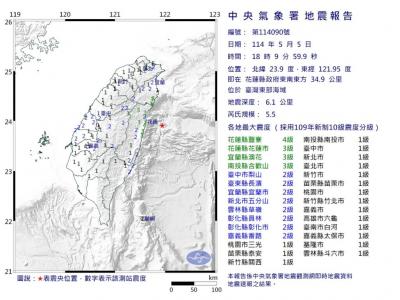
A magnitude 5.9 earthquake that struck about 33km off the coast of Hualien City was the "main shock" in a series of quakes in the area, with aftershocks expected over the next three days, the Central Weather Administration (CWA) said yesterday. Prior to the magnitude 5.9 quake shaking most of Taiwan at 6:53pm yesterday, six other earthquakes stronger than a magnitude of 4, starting with a magnitude 5.5 quake at 6:09pm, occurred in the area. CWA Seismological Center Director Wu Chien-fu (吳健富) confirmed that the quakes were all part of the same series and that the magnitude 5.5 temblor was

Taiwan will now have four additional national holidays after the Legislative Yuan passed an amendment today, which also made Labor Day a national holiday for all sectors. The Chinese Nationalist Party (KMT) and Taiwan People’s Party (TPP) used their majority in the Legislative Yuan to pass the amendment to the Act on Implementing Memorial Days and State Holidays (紀念日及節日實施辦法), which the parties jointly proposed, in its third and final reading today. The legislature passed the bill to amend the act, which is currently enforced administratively, raising it to the legal level. The new legislation recognizes Confucius’ birthday on Sept. 28, the

The Central Weather Administration has issued a heat alert for southeastern Taiwan, warning of temperatures as high as 36°C today, while alerting some coastal areas of strong winds later in the day. Kaohsiung’s Neimen District (內門) and Pingtung County’s Neipu Township (內埔) are under an orange heat alert, which warns of temperatures as high as 36°C for three consecutive days, the CWA said, citing southwest winds. The heat would also extend to Tainan’s Nansi (楠西) and Yujing (玉井) districts, as well as Pingtung’s Gaoshu (高樹), Yanpu (鹽埔) and Majia (瑪家) townships, it said, forecasting highs of up to 36°C in those areas


 RSS
RSS