


China yesterday warned against continued Taiwan-US cooperation, responding to reports that the US military was sending officers to help train Taiwanese counterparts and that a delegation of defense contractors would be visiting the nation next week.
“We resolutely oppose the US having any form of official or military contact with China’s Taiwan region,” China’s Taiwan Affairs Office spokeswoman Zhu Fenglian (朱鳳蓮) told a weekly news briefing in Beijing.
Taiwan has never been part of the People’s Republic of China, but the Chinese Communist Party says it is obliged to unite with China, by force if necessary.
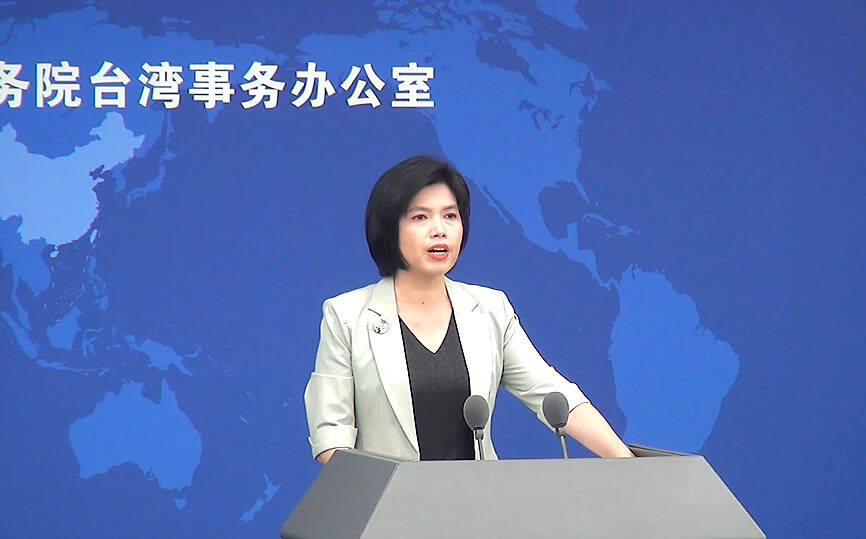
Photo: CNA
Chinese President Xi Jinping’s (習近平) government has flown fighter jets and bombers near Taiwan in increasing numbers, and fired missiles into the sea in an attempt to intimidate the nation.
Taiwanese media reported this month that the US had sent 200 military personnel, mostly marines, to help train Taiwanese troops.
The Ministry of National Defense has neither denied nor confirmed the report.
Meanwhile, a delegation of about 25 defense contractors is visiting the nation next week, hosted by the US-Taiwan Business Council.
Nikkei Asia reported that the weapons manufacturers would discuss joint production of drones and ammunition in Taiwan.
“US defense contractors intentionally provoke confrontation between the two sides, taking the opportunity to make a profit,” Zhu said.
She accused the Democratic Progressive Party, which has been in power for six years, of colluding with the US to press for formal Taiwanese independence.
The US does not formally recognize the Taiwanese government, but is Taipei’s most vital provider of weapons and other security assistance, as well as political support.
China has turned up the heat by sending fighter jets and navy vessels near the nation on a near-daily basis, especially in response to political meetings between Taiwan and the US.
Earlier this month, China held large-scale military exercises simulating a strike on key targets in Taiwan in response to President Tsai Ing-wen (蔡英文) meeting with US House of Representatives Speaker Kevin McCarthy in California.
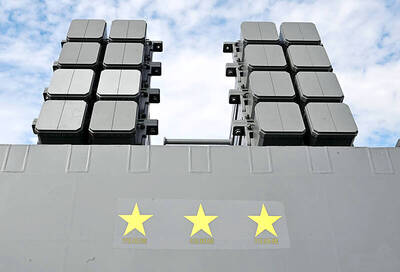
UPGRADE: The Kang Ding-class frigate is replacing its Chaparall missiles with Tien Chien II and Hua Yang VLS, which would provide it with long-range, 360° air defense Taiwan plans to produce 1,200 to 1,376 Hai Chien II missiles (海劍二, Sea Sword II) — also known as TC-2N — to serve as the standard air defense system of the navy’s surface combatant fleet, a source said yesterday. Last week, the Hai Chien II, the naval version of the Tien Kung II missile (天劍二, Sky Sword II), completed a live-fire test in waters off the National Chungshan Institute of Science and Technology’s Jiupeng facility (九鵬) in Pingtung County’s Manjhou Township (滿州). The MIM72 Chaparral and other dated air defense missiles that currently arm Taiwanese ships have inadequate range to combat Chinese

REASONS FOR TRAVEL: An assistant professor said that proposed amendments to penalize drivers if they used drugs overseas would not deter people from traveling People who operate a motor vehicle under the influence of marijuana would have their driver’s license revoked, even if they used the substance while overseas, the Ministry of Transportation and Communications said yesterday, citing proposed amendments to the Road Traffic Management and Penalty Act (道路交通管理處罰條例). The amendments would also authorize the government to revoke the licenses of people determined to have used Category 1 or Category 2 narcotics, even if they were not operating a vehicle while under the influence of drugs, as well as ban them from taking the license test for three years, the ministry said. People aged 18 or

GLOBALGIVING: ‘ Caving to external pressure is not acceptable for an organization that has cultivated justice reform and human rights for 30 years,’ one NGO said A slew of non-government organizations (NGOs) have withdrawn from the GlobalGiving fundraising platform after it announced it would use “Chinese Taipei” instead of “Taiwan” from next month. The Taiwan Good Rice Association wrote on Facebook on Friday that it was informed on April 28 via a teleconference call of the change, which was made because the platform wanted to operate in China. Taiwan Good Rice is to terminate all cooperative relationships with GlobalGiving in response to the platform’s “unilateral and non-negotiable” decision to remove references to Taiwan, the NGO said. “Taiwan is in the official name of Taiwan Good Rice Association and the

HEAVY WEATHER: Typhoon Jangmi is due to crash straight into the Ryukyus as airlines look to shift flights to larger aircraft or cancel flights to Okinawa entirely Taiwan’s international air carriers announced flight adjustments over the weekend as Typhoon Jangmi is forecast to hit the Ryukyu Islands today and tomorrow. The Central Weather Administration (CWA) upgraded Jangmi from a tropical storm to a typhoon at 8am yesterday, with the eye located 580km south of Naha city. It was moving north at 19kph. Today, China Airlines’ CI-120, CI-121, CI-122 and CI-123 flights between Taoyuan and Naha, Okinawa, have been canceled as well as CI-132 and CI-133 between Kaohsiung and Naha. EVA Air’s BR-112, BR-113, BR-186 and BR-185 flights between Taoyuan and Naha are also canceled. Low-cost carrier Tigerair Taiwan canceled IT-230,


 RSS
RSS