


Taiwanese democracy advocate Lee Ming-che (李明哲) yesterday said that the arrest in China of Gusa Press editor in chief Li Yanhe (李延賀), also known as Fucha (富察), is a sign that the Beijing government is extending its suppression of freedom of speech to the publishing industry in Taiwan.
Li returned to Shanghai last month to cancel his household registration, but was secretly arrested by police. His friends and family have not heard from him since.
He was born in China’s Liaoning Province, has a doctorate in Chinese language and literature, and was a deputy managing editor of Shanghai Literature and Art Publishing House. He later married a Taiwanese and has been living in Taiwan for several years. He established Gusa Press (八旗文化) in 2009, received a resident certificate in 2013 and has reportedly obtained Republic of China citizenship.
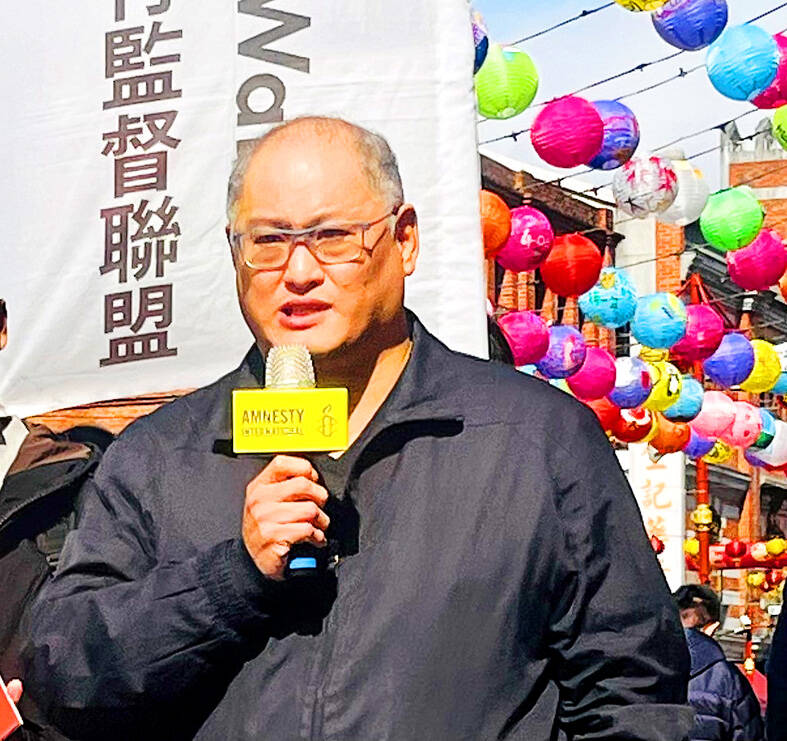
Photo: Chen Yu-fu, Taipei Times
Lee, who served a five-year prison sentence in China on charges of “subversion of state power,” said that Beijing’s attempt to extend its suppression of free speech to Taiwan’s publishing industry should be taken seriously and discussed.
Lee said that Gusa Press has published books, including The China Record: An Assessment of the People’s Republic (中國紀錄:評估中華人民共和國) and Tibet — 70 Years of Domination under the People’s Republic of China (新疆—被中共支配的七十年), that are directly aimed at the core of China’s autocratic regime, so the Beijing government is now clearly reaching out to suppress the most free and open Chinese-language publishing market — Taiwan.
“The issue is how will Taiwanese society react to it? Remain silent out of fear? Or should we let Taiwan and the global society know about the suppression? It is a choice that Taiwanese society has to make,” he said. “What do we choose when our core values are being suppressed?”
“China’s suppression of Taiwan’s self-determination will never stop, and Fucha’s case is just the beginning,” Lee said.
China used to secretly exert pressure, but now it just flagrantly arrests people, he added.
Faced with that pressing threat, Taiwanese society should voice its resistance, he said, adding: “Give dictators an inch and they will take a mile.”
With Fucha at the helm, Gusa Press has published books that break down the concept of Chinese nationalism, which is the base of the Chinese government’s rule, in addition to books on how China is suppressing human rights and non-fiction reports about Chinese society, Lee said.
The books can help Taiwanese understand and break away from a Greater China perspective of history, empowering Taiwanese to resist Beijing’s call for the “great rejuvenation of the Chinese nation,” Lee said.
Gusa Press on Sunday issued a statement, saying that the publishing house, upholding the principle of spreading knowledge, will continue to publish good quality books, and that it believes Fucha, who is lenient toward others and full of passion toward publishing, will be able to continue sharing his knowledge and passion with everyone soon, and that they await his safe return.

Considering that most countries issue more than five denominations of banknotes, the central bank has decided to redesign all five denominations, the bank said as it prepares for the first major overhaul of the banknotes in more than 24 years. Central bank Governor Yang Chin-lung (楊金龍) is expected to report to the Legislative Yuan today on the bank’s operations and the redesign’s progress. The bank in a report sent to the legislature ahead of today’s meeting said it had commissioned a survey on the public’s preferences. Survey results showed that NT$100 and NT$1,000 banknotes are the most commonly used, while NT$200 and NT$2,000

The Centers for Disease Control (CDC) yesterday reported the first case of a new COVID-19 subvariant — BA.3.2 — in a 10-year-old Singaporean girl who had a fever upon arrival in Taiwan and tested positive for the disease. The girl left Taiwan on March 20 and the case did not have a direct impact on the local community, it said. The WHO added the BA.3.2 strain to its list of Variants Under Monitoring in December last year, but this was the first imported case of the COVID-19 variant in Taiwan, CDC Deputy Director-General Lin Ming-cheng (林明誠) said. The girl arrived in Taiwan on

South Korea is planning to revise its controversial electronic arrival card, a step Taiwanese officials said prompted them to hold off on planned retaliatory measures, a South Korean media report said yesterday. A Yonhap News Agency report said that the South Korean Ministry of Foreign Affairs is planning to remove the “previous departure place” and “next destination” fields from its e-arrival card system. The plan, reached after interagency consultations, is under review and aims to simplify entry procedures and align the electronic form with the paper version, a South Korean ministry official said. The fields — which appeared only on the electronic form

The Ministry of Foreign Affairs (MOFA) is suspending retaliation measures against South Korea that were set to take effect tomorrow, after Seoul said it is updating its e-arrival system, MOFA said today. The measures were to be a new round of retaliation after Taiwan on March 1 changed South Korea's designation on government-issued alien resident certificates held by South Korean nationals to "South Korea” from the "Republic of Korea," the country’s official name. The move came after months of protests to Seoul over its listing of Taiwan as "China (Taiwan)" in dropdown menus on its new online immigration entry system. MOFA last week


 RSS
RSS