


Academics and politicians yesterday criticized former minister of culture Lung Ying-tai (龍應台) for misrepresenting Taiwan and trying to sway votes for the Chinese Nationalist Party (KMT) in an op-ed for the New York Times (NYT).
Lung, who served in the administration of former president Ma Ying-jeou (馬英九), wrote an op-ed entitled “In Taiwan, Friends are Starting to Turn Against Each Other” that was published on Tuesday.
She wrote that the Chinese threat is dividing Taiwanese society, with people criticizing each other for either being too pro-China or fanning tensions by being “dangerously anti-China.”
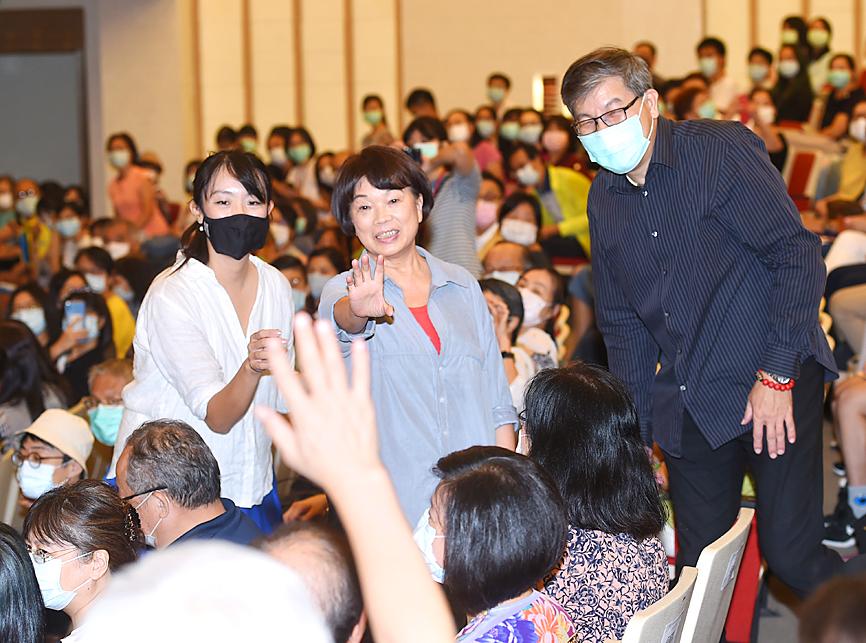
Photo: Fang Pin-chao, Taipei Times
Using her experiences talking with people in Taiwan, she wrote that “the possibility of war with China comes up in nearly every dinner conversation.”
She emphasized the “down-to-earth realism” of rural Taiwanese, which she said she hopes “will prevail over the long run.”
Among the people she quoted were a farmer who supports unification, although he said he would still fight for Taiwan; another farmer affected by Chinese import bans issued under the Democratic Progressive Party (DPP) administration; and a fisherman who said he would fight China because he was already “accustomed to danger,” but has doubts about the younger generation.
Political pundit and US business management professor Chen Shih-fen (陳時奮), writing under the pen name Ong Tario (翁達瑞), said on Facebook that Lung seems to take a neutral stance in the article, but her deceptive “middle path” aims to sway people to support the KMT in next year’s election.
Her premise conforms to the KMT’s policy of boot-licking and surrendering to Beijing, Chen wrote.
She is either very naive, or is trying to whitewash an enemy state’s intimidation or threat of war against Taiwan, he wrote.
Lung’s call to vote for the KMT is clear in the article’s conclusion, which says: “Taiwan is set to hold a pivotal presidential election in January, and the question of whether to confront China or pursue conciliation will have significant implications for us... If the KMT wins, tensions with China might ease; if the DPP retains power, who knows?” he wrote.
Other pundits said that Lung’s writing reflected nostalgia for Chinese history and culture, with little regard for Taiwanese’s struggle for democracy.
Some have disputed Lung’s observation that “the possibility of war with China comes up in nearly every dinner conversation in Taiwan,” Taipei-based Swedish journalist Jojje Olsson wrote on Twitter.
“Far from my experience. It’s hardly even talked about when military exercises are taking place,” he said.
Taiwan Statebuilding Party Taipei chapter director Wu Hsin-tai (吳欣岱) wrote that most observers of the Taiwan Strait would know that a military invasion of Taiwan is dependent on who the leaders in China are and has no bearing on which party rules Taiwan.
“So should Taiwan build up its defense capability and collaborate with the US to strengthen itself? Or should we choose another party with feeble policies, whose leader aims to have a place in history, but might trigger an invasion and war?” Wu wrote.
Telecommunication science professor Lee Chung-hsien (李忠憲), writing in his column for Taro News, countered Lung’s claim that people in Taiwan are turning against each other.
“Real friends in Taiwan are coming closer together in the face of China’s threats by becoming more united and courageous in talking about resistance and fighting an invasion,” Lee said. “Lung’s premise is also way off, as she talks about Taiwan pushing to detach itself from China, while ignoring the fact that it is China that is plotting an invasion.”
He also questioned Lung’s concluding sentence, in which she quotes a person as saying that if war broke out, people would blame whoever fires the first shot.
“In reality, China has already fired on us so many times already... But Lung does not understand, because she sees no need to resist China,” Lee wrote.
“Lung’s piece concerns her own emotional attachment to China because of her family’s roots there,” he added.
Additional reporting by Kayleigh Madjar
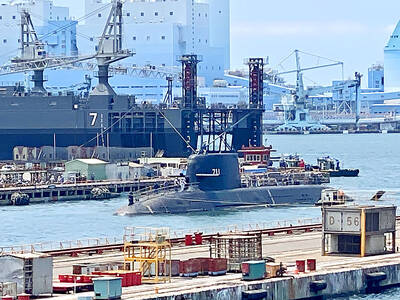
AGING: While Japan has 22 submarines, Taiwan only operates four, two of which were commissioned by the US in 1945 and 1946, and transferred to Taiwan in 1973 Taiwan would need at least 12 submarines to reach modern fleet capabilities, CSBC Corp, Taiwan chairman Chen Cheng-hung (陳政宏) said in an interview broadcast on Friday, citing a US assessment. CSBC is testing the nation’s first indigenous defense submarine, the Hai Kun (海鯤, Narwhal), which is scheduled to be delivered to the navy next month or in July. The Hai Kun has completed torpedo-firing tests and is scheduled to undergo overnight sea trials, Chen said on an SET TV military affairs program. Taiwan would require at least 12 submarines to establish a modern submarine force after assessing the nation’s operational environment and defense

Yangmingshan National Park authorities yesterday urged visitors to respect public spaces and obey the law after a couple was caught on a camera livestream having sex at the park’s Qingtiangang (擎天崗) earlier in the day. The Shilin Police Precinct in Taipei said it has identified a suspect and his vehicle registration number, and would summon him for questioning. The case would be handled in accordance with public indecency charges, it added. The couple entered the park at about 11pm on Thursday and began fooling around by 1am yesterday, the police said, adding that the two were unaware of the park’s all-day live
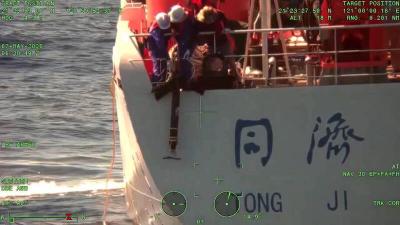
The coast guard today said that it had disrupted "illegal" operations by a Chinese research ship in waters close to the nation and driven it away, part of what Taipei sees a provocative pattern of China's stepped up maritime activities. The coast guard said that it on Thursday last week detected the Chinese ship Tongji (同濟號), which was commissioned only last year, 29 nautical miles (54km) southeast of the southern tip of Taiwan, although just outside restricted waters. The ship was observed lowering ropes into the water, suspected to be the deployment of scientific instruments for "illegal" survey operations, and the coast

A former soldier and an active-duty army officer were yesterday indicted for allegedly selling classified military training materials to a Chinese intelligence operative for a total of NT$79,440. The Taipei District Prosecutors’ Office indicted Chen Tai-yin (陳泰尹) and Lee Chun-ta (李俊達) for contravening the National Security Act (國家安全法) and the Anti-Corruption Act (貪污治罪條例). Chen left the military in September 2013 after serving alongside then-staff sergeant Lee, now an army lieutenant, at the 21st Artillery Command of the army’s Sixth Corps from 2011 to 2013, according to the indictment. Chen met a Chinese intelligence operative identified as “Wang” (王) through a friend in November


 RSS
RSS