


A designated police squad is to be set up to crack down on organized crime, Minister of the Interior Lin You-chang (林右昌) said yesterday.
Lin was asked to brief lawmakers at a meeting of the legislature’s Internal Administration Committee on the measures to be adopted to address rising crime committed by human trafficking groups, emerging gangs and fraud syndicates.
“In recent years, gangs have expanded their operations by engaging in telecom fraud, online gambling, cross-border money laundering, arms and drugs trafficking, as well as other crimes,” he told the committee.

Photo: CNA
“The National Police Agency needs to enforce a systematic crackdown on organized crime by collaborating with administrative agencies to conduct joint inspections and impose penalties on businesses and venues in which gangs invest, and which they operate and own. This is the way to cut off their means,” he said.
Last month, a branch of the Bamboo Union organized a large party at the Taipei Marriott Hotel to showcase its strength and momentum, which is a common method to attract new members, he said.
Twenty-five people attending the party were involved in criminal activities, Lin said, adding that the branch was also found to be involved in nearly two dozen other criminal cases.
The National Police Agency and the High Prosecutors’ Office have launched 13 nationwide crackdowns on gangs over the past three years, Lin said.
The crackdowns have identified 1,180 crime organizations across the country and 755 businesses operated by gangs, he said, adding that 9,443 gang members have been brought to justice.
Illegal gains confiscated by police topped NT$921.7 million (US$30.27 million), Lin said.
“A designated police squad to crack down on gangs is to be established, with members coming from the Criminal Investigation Bureau and police departments in cities and counties,” Lin said.
“The squad will monitor cash flow and connections among active gangs. As gangs are often involved in wind energy, construction and other businesses, each city or county police department is to have a point of contact to help gather evidence,” he said.
Separately, the National Communications Commission (NCC) has asked people to beware of phishing text messages sent by telephone scammers via false base stations.
“Should consumers discover that their mobile phones suddenly lose reception, but quickly regain full signal, or the source of the signal suddenly switches from 4G or 5G systems to 2G, their mobile phones might have been ‘kidnapped’ by false base stations,” NCC vice chairman and spokesperson Wong Po-tsung (翁柏宗) said.
“At this time, they should not click on any link on the text messages sent via false base stations,” Wong said.
These false base stations, usually disguised as those for the 2G system, transmit higher power signals to cover those transmitted from normal base stations and deliver scam text messages, he said.
“In a 2G system, base stations authenticate the identification of mobile phones before transmitting signals, but mobile phones are not able to verify if they are receiving signals from a real or false base station,” Wong said.
“This one-way verification system is a security loophole, which only exists in the 2G system. Taiwan has shut down the entire 2G system. People can determine that their mobile phones are receiving signals from false base stations if signals appear to be from a 2G system,” he said.
Since 2019, the government’s anti-fraud platform has intercepted 75.05 million fraud text messages and 58.85 million scam calls, and suspended nearly 20,000 phone numbers used by scammers, NCC data showed.

Taiwanese paleontologists have discovered fossil evidence that pythons up to 4m long inhabited Taiwan during the Pleistocene epoch, reporting their findings in the international scientific journal Historical Biology. National Taiwan University (NTU) Institute of Ecology and Evolutionary Biology associate professor Tsai Cheng-hsiu (蔡政修) led the team that discovered the largest snake fossil ever found in Taiwan. The single trunk vertebra was discovered in Tainan at the Chiting Formation, dated to between 400,000 and 800,000 years ago in the Middle Pleistocene, the paper said. The area also produced Taiwan’s first avian fossil, as well as crocodile, mammoth, saber-toothed cat and rhinoceros fossils, it said. Discoveries

Taiwanese paleontologists have discovered fossil evidence that pythons up to 4m long inhabited Taiwan during the Pleistocene epoch, reporting their findings in the international scientific journal Historical Biology. National Taiwan University (NTU) Institute of Ecology and Evolutionary Biology associate professor Tsai Cheng-hsiu (蔡政修) led the team that discovered the largest snake fossil ever found in Taiwan. A single trunk vertebra was discovered in Tainan at the Chiting Formation, dated to between 800,000 to 400,000 years ago in the Middle Pleistocene, the paper said. The area also produced Taiwan’s first avian fossil, as well as crocodile, mammoth, sabre-toothed cat and rhinoceros fossils, it said. Discoveries

Whether Japan would help defend Taiwan in case of a cross-strait conflict would depend on the US and the extent to which Japan would be allowed to act under the US-Japan Security Treaty, former Japanese minister of defense Satoshi Morimoto said. As China has not given up on the idea of invading Taiwan by force, to what extent Japan could support US military action would hinge on Washington’s intention and its negotiation with Tokyo, Morimoto said in an interview with the Liberty Times (sister paper of the Taipei Times) yesterday. There has to be sufficient mutual recognition of how Japan could provide
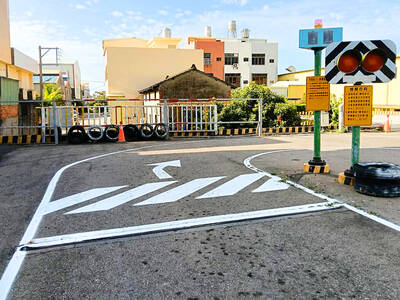
UPDATED TEST: The new rules aim to assess drivers’ awareness of risky behaviors and how they respond under certain circumstances, the Highway Bureau said Driver’s license applicants who fail to yield to pedestrians at intersections or to check blind spots, or omit pointing-and-calling procedures would fail the driving test, the Highway Bureau said yesterday. The change is set to be implemented at the end of the month, and is part of the bureau’s reform of the driving portion of the test, which has been criticized for failing to assess whether drivers can operate vehicles safely. Sedan drivers would be tested regarding yielding to pedestrians and turning their heads to check blind spots, while drivers of large vehicles would be tested on their familiarity with pointing-and-calling


 RSS
RSS